
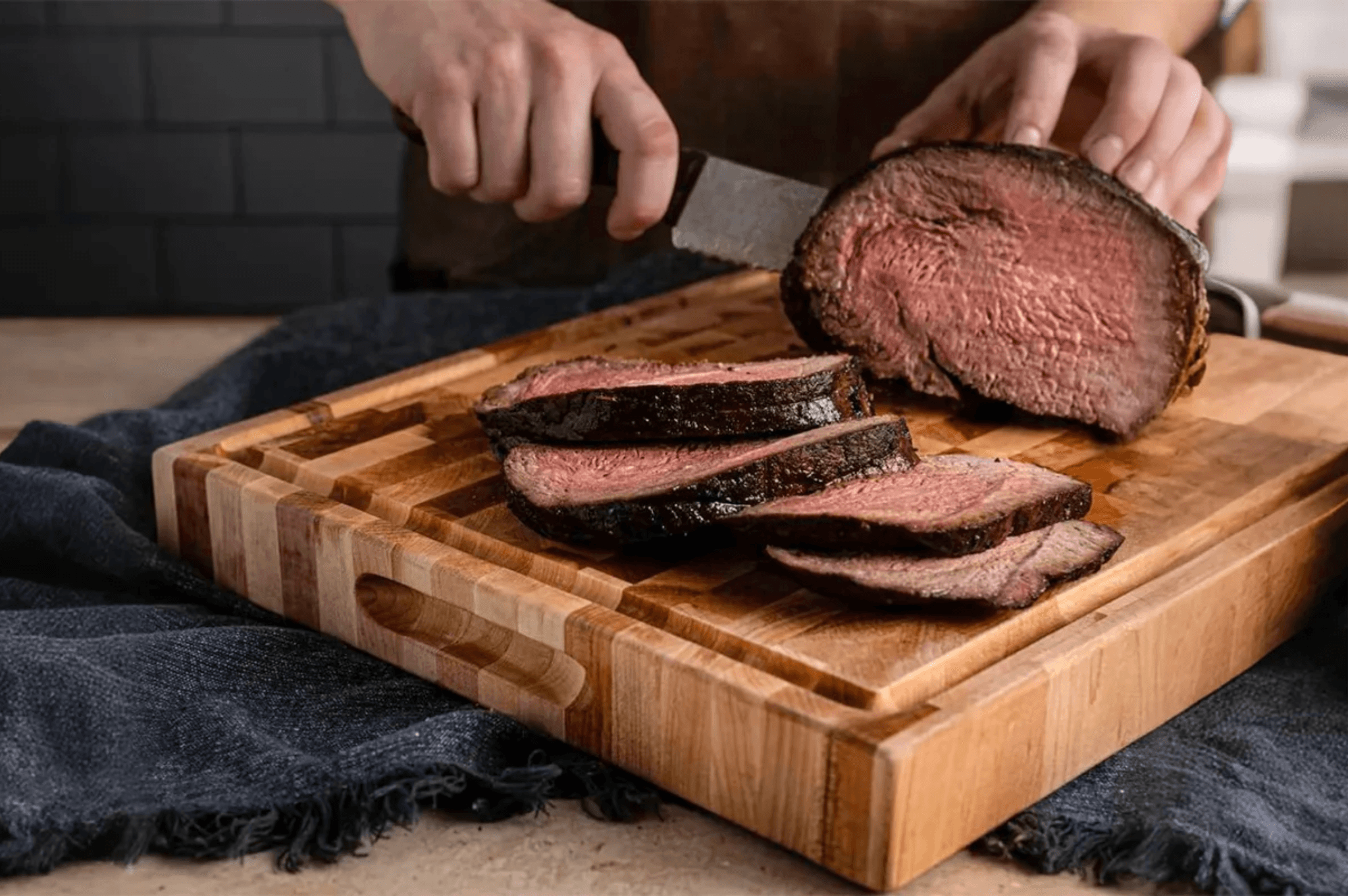
Our picks at a glance
| Pick | Best for | Key certifications | Price | Details |
|---|---|---|---|---|
| The BoardSmith Maple End Grain | Best overall | FSC-certified lumber | $$$ | Full review |
| Sonder LA Alfred Walnut | Best FSC walnut | FSC Certified | $$$ | Full review |
| Andrew Pearce Single Square Edge Walnut | Best single-slab | Single-slab, no adhesive | $$$ | Full review |
| TeakHaus End Grain Teak, Model 802 M | Best value | FSC certified (Leadership Award 2025) | $$ | Full review |
| John Boos Maple CCB Chopping Block | Best professional-grade | NSF certified (select) | $$$ | Full review |
| Larch Wood Canada Medium Classic | Best unique species | Beeswax-hemp finish, no synthetics | $$$ | Full review |
| Virginia Boys Kitchens Large Walnut | Most accessible | Coconut oil finish, USA walnut | $$ | Full review |
| Wusthof Heat-Treated Beech | Best European | Thermal treatment, no coating | $$$ | Full review |
| Bevel & Bond End-Grain Maple | Best gift option | Mineral oil finish, USA-made | $$ | Full review |
Every time a plastic cutting board is used, it sheds microplastic particles directly into the food on it. Research from 2023 found that polyethylene boards release up to 50 grams of microplastic material per year — and given what we're now learning about where those particles accumulate, the question of what you cut your food on is no longer incidental.
The fix is simple and permanent: switch to solid wood. This guide covers nine solid-wood cutting boards from nine different makers — a range of wood species, price points, and origins that covers every household's needs.
What we look for
Three variables determine whether a cutting board is safe: substrate, finish, and adhesive.
Substrate. Solid wood — hard maple, black walnut, black cherry, teak, larch, European beech — is the only acceptable primary material. No paper composites (Epicurean), no bamboo (bamboo boards are assembled with urea-formaldehyde or melamine-UF resin adhesive — the same chemistry in MDF), no acacia with undisclosed adhesive, no polyethylene or polypropylene.
Finish. The cutting surface should be finished in mineral oil, beeswax, a food-grade plant oil, or left unfinished after thermal treatment. No polyurethane, no lacquer on the cutting surface. Polyurethane flakes under repeated knife contact. Lacquer on a cutting surface has no rational justification.
Adhesive. Multi-piece end-grain and edge-grain boards require a bonding agent. The acceptable standard is Titebond III or an equivalent food-safe waterproof PVA — FDA-approved for indirect food contact. Most brands don't disclose the adhesive on the product page; single-slab boards eliminate the question entirely.
Can you name the adhesive, the finish, and the wood species? If not, why not?
A note on price: all solid-wood boards on this list fall in the mid-to-upper price range. Any board in the entry-price range is a composite, a thin face-grain scrap, or a bamboo product assembled with resin binders.
Our picks
1. The BoardSmith Maple End Grain Cutting Board, 16×22×2" — Best overall

The BoardSmith is the only brand on this list that publicly names its adhesive — Titebond III, FDA-approved for indirect food contact — directly on its product pages. That single transparency decision sets it apart from every other maker in the category. The rest of the material story is equally clean: FSC-certified hard rock maple from a Pennsylvania family sawmill, mineral oil + beeswax Board Butter finish applied before shipping, handmade to order in North Carolina. The 16×22×2" is the workhorse size; the brand also offers custom dimensions.
2. Sonder LA Alfred Walnut Cutting Board — Best FSC walnut

Sonder LA sources FSC-certified black American walnut and discloses the adhesive commitment in their FAQ: "we steer clear of formaldehyde-based adhesives." That puts them in a rare category of brands that have actually thought through the adhesive question. The finish is food-grade mineral oil + beeswax applied before shipping. Their material FAQ also explicitly states PFAS-free, BPA-free, microplastic-free — claims that have meaning here because the supply chain supports them. Made in the USA at $179 for the large end-grain board.
3. Andrew Pearce Single Square Edge Walnut Cutting Board — Best single-slab

Andrew Pearce hand-selects American black walnut at his Vermont mill and makes edge-grain boards from single slabs — no lamination, no glue joint anywhere in the board. The adhesive question is eliminated by construction. The finish is a proprietary food-safe allergen-free walnut oil he developed himself; the care instructions explicitly prohibit mineral oil because it doesn't behave the same way with his finish chemistry. One piece of wood, one oil. Made in Hartland, Vermont, at $130.
4. TeakHaus End Grain Teak Cutting Board, Model 802 M — Best value

TeakHaus is the FSC® Leadership Award winner for 2025 — their plantation teak chain-of-custody is the most rigorously certified supply chain of any brand on this list. The Model 802 end-grain board comes pre-finished in mineral oil and beeswax and runs $55. Teak's naturally high silica and oil content provide inherent water resistance without requiring additional treatments. For a fully FSC-certified end-grain board at this price, there is no competition.
5. John Boos Maple CCB End Grain Chopping Block, 20x15x2.25" — Best professional-grade

John Boos has been making maple butcher blocks in Effingham, Illinois since 1887. The CCB series 2¼" end-grain chopping block is the professional option: the extra mass absorbs impact, resists warping under temperature swings, and will outlast most other things in your kitchen. Finish is Boos Block Cream — beeswax and food-grade mineral oil. Select products in the line carry NSF certification. It's the benchmark that other professional-grade boards measure themselves against.
6. Larch Wood Canada Medium Classic Cutting Board — Best unique species
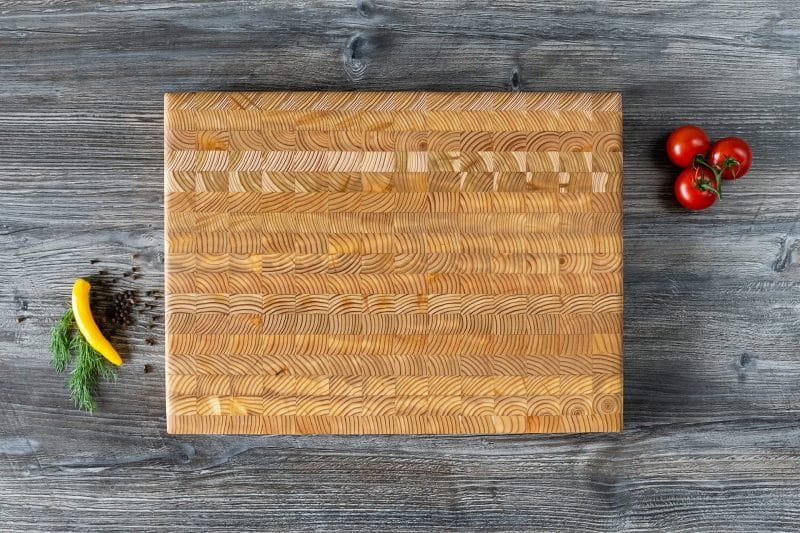
The Larch Wood Canada Medium Classic Cutting Board (on Amazon) is Larch Wood Canada's take on an overlooked species. Eastern larch (also called tamarack, Larix laricina) is the most underused hardwood in cutting board production. It has naturally antimicrobial resin content, a tight end-grain structure that's gentle on knife edges, and a density comparable to hard maple. Larch Wood Canada has been making end-grain larch boards in Cape Breton Island, Nova Scotia since 1985. Every board is pre-finished with a beeswax and hemp oil conditioner containing no synthetic ingredients. If you want something materially different from the maple-walnut-teak axis that dominates this category, this is it. Ships from Canada at $275.
7. Virginia Boys Kitchens Large Walnut Cutting Board — Most accessible

The Virginia Boys Kitchens Large Walnut Cutting Board (on Amazon) is cut from Appalachian black walnut. Appalachian black walnut from certified sustainable hardwood forests, finished with nothing but pure fractionated coconut oil (no GMOs, no paraffins, no synthetic ingredients). Virginia Boys Kitchens is the most accessible price point for a solid American walnut board on this list at $94.95. The coconut oil finish is unusual and effective: it penetrates more deeply than mineral oil and requires less frequent reapplication. Made by hand in Virginia.
8. Wüsthof Heat-Treated Beech Cutting Board — Best European

The Wüsthof Heat-Treated Beech Cutting Board (on Wüsthof) arrives chemically untreated. Thermal modification (the Thermowood process) is a chemical-free treatment: wood steamed at 180–215°C to alter its cellular structure, increasing water resistance and dimensional stability without PFAS, synthetic coatings, or adhesive treatments. No factory finish is applied — the owner conditions it with food-grade mineral oil or linseed oil. This is the only board on the list where the durability story is physics rather than chemistry. Made in Germany by Wüsthof, who have been making kitchen blades since 1814.
9. End-Grain Maple Cutting Board, Handcrafted in USA: Best gift option

The Bevel & Bond maple board is solid North American hard maple, end-grain, at 1.75 inches thick and 10 pounds. The factory finish is mineral oil only: no lacquer, no polyurethane, no synthetic coating on the cutting surface. Bevel & Bond does not publicly disclose the adhesive used to join the end-grain blocks, which puts it alongside most multi-piece makers on this list. Titebond III or a food-safe equivalent is the industry standard for USA-made boards; without written disclosure we cannot verify it directly.
What marks it out: the board arrives in a premium gift box ready to present without rewrapping, carries a 5-year warranty, and production is verifiable as handcrafted in the USA. At $119.99 it covers daily prep, serving, and carving.
What we passed on
Epicurean. The most-recommended cutting board brand in most editorial roundups. Epicurean boards are paper composite — wood fiber bound in a phenol-formaldehyde resin. "Dishwasher safe" is only possible because it isn't solid wood. Disqualified on substrate.
All bamboo boards. Bamboo grows fast and the sustainability narrative is strong. The problem is construction chemistry: bamboo-composite boards require urea-formaldehyde (UF) or melamine-UF adhesive resin to achieve the cutting density needed. This is the same resin system used in MDF furniture. Every bamboo board we evaluated fell into this category. Disqualified on adhesive.
Acacia boards with undisclosed adhesive. Acacia is widely used in mid-priced "premium" cutting boards sold on aesthetics. No major acacia board brand publicly discloses what adhesive binds their multi-piece constructions. Without a verifiable food-safe adhesive, no acacia board passes our gate. If a brand provides written adhesive disclosure with a source URL, we'll revisit.
Virginia Boys Kitchens lacquer SKUs. Virginia Boys Kitchens has a strong walnut + coconut oil story — the 20×15 board is pick #7 above. However, their collection also offers some SKUs with a clear lacquer finish option. A lacquer on a cutting surface is disqualifying. When buying from VBK, verify the specific SKU uses coconut oil finish only.
Care
All natural-oil-finished boards follow the same routine: the brand's designated conditioner or food-grade mineral oil applied when the wood looks dry. Monthly is the baseline; new boards benefit from daily conditioning for the first week. Never run through a dishwasher. Never leave wet on one side — boards that warp are the ones left face-down on a wet counter. Store upright or on a rack with airflow on both surfaces.
One exception: the Andrew Pearce board requires only their Refined Walnut Wood Oil. Their care page explicitly prohibits mineral oil, which doesn't interact correctly with their proprietary finish chemistry.
If you're shopping now, every board on this list is in the product directory, filtered against the criteria applied above.
FAQ
Are bamboo cutting boards actually a problem?
Yes. Bamboo composite boards require urea-formaldehyde or melamine-UF resin adhesive to achieve the density needed for a functional cutting surface. That is the same resin chemistry used in MDF furniture. Every bamboo board evaluated for this guide fell into this category and none passed the adhesive gate, regardless of how the sustainability story is presented.
What adhesive is acceptable in a multi-piece wood board?
The industry standard for USA-made professional boards is Titebond III Ultimate Wood Glue, which holds FDA approval for indirect food contact. Most brands will not name the specific adhesive on the product page; The BoardSmith is the only maker on this list that discloses it directly. For single-slab boards like the Andrew Pearce, there is no bonding agent in the construction, so the question does not apply.
Does the finish on a cutting board matter?
Yes, particularly for the cutting surface. Polyurethane and lacquer finishes flake under knife contact and are disqualifying for this guide. Acceptable finishes are food-grade mineral oil, beeswax, walnut oil, or no factory finish at all. The Wusthof board is the only pick here that ships with no finish applied; it relies on thermal modification (the ThermoWood process) for durability instead of a surface coating.
Is end-grain better than edge-grain for daily cooking?
End-grain lets knife edges slide between wood fibers rather than shearing across them, which is gentler on both the blade and the board surface. Edge-grain boards are typically more affordable and more resistant to warping in humid environments. The Andrew Pearce single-slab edge-grain boards show that grain orientation matters less than the quality of the wood and the transparency of the materials story.
Is teak safe for food contact?
Yes. Teak's naturally high silica and oil content make it inherently water-resistant and durable without additional treatments or coatings. The concern with teak products is usually sourcing, not chemistry. FSC-certified plantation teak, as used by TeakHaus, has a verifiable supply chain; unlabeled teak boards typically do not.
Cover image: Hu Nhu via Wikimedia Commons (CC BY-SA 4.0) — source.
