Our picks at a glance
| Pick | Best for | Key certifications | Price | Details |
|---|---|---|---|---|
| Naturepedic Organic Classic 2-Stage Crib Mattress | Deepest certification stack | GOTS, MADE SAFE, Greenguard Gold | $ | Full review |
| Avocado Organic Crib Mattress | Third-party PFAS screening (679 substances) | GOTS, GOLS, Greenguard Gold | $$ | Full review |
| My Green Mattress Emily Organic Crib Mattress | Value certified organic | GOTS, GOLS, MADE SAFE | $ | Full review |
| Savvy Rest The Savvy Baby | Pure latex, simplest material story | GOTS, GOLS | $$ | Full review |
| DaVinci Baby Kalani 4-in-1 Convertible Crib | Budget non-toxic crib | Greenguard Gold, FSC Certified | $ | Full review |
| Babyletto Hudson 3-in-1 Convertible Crib | Wide availability, mid-range | Greenguard Gold, FSC Certified | $$ | Full review |
| Oeuf Sparrow Crib | Minimalist design, European birch | Greenguard Gold, FSC Certified | $$$ | Full review |
| Romina Furniture New York Crib | 100% solid wood, no engineered wood | Greenguard Gold | $$$ | Full review |
A baby sleeps 10 to 14 hours a day. No other environment in your child's life involves this much sustained close contact — and no other purchase has higher stakes when it comes to what the product is made from.
Conventional crib mattresses are built around polyurethane foam cores, which off-gas volatile organic compounds — formaldehyde, acetaldehyde, benzene — during normal use. Federal flammability law requires mattresses to resist open flame, and foam burns readily, so most are treated with chemical retardants: historically PBDEs, more recently organophosphate compounds and antimony. Research has found these compounds in the blood of infants at levels correlated with mattress age and hours of daily contact. Researchers at the University of California, San Francisco have documented that children are uniquely vulnerable to such exposures — they absorb more per pound of body weight, and developmental windows during infancy make low-level chemical contact potentially more consequential than it would be for adults.
Then there is the problem of synthetic materials. Research from UCSF's Tracey Woodruff has documented that polyester and other plastic-derived fabrics in children's products shed microplastics continuously — particles children inhale and absorb through sustained skin contact. A baby sleeping on a polyester-covered mattress is spending a third of their life in direct contact with a material that off-gasses these particles without pause.
The cribs and mattresses in this guide passed every one of our hard disqualifiers. None contain PFAS of any kind. None use chemical flame retardants. None have polyester or synthetics as the primary cover or padding material. They represent brands with real material disclosure — the kind that holds up when you look past the marketing.
What we look for
No chemical flame retardants. There are two ways to meet federal flammability law: add a retardant to foam, or wrap the mattress in a natural fiber that chars without burning. We require the latter — organic wool is the standard solution. Wool passes the flame test through its natural chemistry, not through synthetic additives. Antimony, boric acid, PBDEs, and organophosphate replacements are all disqualifiers.
No PFAS. Per- and polyfluoroalkyl substances appear in waterproofing coatings and stain-resistant treatments. They accumulate in bodies and environments and do not break down. We require either no waterproofing coating at all, or a verified PFAS-free alternative with independent third-party confirmation.
No polyester as the primary material. Polyester is a plastic-derived fiber that sheds microplastics with normal use. We disqualify any mattress where a synthetic fabric is the primary cover or padding material.
For cribs: Solid wood — not MDF, particleboard, or laminate — with non-toxic finishes: either zero-VOC water-based paint or plant-based oil and wax. GREENGUARD Gold certification means the finished piece has been tested for VOC emissions at levels established as safe for infants in enclosed spaces.
Certifications we rely on: GOTS (Global Organic Textile Standard), GOLS (Global Organic Latex Standard), MADE SAFE (full ingredient toxicant screening), GREENGUARD Gold (chemical emissions), EWG Verified, and UL Non-Detectable PFAS.
Our picks
1. Naturepedic Organic Classic 2-Stage Crib Mattress — Best Certified Mattress
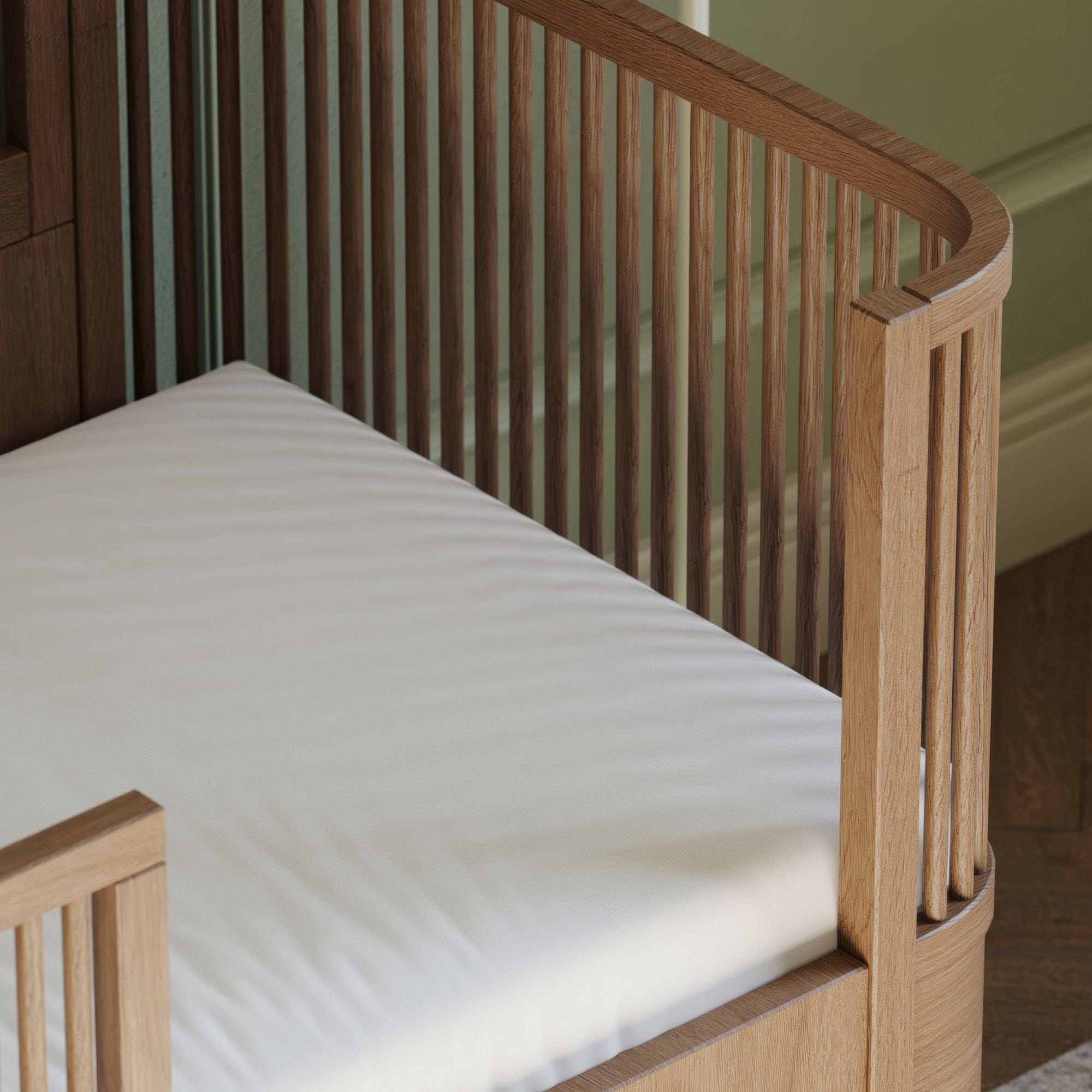
The Naturepedic Organic Classic carries the deepest certification stack of any crib mattress we evaluated, and its waterproofing approach is the detail worth understanding: instead of PFAS coatings, Naturepedic uses a food-grade PLA film derived from non-GMO sugarcane — a claim independently validated by UL, which confirmed non-detectable PFAS at rigorous detection limits across the product line. The 144-coil innerspring core means no polyurethane foam anywhere in the sleep surface. The cover and fill are 100% GOTS-certified organic cotton. The mattress passes federal flammability requirements without any flame retardant chemicals — Naturepedic holds a patent on this design. The 2-stage construction provides a firmer infant surface; flip it for a slightly softer toddler surface.
2. Avocado Organic Crib Mattress — Best for Third-Party Verified Clean

The Avocado Organic Crib Mattress goes further on PFAS testing than nearly any competitor: Intertek screened for 679 individual PFAS substances at a 10 ppb detection limit and found nothing. The construction is a genuine hybrid — 242 individually-wrapped steel coils beneath a layer of GOLS-certified organic Dunlop latex, hemp pads, and coconut husk fiber, all wrapped in GOTS-certified organic cotton and an organic wool cover that serves simultaneously as fire barrier and temperature regulator. The certification list is the longest of any mattress in this guide: GOTS, GOLS, GREENGUARD Gold, MADE SAFE, EWG Verified, OEKO-TEX Standard 100 Class I (the class specifically for infant contact products), UL Formaldehyde Free, and B Corp.
3. My Green Mattress Emily Organic Crib Mattress — Best Value Organic Mattress
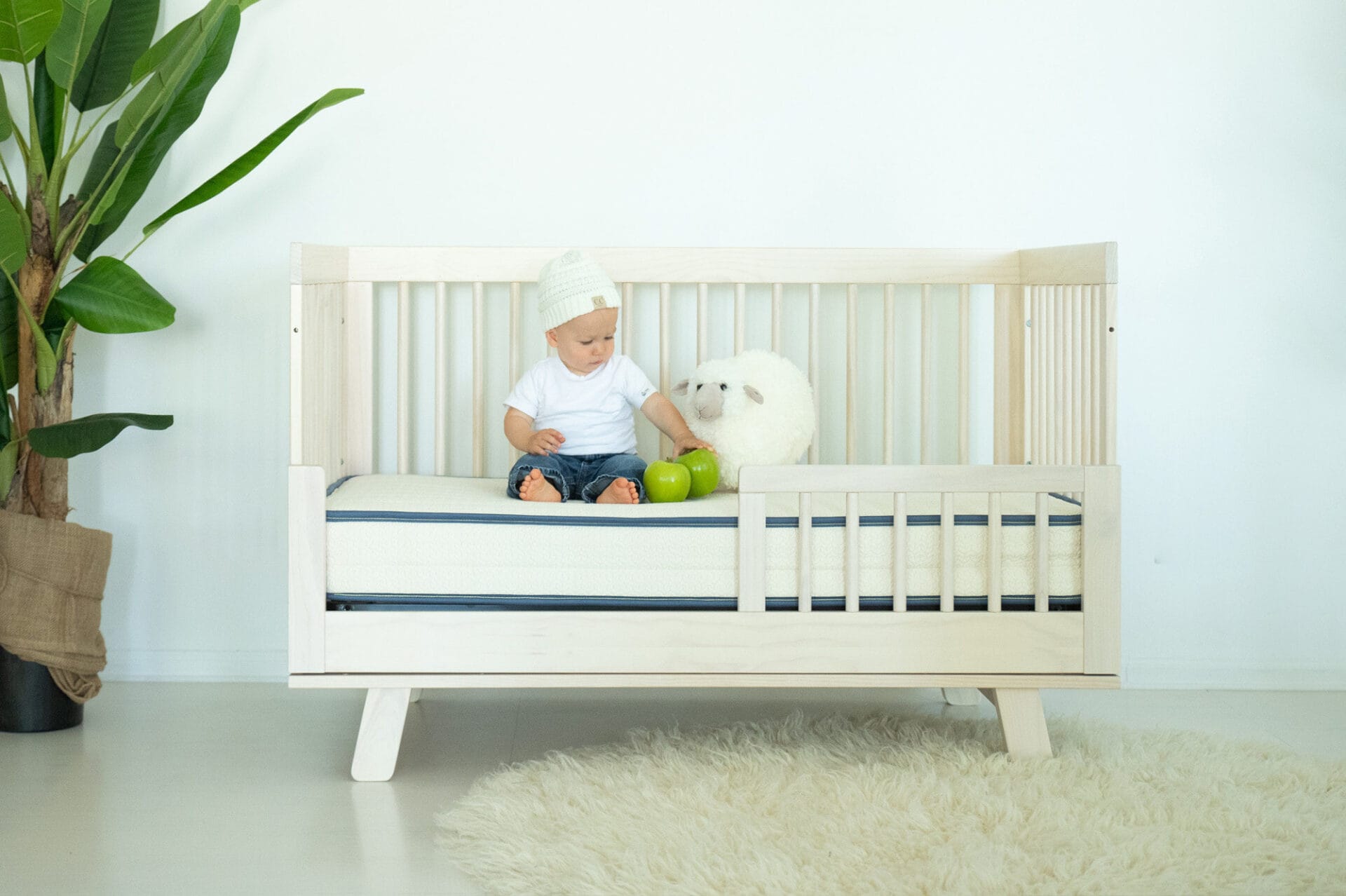
The My Green Mattress Emily delivers GOTS, GOLS, MADE SAFE, and GREENGUARD Gold certifications at $359, and the coconut coir core sets it apart: coconut fiber is naturally breathable and moisture-wicking, which reduces the heat retention that foam builds up during sleep. The GOTS-certified organic cotton and wool cover is the only fire barrier — no chemical flame retardant anywhere in the construction. GOTS, GOLS, MADE SAFE, and GREENGUARD Gold at this price point is genuinely rare.
4. Savvy Rest The Savvy Baby — Best Pure Latex Mattress
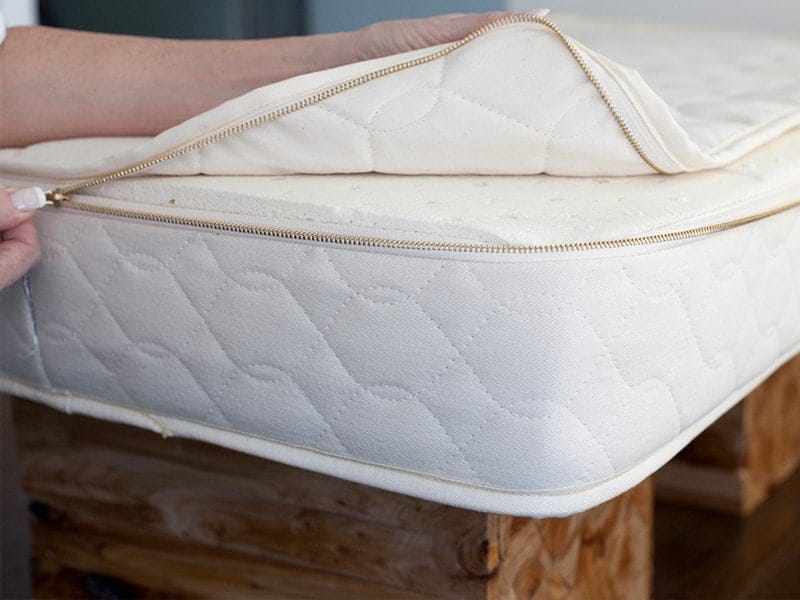
The Savvy Rest Savvy Baby has the simplest ingredient list of any mattress in this guide: a single 5-inch layer of GOLS-certified organic Dunlop latex, enclosed in GOTS-certified unbleached organic cotton and an organic wool batting fire barrier. Cotton, wool, latex — that is the entire construction. No foam, no metal coils, no synthetics of any kind. For families who prefer to avoid innersprings and want a clear material story, this is the option. At 13 lbs it is lighter than most innerspring alternatives, and organic Dunlop latex provides the firm, resilient support appropriate for infants.
5. DaVinci Baby Kalani 4-in-1 Convertible Crib — Best Budget Crib

The DaVinci Baby Kalani is the most accessible entry point for GREENGUARD Gold certified crib safety, with a clear material story: 100% solid New Zealand pine, FSC certified, finished with a zero-VOC non-toxic process that tests below detectable levels for lead and phthalates. It converts from crib to toddler bed, daybed, and full-size bed with separately purchased conversion kits. Around $249 on Amazon, with both GREENGUARD Gold and FSC certification, this is the most cost-efficient non-toxic crib we found.
6. Babyletto Hudson 3-in-1 Convertible Crib — Best Mid-Range Convertible Crib

The Babyletto Hudson is the most widely available non-toxic crib in the mid-range, and the material story holds up: solid, sustainably sourced New Zealand pine throughout, GREENGUARD Gold certified, FSC certified, with finishes tested to undetectable formaldehyde levels and under 10 ppm lead. It comes in 16+ colors, converts to a toddler bed with a separately available conversion kit, and ships quickly from most major retailers. For parents who want a vetted non-toxic crib without spending weeks researching, this is the default recommendation.
7. Oeuf Sparrow Crib — Best for Minimalist Design

The Oeuf Sparrow is made in an FSC-certified facility in Latvia from European birch, finished with a zero-VOC water-based lacquer, and GREENGUARD Gold certified. The design is pared to the point of austerity — a Scandinavian-influenced silhouette that reads more like considered adult furniture than a baby product and holds its aesthetic as the room evolves. It converts to a toddler bed. At around $1,030, it is the premium option for parents who want GREENGUARD Gold and FSC integrity with a design that does not announce itself as nursery gear.
8. Romina Furniture New York Crib — Best Fully Solid Wood Crib

The Romina Furniture New York uses 100% solid European beechwood throughout — including the mattress support platform and back panels — with no MDF, no particleboard, and no veneers anywhere in the piece. Most cribs use engineered wood in structural panels because it is cheaper to produce; this one does not. Finishes are either a water-based non-toxic paint or a blend of vegetable oils and beeswax for the natural wood options. GREENGUARD Gold testing here covers 10,000+ chemical compounds — a substantially broader screen than the industry standard. For parents who want complete material confidence and are unwilling to find the compromise, this is the answer.
FAQ
What certifications actually matter for a crib mattress?
GOTS (textiles and padding), GOLS (latex), MADE SAFE (full ingredient toxicant screening), Greenguard Gold (VOC emissions), and UL Non-Detectable PFAS (waterproofing chemistry) are the ones we weight most heavily. Each maps to a specific disqualifier: GOTS and GOLS address synthetic content, Greenguard Gold addresses off-gassing, MADE SAFE covers the full ingredient inventory, and UL Non-Detectable PFAS addresses what is in the waterproof layer.
Do conventional crib mattresses really off-gas harmful chemicals?
Research has found organophosphate flame retardant compounds in infant blood at levels correlated with mattress age and hours of daily contact. Polyurethane foam cores off-gas VOCs including formaldehyde and benzene during normal use. Infants absorb more per pound of body weight than adults, and developmental windows during infancy make low-level chemical contact a meaningful consideration.
Is latex a safe material for an infant sleep surface?
GOLS-certified organic Dunlop latex is considered safe for infant sleep. The GOLS standard requires at least 95% organically produced raw material and prohibits harmful processing chemicals. Organic Dunlop latex also provides the firm, resilient support that infant sleep safety guidelines call for. The certification is the verification: a brand's claim of "natural latex" without a GOLS certificate is unverified.
How does wool replace chemical flame retardants?
Wool chars without burning because of its high moisture and protein content. This physical property allows organic wool batting to meet federal flammability standards (16 CFR 1633) without any chemical additives. The wool acts as a natural barrier that slows flame spread long enough for the mattress to pass the open-flame test. All four mattresses in this guide use this approach: organic wool batting as the sole fire barrier, with no organophosphates, PBDEs, or antimony added.
Do these cribs meet federal safety standards?
All cribs in this guide meet current CPSC regulations, which prohibit drop-side rails, require slat spacing between 2 3/8 and 6 cm, and mandate minimum mattress support strength. GREENGUARD Gold tests for over 10,000 chemical compounds at emissions levels established as safe for infants. Meeting GREENGUARD Gold is a higher chemical-emissions bar than meeting safety regulations alone.
What is the difference between GOTS and GOLS?
GOTS (Global Organic Textile Standard) covers woven and fibrous materials: the cotton cover, wool batting, and any fabric components. GOLS (Global Organic Latex Standard) covers the latex core specifically, requiring at least 95% organic raw material content. A mattress with both certifications has had its primary materials verified independently: the fabric layers through GOTS and the latex through GOLS.
Cover photo via Unsplash (Unsplash License).