When Caraway calls its pans "ceramic" and Xtrema calls its pans "ceramic," they mean different things. One is a sol-gel coating applied over aluminum. The other is the material itself. The word is doing different work in each case, and most cookware marketing does not explain which is which.
This explainer defines both, covers what happens when coatings degrade, and gives you a practical framework for evaluating claims like "ceramic," "PFAS-free," and "non-toxic" on a pan's product page.
What "Ceramic-Coated" Actually Means
A ceramic-coated pan is a conventional metal pan, almost always aluminum, with a thin sol-gel coating applied to the cooking surface. Sol-gel is a chemical process that converts a liquid silica-based precursor into a hard, glass-like film when cured at high heat. The resulting surface is smooth, hydrophobic, and genuinely non-stick when new.
The coating is real chemistry. It is manufactured without PTFE (polytetrafluoroethylene, the fluoropolymer in Teflon) and without PFOA (perfluorooctanoic acid, the processing chemical historically used in PTFE manufacturing). When a brand says "PFAS-free" for a ceramic-coated pan, that claim is generally accurate: these coatings do not use per- and polyfluoroalkyl substances.
What ceramic-coated does not mean: the pan is made of ceramic. The structural material is aluminum. The cooking surface is an applied film. Brands including Caraway, GreenPan, and Our Place make this type of cookware. All describe it using the word "ceramic." None of them are technically wrong. But they are describing a coating, not a material.
What True Ceramic and Uncoated Materials Mean
True ceramic cookware means the entire cooking vessel is made from ceramic: clay-based material fired at high temperature, with no metal substrate and no applied coating. Xtrema is the primary commercially available example. When you cook in an Xtrema pan, the cooking surface is the same material as the walls and the base. There is nothing to degrade or separate from a substrate.
More broadly, "uncoated" describes any cookware where the cooking surface is the base material itself, without an applied film:
- Stainless steel (food-grade 18/10 or 316 alloy)
- Cast iron (bare or enameled)
- Carbon steel
- Borosilicate glass
- Solid ceramic (Xtrema and equivalents)
None of these have a coating lifecycle. The surface you cook on at purchase is the surface you cook on indefinitely.
How Coatings Degrade
Sol-gel ceramic coatings are not permanent. Their non-stick properties come from the microscopic smoothness of the cured silica surface. Once that surface is scratched, chipped, or worn through repeated heat cycling and cleaning, the coating's function diminishes and its physical integrity changes.
The rate of degradation depends on product quality and use patterns. Metal utensils accelerate surface scratching. High heat accelerates breakdown of the sol-gel matrix. Dishwasher detergents are abrasive. Most ceramic-coated pans, used normally, show meaningful non-stick performance loss within two to five years.
A PFAS-free pan with a partially worn coating is not the same as a pan that never had a coating. The non-toxic property is only as durable as the coating itself.
What "PFAS-Free" Does and Doesn't Mean
PFAS is a broad category: per- and polyfluoroalkyl substances, a class of thousands of fluorinated chemicals that includes PTFE, PFOA, PFOS, and related compounds. The EPA's PFAS overview covers the current regulatory and health research context.
For cookware, "PFAS-free" in the context of ceramic-coated pans means the coating is manufactured without PTFE, PFOA, or other fluorinated compounds. That is a real and meaningful distinction from traditional non-stick. PTFE releases fumes at sustained high temperatures (above roughly 260C) that are acutely harmful to birds and potentially concerning for people in poorly ventilated conditions. Ceramic coatings do not carry that risk.
What "PFAS-free" does not address:
- The longevity of the coating. PFAS-free is a manufacturing claim about what the coating is not made from. It says nothing about how long the coating remains intact.
- The safety of the base material once the coating degrades. PFAS-free aluminum is still aluminum, with aluminum's own reactivity characteristics.
- Whether the coating chemistry has been independently tested and at what temperatures. Most brand claims in this area are self-reported.
The meaningful use of "PFAS-free" in cookware describes the coating's chemistry. It does not describe the pan's durability or what the cooking surface becomes after the coating's useful life ends.
How to Read the Marketing
When a brand calls its cookware "ceramic," the relevant follow-up question is: is the cooking surface a coating applied over another material, or is the pan itself made from ceramic?
When a brand says "non-toxic" or "PFAS-free," the relevant questions are:
- What is the base material?
- Is the non-stick surface a coating or the base material itself?
- What testing has been done on the coating chemistry, and by whom?
- What happens to the cooking surface when the coating wears?
Brands with genuine materials confidence answer these directly in product documentation. Marketing copy that emphasizes what the coating does not contain ("no PTFE, no PFOA, no PFAS") without describing what it does contain, or what material it covers, is worth noting.
One reliable signal: brands that disclose the base material (aluminum, stainless steel) alongside their coating description are more transparent than those whose product pages lead entirely with coating claims and leave the substrate unmentioned.
What to Do With This Information
Ceramic-coated pans are a genuine improvement over PTFE-coated pans for buyers who want to avoid fluorinated chemistry entirely. They are not permanent cookware. Treating them accordingly, with low to medium heat, wooden or silicone utensils, gentle hand washing, and replacement when the coating shows visible wear, extends their useful life and manages the degradation risk.
Uncoated materials sidestep the coating question entirely. Stainless steel, cast iron, and carbon steel require more technique (temperature management, appropriate fats, seasoning for carbon steel and cast iron) but do not require replacement on a coating schedule. Xtrema's solid ceramic is the closest approximation of a pan whose cooking surface actually matches what the name "ceramic" implies.
For specific picks across both categories, our non-toxic cookware guide covers 14 pans across five materials, each vetted for full material disclosure and screened against our disqualifier list. The non-toxic bakeware guide applies the same criteria to sheet pans, baking dishes, and muffin tins.
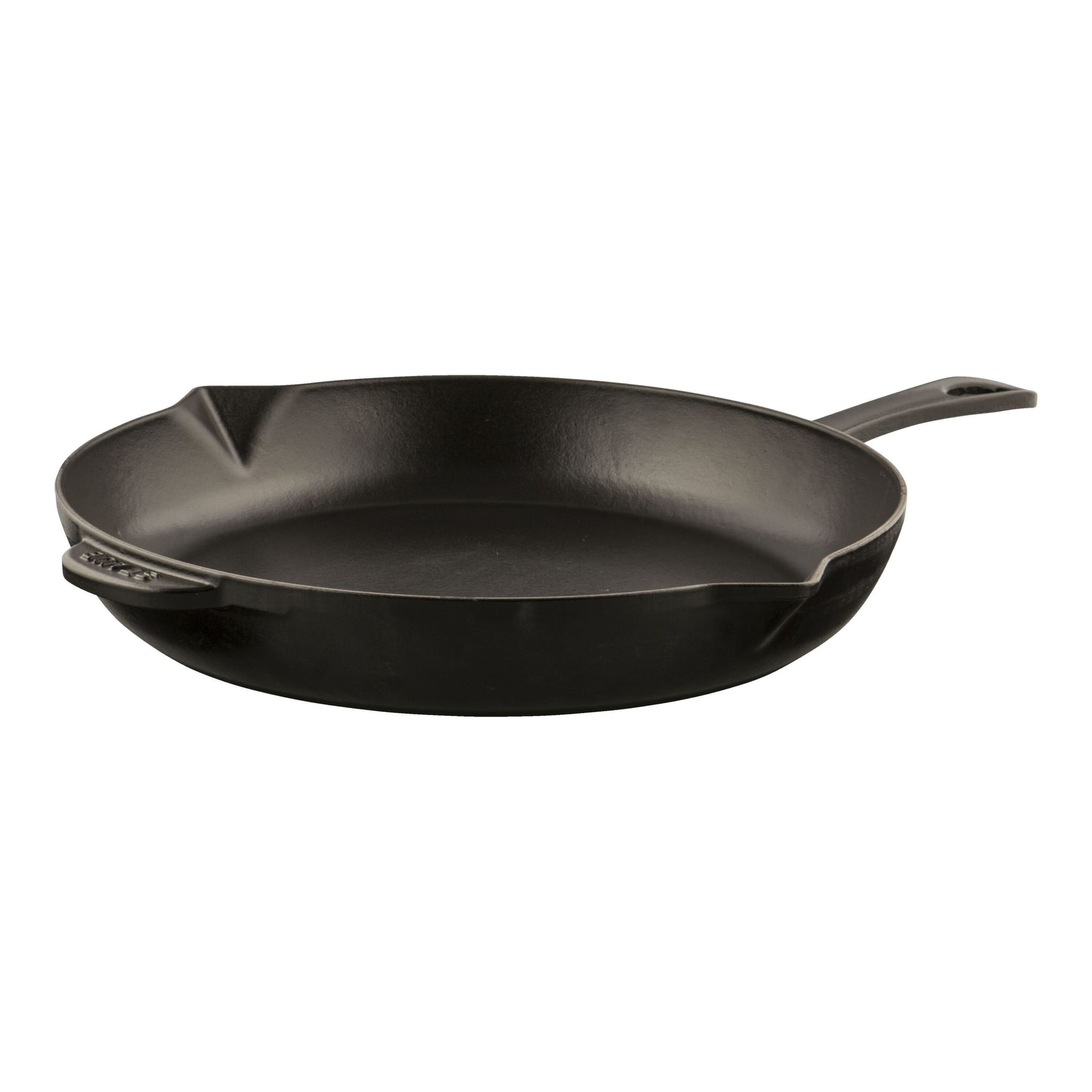
Cover image: Staub 12" Cast Iron Fry Pan via Zwilling (product imagery, used for editorial illustration) — source.