

Our picks at a glance
| Pick | Best for | Key certifications | Price | Details |
|---|---|---|---|---|
| Nordic Ware Naturals Baker's Half Sheet Pan | Best overall | NSF certified | $ | Full review |
| Caraway Large Baking Sheet | Best ceramic-coated sheet pan | Eurofins PFAS-tested | $$ | Full review |
| USA Pan Bakeware Half Sheet Pan | Best budget coated pick | PTFE-free Americoat | $ | Full review |
| Xtrema 2-Quart Loaf Pan | Best loaf pan | Prop 65 tested | $$ | Full review |
| Lodge Cast Iron Muffin Pan | Best cast iron muffin tin | Made in USA | $ | Full review |
| Xtrema 6-Cup Muffin Pan | Best ceramic muffin tin | Heavy-metal tested | $$ | Full review |
| Pyrex Basics 3-Quart Glass Baking Dish | Best casserole dish | Soda-lime glass | $ | Full review |
| Lodge Chef Collection Cast Iron Bread Oven | Best bread baker | Made in USA | $ | Full review |
Most bakeware guides rank by how evenly a pan browns cookies. This one starts somewhere else: what is the pan made of, and what does the coating do at 425°F?
The PFAS problem in nonstick bakeware is the same as in cookware, just less discussed. Polytetrafluoroethylene (PTFE) coatings (the chemistry behind Teflon and most generics) begin off-gassing measurable fluorinated compounds above 500°F and degrade faster than pans used on an open burner. Bakeware routinely hits 425–450°F. At those temperatures, a scratched or thin PTFE coating isn't just a surface problem; it is a chemistry problem.
In 2024, the EPA finalized rules designating PFOA and PFOS as hazardous substances under CERCLA. In 2025, the EU restricted the entire PFAS class in food-contact materials. The regulatory direction is consistent: the chemistry is being phased out. We screen against all of it.
What we look for
No PTFE or PFAS in any form. The coating class includes PTFE (Teflon), PFOA, PFOS, GenX, and the full C4–C10 fluorotelomer range. "PFOA-free" alone is not a pass: the question is what the coating actually is. We require either (a) no coating at all, (b) a non-fluorinated coating with an independent test result confirming it, or (c) a material that is inherently PFAS-free by chemistry (glass, bare metal, pure ceramic).
Full material disclosure. Every material in contact with food needs to be named on the brand's product page or spec sheet, not hidden behind "premium nonstick" or "proprietary coating." If the brand won't name it, we don't list it.
Sourced claims only. Every certification, every test result, every made-in claim on this page links back to primary documentation: the brand's spec page, a third-party lab's certificate, or the certifier's registry. We don't take marketing copy as evidence.
Coating transparency for sol-gel ceramics. The ceramic-coated category is more complicated than it looks. "Ceramic" usually means a sol-gel silica network applied over steel, not fired ceramic. That coating can be PTFE-free and still contain heavy-metal pigments or proprietary binders the brand won't disclose. We require either third-party PFAS testing or a disclosed formulation.
In-stock and currently purchasable. We don't list products that are sold out or discontinued. Every pick on this page was in stock at the time we verified it.
500°F
temperature
where PTFE begins measurable off-gassing
7
of 9 picks
have no nonstick coating at all
0
paid placements
on this list or any other
Our picks
1. Nordic Ware Naturals Baker's Half Sheet Pan: Best overall

The Nordic Ware Naturals Baker's Half Sheet Pan is the simplest non-toxic baking sheet on the market: natural aluminum, no coatings, no liners, nothing between the batter and the metal. It has been NSF certified since before most of its competitors existed, made in the USA since 1946, and it costs $22.
Natural aluminum is mildly reactive with highly acidic foods: tomato sauce or citrus marinades will pick up trace amounts over long exposures. For baking (cookies, roasted vegetables, sheet-pan dinners), this isn't a meaningful concern. The pan browns evenly because aluminum conducts heat well, and because there's no coating to degrade, it will outlast any nonstick pan in the house.
The trade-off: without a nonstick surface, sticky foods need parchment paper or a light oil. That's a fair exchange for the complete elimination of coating chemistry.
Price: $20 · Material: Natural aluminum · Made in: USA
2. Caraway Large Baking Sheet: Best ceramic-coated sheet pan
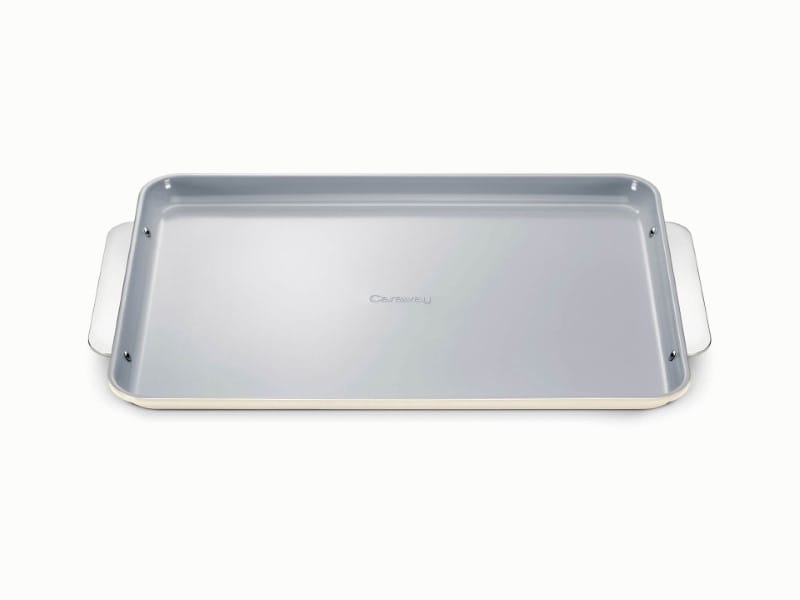
The Caraway Large Baking Sheet is the strongest choice for buyers who want a nonstick surface that has been independently verified. Caraway tests every coating batch with third-party PFAS screening by Eurofins, a standard the rest of the ceramic-coated category almost uniformly ignores. The sol-gel ceramic surface bonds to aluminized steel without PTFE, PFOA, or heavy-metal pigments.
The "ceramic" in this coating is a silica-based sol-gel network, not fired clay. That matters because the term is loosely regulated. What Caraway has done is have the chemistry verified externally and publish that it passed. The Eurofins documentation is available on their materials page, not just cited in marketing copy.
At $65, it's priced at the higher end of the ceramic category. Available in ten colorways, which shouldn't affect your purchase decision but does affect your kitchen cabinet.
Price: $65 · Coating: Sol-gel ceramic, PFAS-tested by Eurofins · Made in: China
3. USA Pan Bakeware Half Sheet Pan: Best budget coated pick
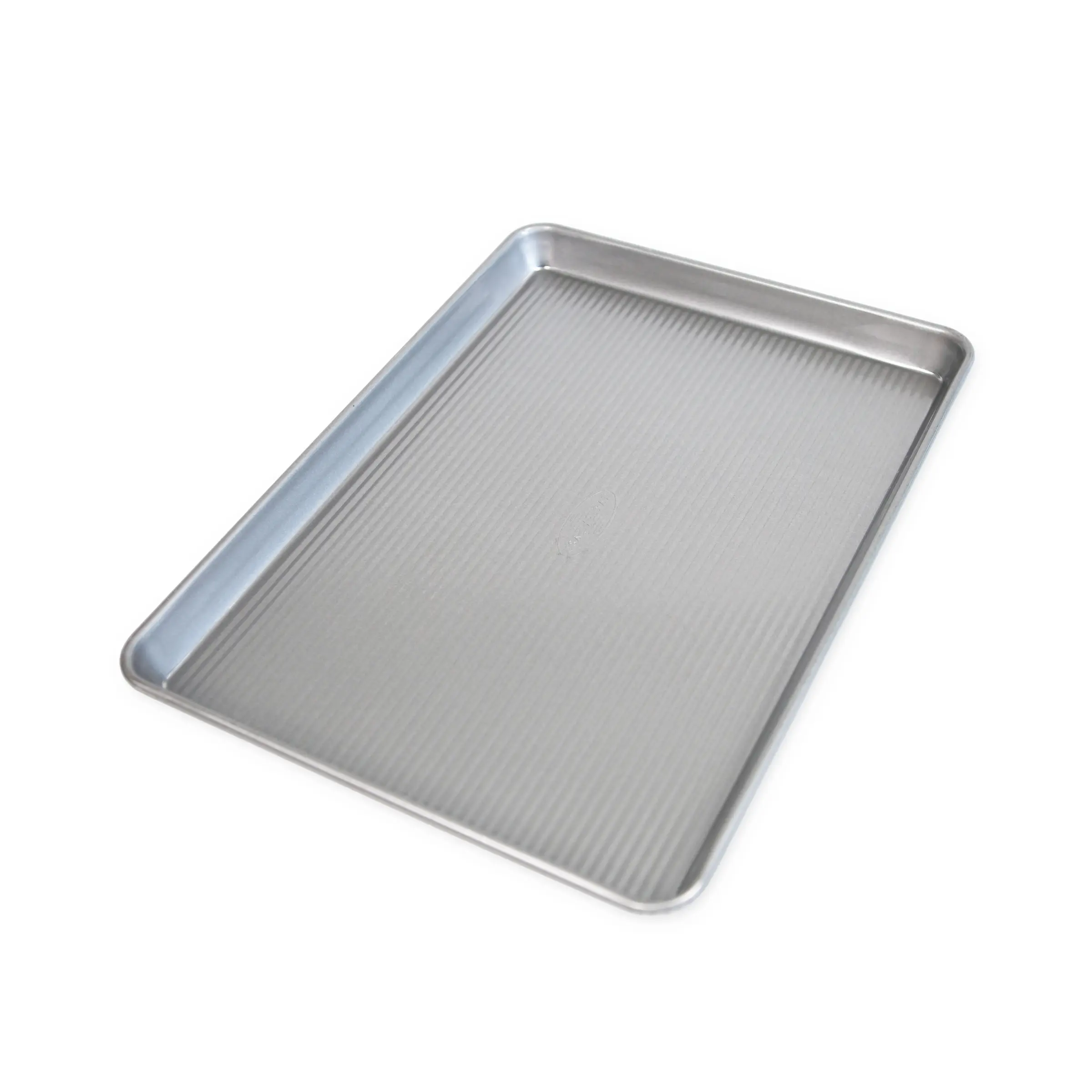
The USA Pan Half Sheet Pan uses Americoat, a patented silicone-based release agent baked into aluminized steel. It is not a separate nonstick layer in the traditional sense: it's a silicone treatment applied to the corrugated commercial steel surface. No PTFE, no PFOA, independently tested.
USA Pan makes commercial-grade bakeware for institutional kitchens, which is why the gauge is heavier than typical consumer pans at this price point. The corrugated underside increases rigidity and promotes air circulation. The pan has been in continuous production long enough that the Americoat process is well-documented in patent filings as well as on the brand's own materials page.
At $22.47, it's direct competition for the Nordic Ware above. The Nordic Ware is simpler (no coating at all); the USA Pan is more comparable to a nonstick without the PTFE. Which one you prefer depends on whether you want the pure aluminum surface or a light release coating you've verified.
Price: ~$22.47 · Coating: Americoat (PTFE-free silicone-based) · Made in: USA
4. Xtrema 2-Quart Loaf Pan: Best loaf pan

The Xtrema 2-Quart Loaf Pan is the gold standard for loaf pan transparency. Xtrema makes 100% pure ceramic cookware, not ceramic-coated metal, not a silica sol-gel on steel, but fired ceramic with no coating layer of any kind. The raw formulation is the food-contact surface. Third-party Prop 65 heavy-metal testing is disclosed publicly on the Xtrema website, not buried in a PR deck.
The material trade-off with pure ceramic is thermal shock sensitivity. Don't put a cold Xtrema pan into a hot oven, and don't take a hot pan and set it on a cold countertop. Pre-warm it with the oven. Beyond that, it functions like any stoneware loaf pan: slower to heat than metal, retains heat longer, and produces a moist, evenly baked interior.
At $63, it is the most expensive loaf pan on this list by a considerable margin. The justification is the material and the transparency record, not the price tag itself.
Price: $63 · Material: 100% pure ceramic (no coatings) · Prop 65 tested: Yes
5. Lodge Cast Iron Muffin Pan: Best cast iron muffin tin

The Lodge Cast Iron Muffin Pan is one of the few muffin tins whose complete material list fits in a single word: iron. No enameling, no coatings, no surface treatments beyond the thin layer of vegetable oil applied during pre-seasoning at the factory. Made in South Pittsburg, Tennessee, since 1896.
Cast iron muffin pans are heavier than aluminum and require a bit more care: hand wash, dry immediately, rub with oil occasionally. The payoff is a pan that seasons over time (the surface becomes increasingly nonstick with use), will outlast every other item in the kitchen, and has exactly one material in contact with food.
The 12-cup format is standard. Pre-seasoning means it's usable immediately, though the natural release improves after a few bakes. Cornbread comes out particularly well.
Price: $31.44 · Material: Cast iron, vegetable oil seasoning · Made in: USA
6. Xtrema 6-Cup Muffin Pan: Best ceramic muffin tin

The Xtrema 6-Cup Muffin Pan uses the same 100% pure ceramic formulation as the full Xtrema cookware line: no glazes, no metallic colorants, no proprietary coating chemistry. Third-party heavy-metal testing is disclosed on the Xtrema safety page. Dishwasher safe, which the cast iron version above is not.
Six cups rather than twelve is a format choice. If you bake muffins in half batches or want a lighter pan to handle, this is the alternative to Lodge. If you routinely bake full dozen batches, you'll want to account for running two rounds.
At $72, it's priced between the Lodge ($35) and what you'd pay for a quality enameled cast iron muffin pan. For buyers who want a lighter, dishwasher-safe ceramic option over cast iron, this is the pick.
Price: $72 · Material: 100% pure ceramic · Dishwasher safe: Yes
7. Pyrex Basics 3-Quart Glass Baking Dish: Best casserole dish
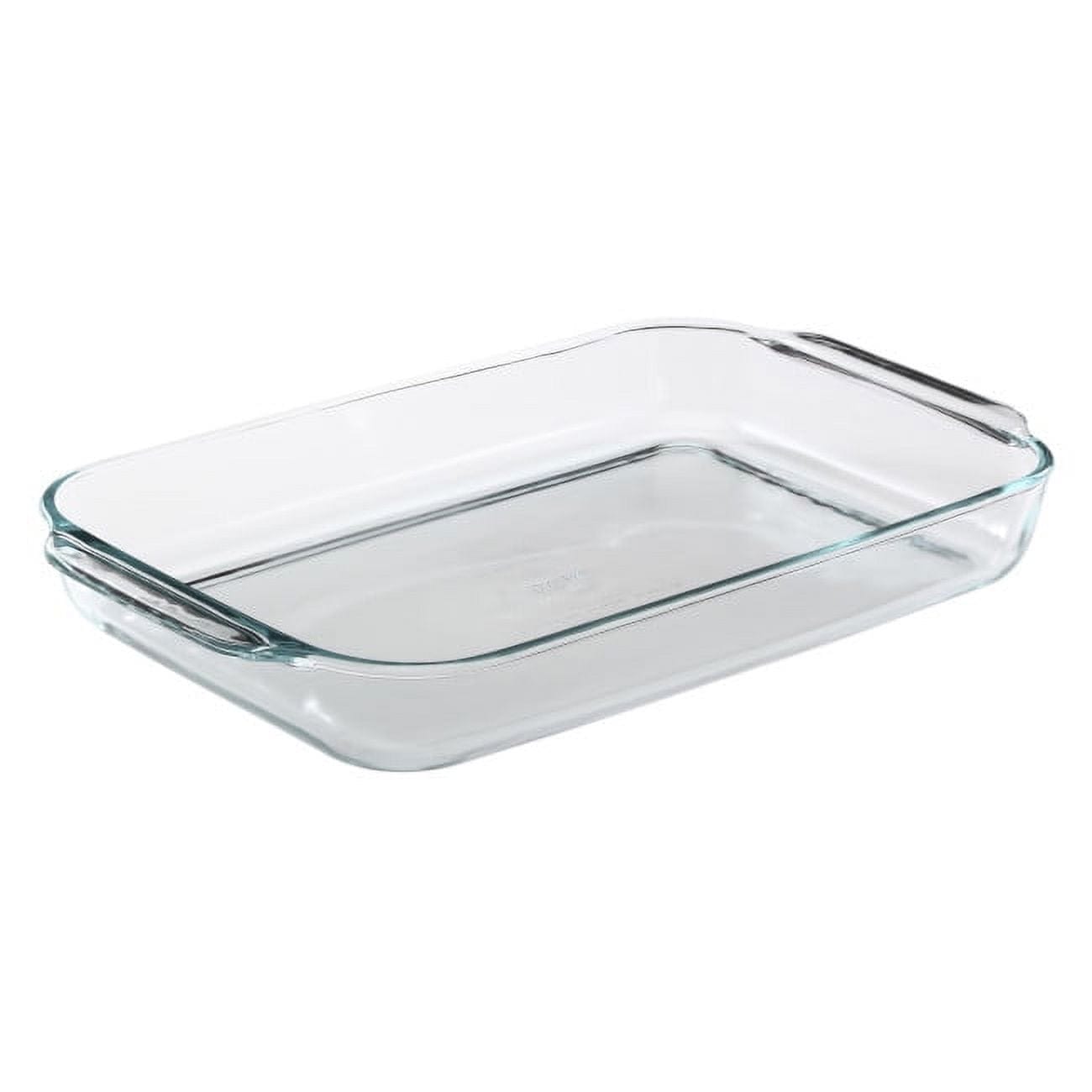
The Pyrex Basics 3-Quart Glass Baking Dish doesn't need much editorial justification. Soda-lime glass is one material with one ingredient: glass. No coatings, no liners, no PFAS, no organic chemistry of any kind on the food-contact surface. Oven safe to 450°F, freezer safe, dishwasher safe.
The caveat worth stating plainly: Pyrex sold in the US is soda-lime glass, not the borosilicate formulation from the original 1915 design (which was discontinued in 1998). Soda-lime glass is more susceptible to thermal shock: don't take it from the freezer to a 450°F oven directly. Let it come to room temperature first, or go from room temp to oven. The glass itself is completely inert; the thermal shock sensitivity is a handling note, not a chemistry concern.
It is among the least expensive options on the list at $22.99 and handles lasagna, gratins, and roasted vegetables equally well.
Price: $22.99 · Material: Soda-lime glass · Oven safe: 450°F
8. Lodge Chef Collection Cast Iron Bread Oven: Best bread baker

The Lodge Chef Collection Cast Iron Bread Oven is a combo cooker: a shallow skillet base and a deep domed lid that functions as a Dutch oven for bread baking. Pre-seasoned with vegetable oil. No enameling. No coatings. Made in the USA.
The design solves the home bread baker's fundamental problem: getting oven-spring crust without a commercial steam-injected deck oven. The domed lid traps steam from the loaf itself during the first 20 minutes of baking, then comes off to let the crust brown. The cast iron mass provides the high, stable heat that develops crumb structure. The result, at $120, is the professional sourdough baker's method without the $3,000 oven.
Material-wise: the only thing between the dough and the iron is the vegetable oil seasoning layer, which is thinner than it sounds and doesn't transfer detectable amounts to the food. This is the same iron-only contact as a bare Lodge skillet.
Price: $99.95 · Material: Cast iron, vegetable oil seasoning · Made in: USA
What we passed on
360 Cookware bakeware (Cookie Sheet, Pie Pan, Bake & Roast Pan): surgical stainless steel with no coatings, made in the USA, and well-documented materials. We wanted to include them. Every bakeware item in the 360 Cookware line showed "Sale Sold out" at the time of publication. We don't list out-of-stock products.
Traditional PTFE nonstick bakeware: the entire category of pans with Teflon-style coatings. PTFE begins off-gassing measurable fluorinated compounds above 500°F; bakeware routinely reaches those temperatures. The coating also scratches over time, and scratched PTFE in contact with food is a more direct exposure pathway than on a stovetop pan.
Most "ceramic" pans without third-party testing: sol-gel ceramic coatings marketed as "ceramic nonstick" are generally PTFE-free but are not uniformly tested for PFAS. Without a test result from an independent lab (or a formulation disclosure that makes independent testing unnecessary), we can't confirm the claim. Several popular brands in this category declined to disclose their testing methodology.
Silicone molds, technically PFAS-free and not plastic, but the silicone certification landscape is fragmented. "Food-grade" means different things from different manufacturers. Platinum-cured silicone with an LFGB certificate or NSF rating is acceptable; undisclosed-curing-agent silicone from private-label manufacturers is not, and that describes most of the category on Amazon.
How this was vettedLast verified August 2026
Each product was screened against our published disqualifiers: no PTFE or PFAS in any form, no undisclosed coatings, claims traced to primary documentation. In-stock status was confirmed at time of publication. Reddit sentiment across r/BuyItForLife, r/ZeroWaste, and r/Cooking was used to identify candidates and validate community reception.
Read the full criteria →FAQ
Is PTFE safe in bakeware?
PTFE (the chemistry behind Teflon and most generic nonstick coatings) begins off-gassing measurable fluorinated compounds above 500°F, and bakeware routinely reaches 425 to 450°F in a home oven. A scratched or thin coating degrades faster at oven temperatures than on a stovetop. The EPA designated PFOA and PFOS as hazardous substances under CERCLA in 2024, and the EU restricted the entire PFAS class in food-contact materials in 2025. We screen against all PTFE and PFAS in any form.
What does "ceramic nonstick" mean on bakeware?
"Ceramic" in bakeware almost always refers to a sol-gel silica network applied over steel, not fired ceramic. That coating can be PTFE-free and still contain heavy-metal pigments or proprietary binders the brand will not disclose. The Caraway Large Baking Sheet is the only sol-gel ceramic pick on this list because Caraway has that coating independently tested by Eurofins and publishes the results. Most ceramic-coated bakeware has not done the same.
Is cast iron bakeware safe?
Bare cast iron is one of the safest baking surfaces available: the only material in contact with food is iron, plus the thin vegetable oil layer applied during pre-seasoning. Cast iron does not have coatings that degrade or off-gas. It requires hand-washing and occasional re-oiling, but those are care steps, not chemistry concerns.
Can I put a Pyrex dish directly from the freezer into a hot oven?
No. Pyrex sold in the US since 1998 uses soda-lime glass, not the original borosilicate formulation, and soda-lime glass is more susceptible to thermal shock. Taking a cold dish directly to a hot oven can crack it. Let the dish come to room temperature before baking. The glass itself is completely inert; the thermal shock sensitivity is a handling note, not a chemistry concern.
What is Americoat, and how does it compare to PTFE?
Americoat is USA Pan's patented silicone-based release agent baked into aluminized steel. It is not a separate nonstick layer in the traditional sense but a silicone treatment on a corrugated commercial-grade surface. No PTFE, no PFOA, and independently tested. It sits between the Nordic Ware (no coating at all) and conventional PTFE nonstick in terms of surface chemistry involved.
Cover image: Neven Krcmarek via Unsplash (Unsplash License). source.
