Our picks at a glance
| Pick | Best for | Key certifications | Price | Details |
|---|---|---|---|---|
| Lodge Cast Iron Skillet, 10.25in | Everyday cooking | Food-grade seasoning | $ | Full review |
| 360 Cookware Stainless Steel Large Cookie Sheet | Baking | None | $$ | Full review |
| Bambu Classic Cutting & Serving Boards | Food prep | FSC Certified | $ | Full review |
| Bambu Kitchen Basics 3-Piece Bamboo Utensil Set | Cooking utensils | FSC Certified | $ | Full review |
| Weck 743 Mold Jar | Food storage | None | $ | Full review |
| SAKI Luna Stainless Kettle | Boiling water | None | $$ | Full review |
| East Fork Solid Enamel Dinner Plate | Everyday dining | None | $$ | Full review |
| Branch Basics Concentrate | Kitchen cleaning | EWG Verified | $$ | Full review |
Why the kitchen is the highest-priority room
Most adults prepare three meals a day in their kitchen. The surfaces, coatings, containers, and cleaners you use in that space are in contact with food, hands, and water hundreds of times a week. That makes the kitchen the most direct pathway for dietary exposure to synthetic chemicals. Non-stick coatings on pans can release PFAS compounds under normal cooking temperatures. Plastic cutting boards shed microplastic fragments into food. Conventional all-purpose cleaners introduce synthetic fragrance chemicals and optical brighteners into the environment you prepare food in.
Fixing the kitchen is not about buying everything new at once. Start with the highest-contact surfaces, work category by category, and verify materials before you buy. Every pick below was chosen because the brand discloses exactly what goes into the food-contact surface and the claim is traceable to a source.
What we look for
No PFAS, in any form. That means no polytetrafluoroethylene (PTFE), no "ceramic" non-stick with an undisclosed binder, no stain-repellent or water-resistant finishes, no "sol-gel" or hybrid coatings. We check the brand's materials page and, where relevant, third-party testing. A claim of "PFAS-free" without a named alternative and a verifiable source is not enough.
No plastic in the food-contact surface. Polypropylene spatulas, polyethylene cutting boards, melamine plates, and Tritan storage containers all leach detectable compounds under heat and mechanical stress. The picks here use cast iron, stainless steel, bamboo, borosilicate glass, and vitreous enamel. Each material has a verifiable composition.
No undisclosed adhesives or finishes. Bamboo is inherently sustainable material; the finishing chemistry is where most bamboo products fail. We require brands to name the finish and its composition. Same rule applies to wood cutting boards: "non-toxic finish" without a named product fails the screen.
No synthetic fragrance in cleaning products. "Fragrance" as a catch-all ingredient can contain hundreds of undisclosed compounds. We require named ingredients or a published full-disclosure formulation. EWG Verified is an acceptable third-party screen for cleaning products because EWG publishes its criteria and the database is publicly searchable.
Certification has to resolve. Every certification we list can be verified in the issuing authority's registry against the specific product or brand. We do not count self-declared certs.
Our picks
1. Lodge Cast Iron Skillet, 10.25in: Best cookware

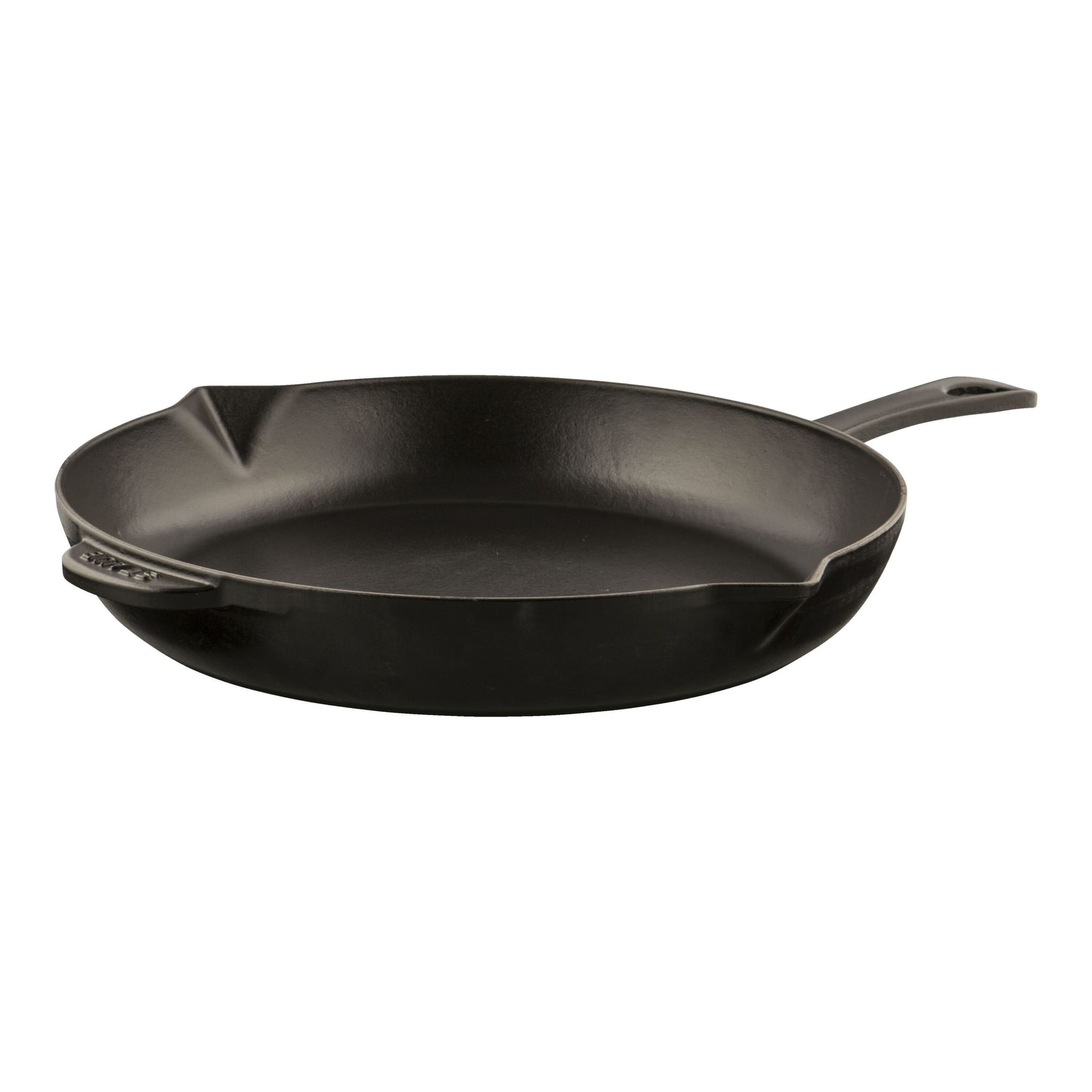
The Lodge Cast Iron Skillet, 10.25in is the anchor cookware pick because it has no food-contact coating to fail, chip, or emit. The iron food surface builds a natural polymerized oil layer with use. It handles stovetop, oven, and grill. The pre-applied seasoning uses food-grade flaxseed oil, disclosed on Lodge's product page. Lodge manufactures in the United States with foundry scrap iron and sand molds; the company discloses its sourcing chain.
The only maintenance: dry it promptly after washing and rub a small amount of neutral oil onto the surface before storage. That is the entire care protocol.
2. 360 Cookware Stainless Steel Large Cookie Sheet: Best bakeware

The 360 Cookware Stainless Steel Large Cookie Sheet is the right answer for bakeware because 304 (18/8) surgical-grade stainless steel is inert at baking temperatures. No PFAS coating, no aluminum substrate exposed to food. 360 Cookware manufactures in West Bend, Wisconsin and publishes its steel specification.
Most "nonstick" bakeware uses PTFE or PFOA-replacement fluoropolymer coatings. 360 Cookware is bare stainless steel. Food releases cleanly with a thin layer of butter or oil. The sheet pan heats evenly because 360's manufacturing process creates a vapor-sealed construction that distributes heat through the steel body rather than relying on a dark coating to absorb radiant heat.
3. Bambu Classic Cutting & Serving Boards: Best cutting board

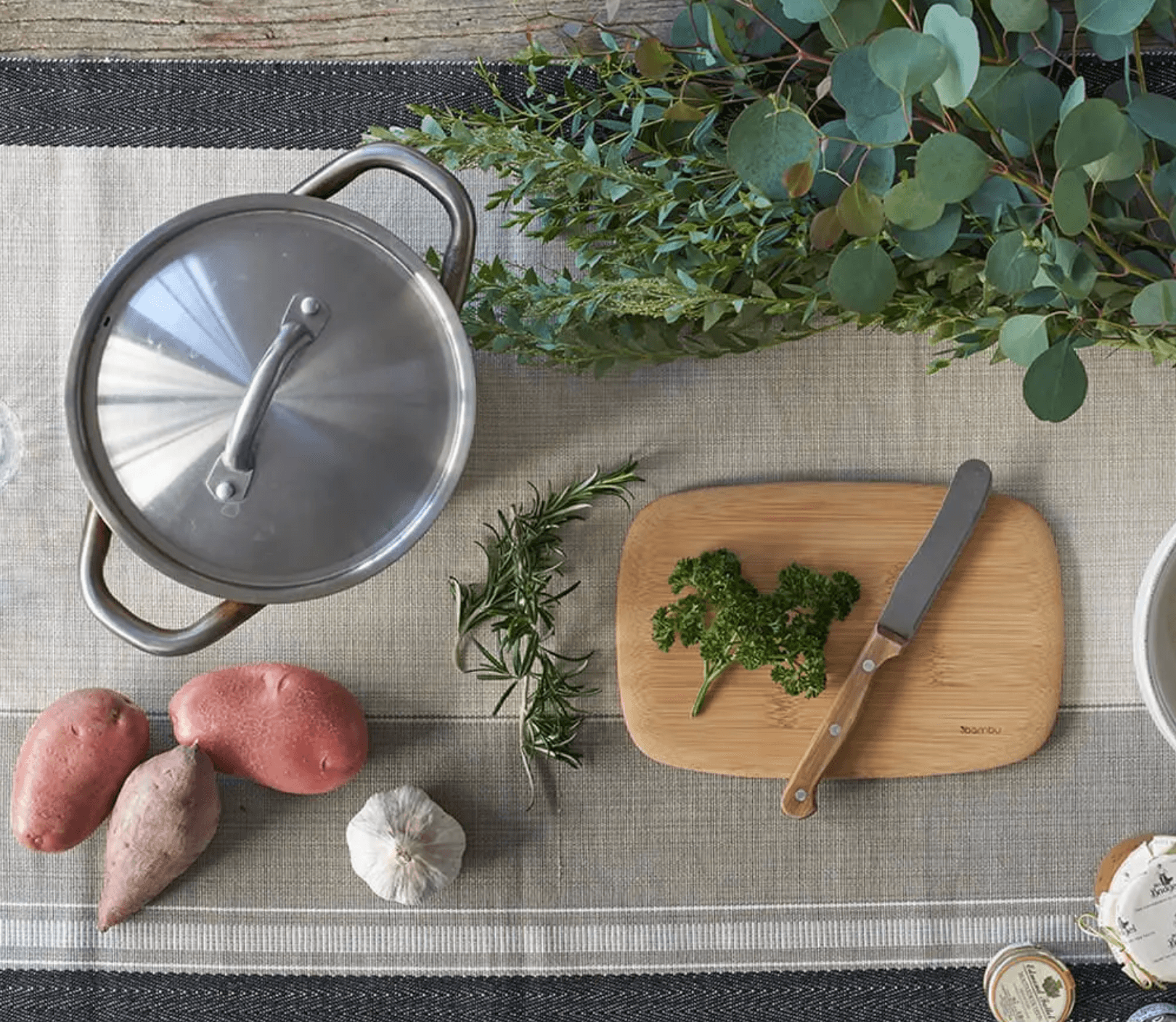
The Bambu Classic Cutting & Serving Boards pass the two tests most bamboo boards fail: the finish is a USDA BioPreferred plant-based lacquer (not a urea-formaldehyde binder), and the bamboo is FSC chain-of-custody certified. Bambu discloses both on the product page.
Unlike composite bamboo boards, which use formaldehyde-based adhesive to bind bamboo strips under pressure, Bambu's Classic boards disclose their finish chemistry. They are fully reversible, medium (12x8in) and large (15x11in). Made by hand in China under Bambu's own factory oversight.
4. Bambu Kitchen Basics 3-Piece Bamboo Utensil Set: Best utensils

The Bambu Kitchen Basics 3-Piece Bamboo Utensil Set replaces plastic or nylon spatulas and spoons with FSC-certified bamboo. The food-contact surface is bamboo with no added finish, no coating, and no plastic components. Includes a spoon, slotted spoon, and spatula.
The case for bamboo utensils over silicone: bamboo is a named, verifiable material. "Food-grade silicone" is a category that covers a wide range of formulations. Unless a silicone product specifies platinum-cure and publishes its composition, the material cannot be independently verified. Bambu's material is unambiguous.
5. Weck 743 Mold Jar: Best food storage
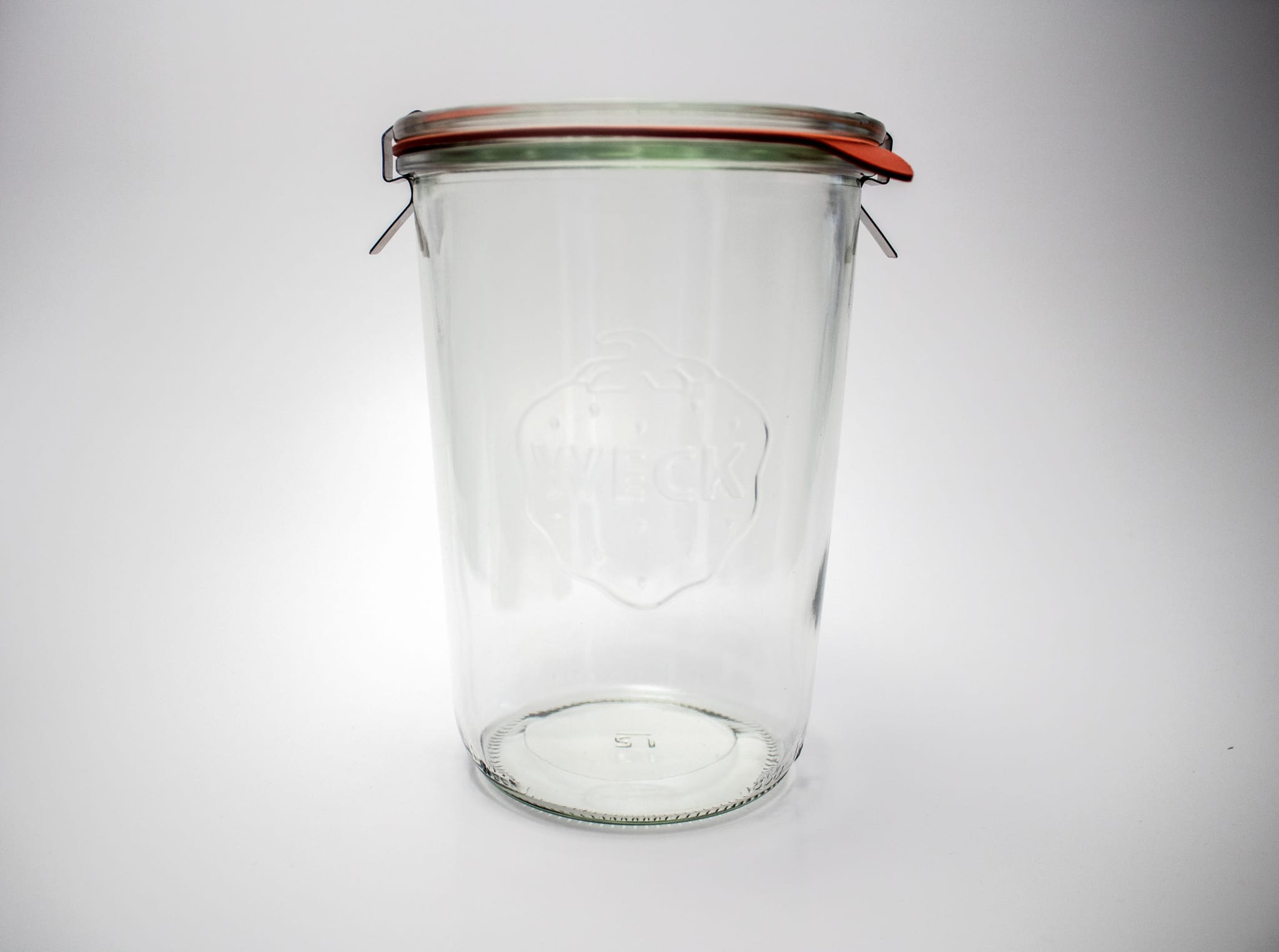
The Weck 743 Mold Jar is a German-made borosilicate glass jar with a rubber seal, glass lid, and stainless steel clips. No plastic anywhere in the food path. Weck has manufactured glass preservation jars in Bonn, Germany since 1900.
The food-contact surfaces are borosilicate glass (thermally stable, no plasticizers) and natural rubber (the orange seal ring). The stainless steel clips hold the seal; they do not contact food. This replaces plastic containers, ziplock bags, and any food storage vessel where plastic is in direct contact with the food. Borosilicate is safe for refrigerator, freezer, oven up to 300F, and the dishwasher.
6. SAKI Luna Stainless Kettle, Temperature Control, 1.75L: Best kettle

The SAKI Luna Stainless Kettle has an 18/8 stainless steel interior. No plastic lining in the water chamber. The temperature control holds water at precise settings (160F, 175F, 195F, 205F, boil) so you are not over-boiling and re-boiling water in a plastic-lined kettle.
Most electric kettles use a plastic interior or plastic heating element housing that contacts the water. SAKI's Luna uses stainless throughout the water-contact path, with a stainless steel heating base. The temperature hold function means water only boils once per use.
7. East Fork Solid Enamel Dinner Plate: Best dinnerware

The East Fork Solid Enamel Dinner Plate is not a ceramic or pottery plate. It is powdered glass fused to heavy-gauge steel at high heat. The food-contact surface is pure glass, the same material category as a drinking glass. No plastic, no chemical coatings, no cadmium or lead-based pigments.
East Fork formulates the glaze colors in-house in Asheville, North Carolina, and discloses the construction method on the product page. The steel body gives the plate a heft and durability that ceramics lack. It does not chip the way traditional enameled cast iron does under impact. Available in Bluegrass, Robin, Chive, and Campfire. Stackable and lightweight.
8. Branch Basics Concentrate: Best kitchen cleaner

The Branch Basics Concentrate is an EWG Verified concentrate that dilutes into a multi-surface spray, dish soap, and laundry detergent from one bottle. Every ingredient is disclosed on the label and on the brand's website. No synthetic fragrance, no optical brighteners, no quaternary ammonium compounds.
The EWG Verified standard requires full ingredient disclosure and prohibits ingredients on EWG's list of chemicals of concern. Branch Basics meets that standard. The concentrate format means you are not paying to ship water, and you are not generating plastic bottle waste on a monthly cycle.
What we passed on
Calphalon non-stick bakeware. The coating uses a PTFE-based non-stick surface. No PFAS disclosure, no coating chemistry named beyond "non-stick." Fails the coating screen outright.
OXO Good Grips cutting boards. The large OXO boards use polypropylene, which sheds plastic fragments under knife contact at a rate measurable in milligrams per cut surface per use (documented in peer-reviewed testing). Popular and inexpensive; does not pass the plastic screen.
Nespresso Original Line pods. Frequently paired with stainless kettles in kitchen roundups. The pod filter paper contacts hot water and the pod casing is aluminum with a plastic film seal. The plastic seal contact during brewing is not disclosed in detail by Nespresso. We could not verify the composition of the film material.
FAQ
Is Teflon still in kitchenware?
PTFE (the compound marketed as Teflon) is still in widespread use. The original PFOA used to bond PTFE to pans was phased out in 2013 following EPA action, but PTFE itself remains common. PTFE begins to break down and release detectable compounds at temperatures above 500F, which is achievable on a gas burner on high heat. "PFOA-free" on a label means the bonding compound changed; it does not mean the coating changed.
Can I use metal utensils on cast iron?
Yes. Cast iron is harder than any metal utensil you will use on it. Metal utensils will not damage the seasoning layer in normal use. The seasoning is polymerized oil baked into the iron surface, not a coating applied on top of it. Abrasive scrubbing and prolonged soaking are what damage cast iron, not metal tools.
What does EWG Verified mean for cleaning products?
EWG (Environmental Working Group) Verified means the product manufacturer disclosed every ingredient to EWG, and every disclosed ingredient was evaluated against EWG's database for health concerns. The standard prohibits ingredients on EWG's list of chemicals of concern, including synthetic fragrance, 1,4-dioxane-forming ingredients, and certain preservatives. It is not a third-party lab test; it is a disclosure-and-review standard.
Is borosilicate glass safer than regular glass for food storage?
Both borosilicate and soda-lime glass are inert and do not leach detectable compounds into food under normal storage conditions. Borosilicate glass is more thermally stable, meaning it handles rapid temperature changes without cracking. For food storage purposes, the material difference is less important than using glass at all instead of plastic.
What is solid enamel vs. traditional enameled cast iron?
Traditional enameled cast iron (Le Creuset, Staub) is cast iron with a vitreous enamel coating. The core material is cast iron; the enamel is the food-contact surface. Solid enamel dinnerware (like East Fork's plates) is a different category: heavy-gauge steel with enamel fused to it. The food-contact surface is the same material (powdered glass fired at high heat), but the base is lighter-gauge steel. The key shared property is that both have a glass food-contact surface with no plastic or synthetic coating.
Cover image: Gulru Sude via Pexels (Pexels License). Source.