Our picks at a glance
| Pick | Best for | Key certifications | Price | Details |
|---|---|---|---|---|
| Force of Nature Appliance Starter Kit | Daily prevention and full disinfection | EPA List N | $$ | Full review |
| Branch Basics Concentrate | Whole-home mold prevention diluted to task | EPA Safer Choice | $$ | Full review |
| CleanSmart Daily Surface Cleaner, 2-Pack | Ready-to-use HOCl spray | EPA List N | $ | Full review |
| Concrobium Mold Control, 32 oz | Porous surfaces and long-term prevention | EPA Reg. Cat. IV | $ | Full review |
| CLR Mold & Mildew Clear, 32 fl oz | Tile, grout, and fiberglass stain removal | EPA Safer Choice | $ | Full review |
Mold does not care about marketing. It grows wherever moisture, warmth, and a food source converge: bathroom grout, window sills, the silicone bead around a tub, the corner of a basement wall, inside a front-loading washer gasket. Most household mold removers default to sodium hypochlorite (bleach) or quaternary ammonium compounds (quats). Both work, but neither is benign. Bleach off-gases chlorine and forms chloramines when it contacts ammonia in urine residue. Quats are persistent biocides linked to reproductive toxicity in animal studies, and the EPA has noted antimicrobial resistance concerns. Synthetic fragrance masking those odors adds its own undisclosed chemical load.
There are cleaner options, and EPA registration is the signal. The products in this guide share a core property: they're effective enough to earn an EPA designation while using chemistry that doesn't require a hazmat warning label. Five different mechanisms, one shared goal.
What we look for
No chlorine bleach and no quats. Sodium hypochlorite is corrosive and releases chlorine gas in enclosed spaces. Quaternary ammonium compounds persist on surfaces, enter waterways, and have raised antimicrobial resistance flags with the EPA. Any mold remover relying on either as the primary mechanism was excluded.
An EPA registration that matches the claim. "Kills mold" can mean almost anything without a registration number behind it. We looked for EPA List N registration (the gold standard for disinfectants, confirmed to inactivate SARS-CoV-2 and reviewed for 99.9% pathogen reduction), EPA Safer Choice certification (every ingredient screened against a database of hazardous chemicals), or an EPA pesticide registration with a documented toxicity category. Unregistered "natural" products, no matter how appealing the label, were excluded: without a registration number there is no way to independently verify the kill claim.
Full ingredient disclosure. The products that remain are ones where you can read the full formula before you buy. Proprietary blends are excluded. "Natural fragrance" with no constituent list is excluded. If we can't trace every active and inert ingredient to a verifiable source, the product doesn't make the list.
No synthetic fragrance, no masking agents. Mold removers are typically used in small, enclosed spaces with limited ventilation. A fragrance designed to cover the bleach smell is just adding more volatile compounds to that air. Every product in this guide is fragrance-free.
Chemistry that degrades cleanly. The best-in-class options here share a property that conventional disinfectants lack: they break down after use into components that are not persistent in the environment. Hypochlorous acid (HOCl) degrades to saline. The tri-salt polymer in Concrobium breaks down to its salt components. Residue is minimized by design, not by rinsing.
How we screened these products: Every candidate was evaluated against the full active and inert ingredient list, the EPA registration number, and the product's Safety Data Sheet. For HOCl products, we cross-referenced the EPA Reg. No. against the List N database directly. For Safer Choice products, we confirmed the designation against the EPA's searchable program registry, not the brand's own marketing copy.
Our picks
1. Force of Nature Cleaner & Disinfectant Appliance Starter Kit - Best overall
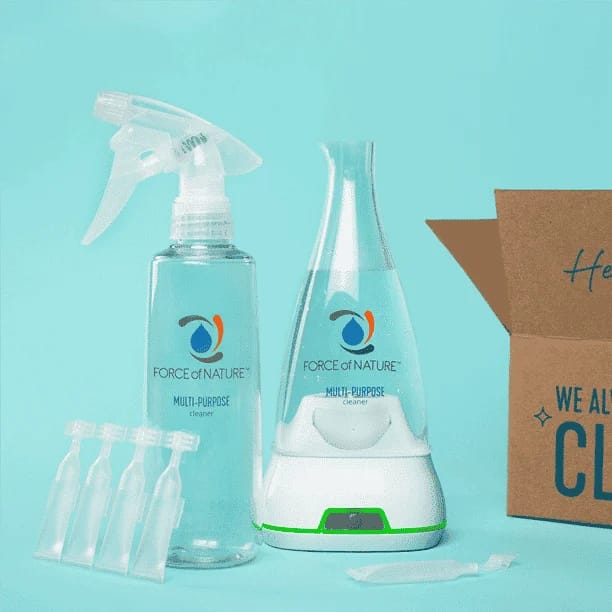
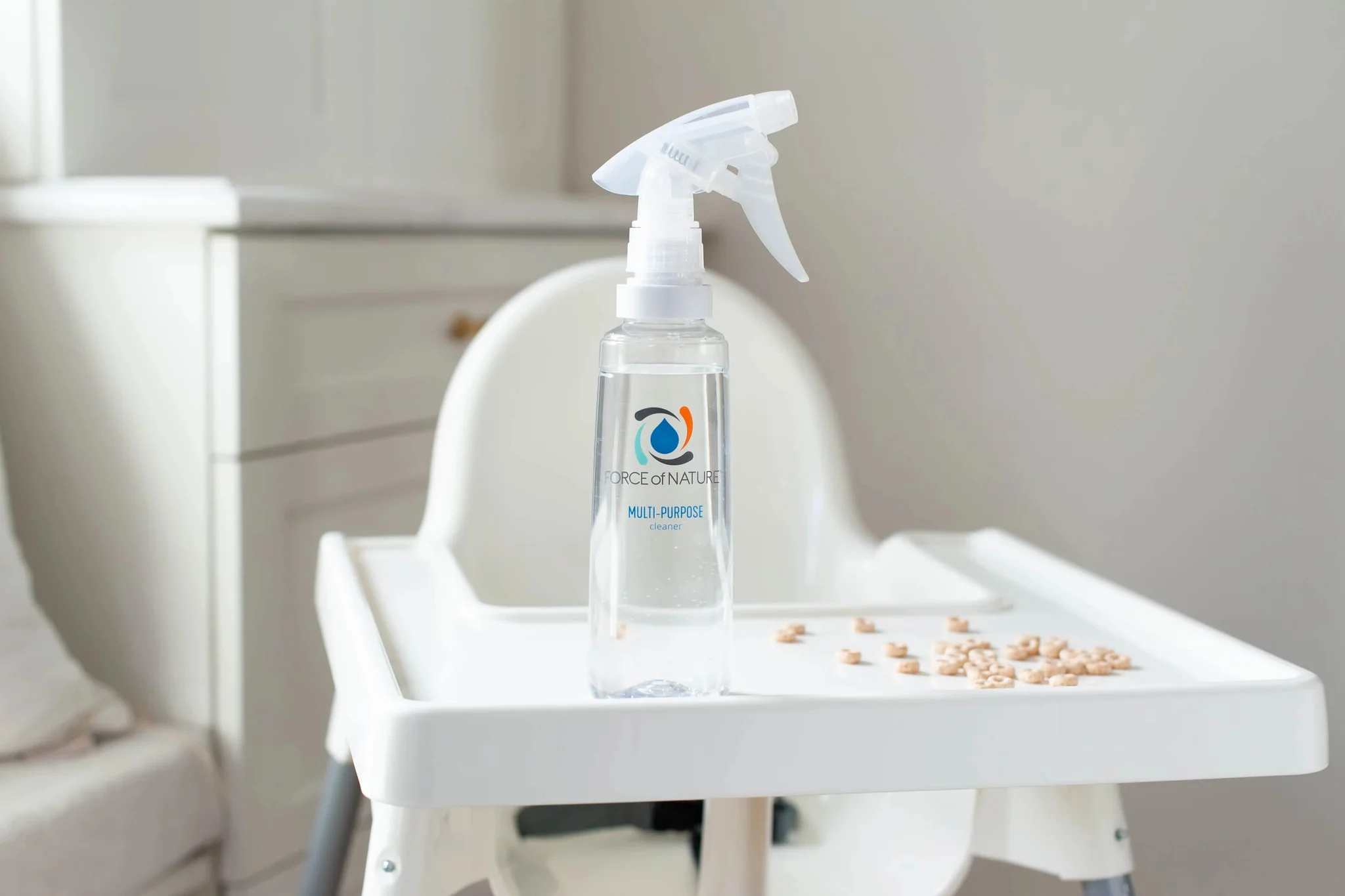
The Force of Nature Cleaner & Disinfectant Appliance Starter Kit makes hypochlorous acid on demand by electrolyzing a capsule of salt, water, and a trace of vinegar. The resulting HOCl solution is EPA List N registered (Reg. No. 92176-1) for use against SARS-CoV-2, influenza, norovirus, and over 300 other pathogens.
HOCl is the same oxidant your immune cells produce to neutralize bacteria and viruses. At a 200 ppm concentration, it disrupts cell membranes and denatures proteins. It has no warning label under EPA classification, leaves no chemical residue, and degrades to saline after contact. The appliance mixes a fresh batch per use, so the active ingredient is always at full concentration.
For mold and mildew specifically: HOCl penetrates surface biofilms and kills fungal cells at the membrane level. On hard non-porous surfaces (glass, sealed tile, countertops, bathroom fixtures), it outperforms bleach at equivalent concentrations without the respiratory hazard or the surface corrosion risk.
2. Branch Basics Concentrate - Best concentrate for whole-home use

Branch Basics Concentrate is an EPA Safer Choice-certified, plant-derived surfactant blend that dilutes to four different product types depending on the ratio: all-purpose cleaner, bathroom cleaner, laundry, or a heavy-duty degreaser. The mold-prevention dilution is the "Bathroom" ratio (2 pumps per 16 oz water), which produces a pH-elevated solution that interferes with the conditions mold needs to colonize a surface.
The formula's ingredients are fully disclosed: coco glucoside, sodium phytate, gluconolactone, and proprietary plant-derived surfactants (disclosed at the category level in the Safer Choice registry). No phosphates, no quats, no synthetic fragrance, no optical brighteners. EPA Safer Choice review screens every ingredient, active and inert, against a database of hazardous chemicals.
Branch Basics works best as a prevention tool rather than a remediation one. For established mold colonies with visible staining, pair it with one of the more targeted removers below. For routine bathroom cleaning and mold-hostile maintenance on tile, glass, and sealed surfaces, this is the lowest-toxicity option in the guide.
3. CleanSmart Daily Surface Cleaner, 23 fl oz (2-Pack) - Best ready-to-use spray

CleanSmart Daily Surface Cleaner is a ready-to-use hypochlorous acid spray registered under EPA List N (Reg. No. 69997-2). Active ingredient: hypochlorous acid at 0.0177%. The other 99.98% is water.
This is the HOCl pick for households that don't want to invest in an appliance. The spray format is straightforward: apply, wait 60 seconds for contact time, and the solution has done its work. No rinsing required. No residue. The formulation is pet-safe, fragrance-free, and works on high-touch surfaces without leaving a film.
The 2-pack format (two 23 oz bottles) makes it practical for bathroom, kitchen, and laundry area use simultaneously. Shelf life is roughly one year from manufacture. For high-frequency bathroom surfaces where mold finds purchase (the silicone bead around a tub, the track on a sliding shower door, the underside of a toilet seat), this is the most convenient maintenance spray in the guide.
4. Concrobium Mold Control, 32 oz Spray - Best for porous surfaces
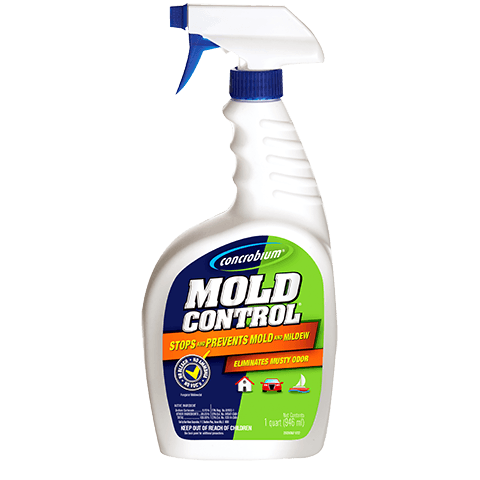
Concrobium Mold Control uses a mechanism the others in this guide don't: physical crystallization. The active formula contains sodium carbonate (0.75%), sodium bicarbonate (0.5%), and trisodium phosphate (0.1%). As the spray dries, these salts crystallize and physically crush mold cells at the root structure, rather than exposing the surface to an oxidizing or surfactant chemical. The mineral barrier left behind raises the pH of the treated surface, preventing mold spores from taking hold.
This physical mechanism is what makes Concrobium the pick for porous materials. HOCl and surfactant formulas work on non-porous hard surfaces. Concrobium's tri-salt polymer is designed to penetrate into the surface substrate. The EPA has registered it under Reg. No. 77257-1, Category IV: "practically non-toxic," the safest tier in the EPA pesticide classification hierarchy.
No bleach, no ammonia, no VOCs, no fragrance. It has the scent of sodium bicarbonate while wet (faint baking-soda smell that dissipates on drying). Use it on drywall, wood framing, concrete, fabric, and grout. It is the only product in this guide with a documented prevention mechanism beyond surface disinfection.
5. CLR Mold & Mildew Clear, 32 fl oz - Best foam for tile and grout
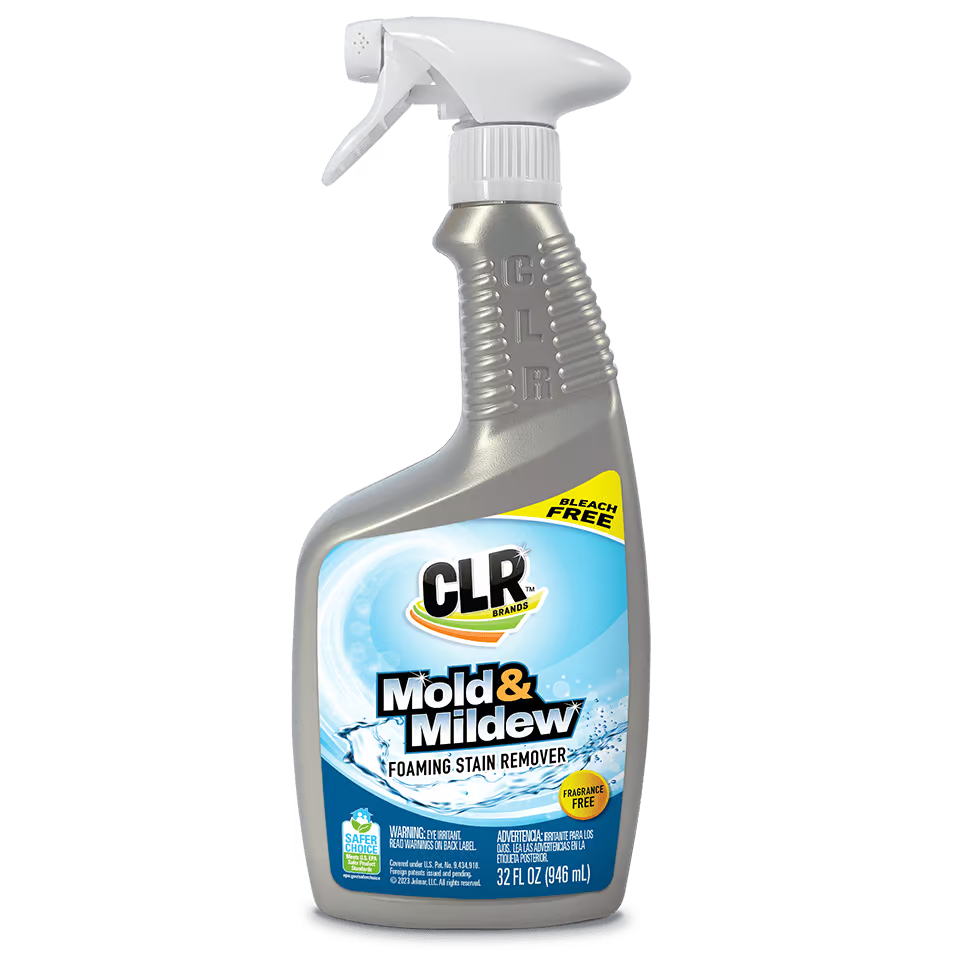
CLR Mold & Mildew Clear is a foaming spray with EPA Safer Choice certification. The formula is bleach-free and fragrance-free. Every ingredient has been screened by the EPA against the Safer Choice standard: no phosphates, no quats, no phthalate fragrance carriers.
The foam format is specifically suited to vertical surfaces: shower walls, tile backsplashes, and grout lines where a liquid would run off before achieving contact time. The foam clings for the dwell time needed to break down staining. CLR's published formula does not rely on abrasives, so it's safe on colored grout, fiberglass, and glass shower enclosures.
At the price point (around $14 for 32 oz), it's the most accessible entry in this guide. It handles what it claims: mold and mildew staining on tile, grout, fiberglass, and sealed stone surfaces. For remediation of existing black mold on porous materials, add Concrobium. For full-surface disinfection, use HOCl. For visible tile staining as part of routine maintenance, CLR is the straightforward choice.
What we passed on
RMR-86 and RMR-141 both use sodium hypochlorite as the active ingredient. They work, but the bleach hazard and chlorine off-gassing are exactly what this guide screens against.
Tilex Mold & Mildew Remover is another bleach-based product with synthetic fragrance added to mask the odor. Two disqualifiers in one label.
Lysol Mold and Mildew Foamer lists benzalkonium chloride as the active ingredient: a quaternary ammonium compound. Quats are persistent biocides with antimicrobial-resistance concerns documented by the EPA, and the product contains additional synthetic fragrance.
Wet & Forget (outdoor formula) markets as a "no-scrub" mold remover. The active ingredient is alkyl dimethyl benzyl ammonium chloride, another quat. Indoor use would contribute to quat accumulation on surfaces.
FAQ
Does bleach actually kill mold?
Bleach kills mold on non-porous hard surfaces but does not penetrate porous materials. On drywall or wood, it can bleach the staining while leaving the mold root structure (hyphae) alive in the substrate. A surface that looks clean after bleach treatment may still have viable mold colonies below. HOCl and tri-salt polymer products address surface and subsurface mold without the respiratory hazard of chlorine gas.
Is hypochlorous acid (HOCl) the same as bleach?
No. Bleach is sodium hypochlorite (NaOCl), an alkaline compound that off-gases chlorine. HOCl is the neutral acid form of the same molecule, produced either by electrolyzing saltwater or through chemical processes. At comparable concentrations, HOCl is 80 to 100 times more effective as a disinfectant than sodium hypochlorite, requires no warning label, and degrades to saline after use. The mechanism is the same oxidative damage to cell membranes; the safety profile is fundamentally different.
Is Concrobium safe to use in a bathroom with poor ventilation?
Yes. Concrobium Mold Control has no VOCs, no chlorine, no ammonia. The EPA Category IV classification ("practically non-toxic") applies to the worst-case exposure scenarios the agency tests. The faint sodium bicarbonate odor dissipates quickly. Ventilation is still worth maintaining as a practice during any cleaning task, but this product doesn't require it the way bleach or solvent-based removers do.
What is the difference between mold and mildew?
Mildew is a specific type of mold that grows flat on surfaces, usually appearing gray or white, and is associated with high humidity in bathrooms, on fabrics, and on plant leaves. Most household cleaning products marketed for "mold and mildew" target both. The distinctions matter less than the underlying condition: moisture control is what prevents recurrence. Fixing the moisture source (a leaking grout seal, an exhaust fan that isn't functioning, inadequate bathroom ventilation) is the only permanent solution. The products in this guide kill and suppress what's present; they don't solve the root cause.
Can I use these products on colored grout without fading it?
CLR Mold & Mildew Clear and Branch Basics are both safe on colored grout according to the brands' product specifications. The HOCl products (Force of Nature, CleanSmart) are pH-neutral and non-abrasive: no fading risk on colored grout. Concrobium is also safe on colored grout. The products to avoid on colored grout are any that rely on sodium hypochlorite, which oxidizes the pigments used in colored grout and causes irreversible bleaching.
Cover image: PattayaPatrol via Wikimedia Commons (CC BY-SA 4.0). Source.