The foam block under your kitchen sink is almost certainly made of polyurethane, a petroleum-derived plastic. As you scrub with it, the foam sheds microplastic particles into your dishwater. The yellow-green sponge is a microplastic emitter sitting next to your food. Studies published in Environmental Science and Technology have traced microplastic contamination in sink drain samples back to sponge abrasion.
The abrasive pad bonded to the underside adds a second layer: most conventional scouring pads are polyester or nylon, both synthetic plastics. A third issue compounds both: a majority of sponges sold with "antibacterial" or "stays fresh" claims carry a triclosan or nanosilver antimicrobial finish. The EPA classifies both as pesticide-class biocides. They don't wash off. They leach slowly into the rinse water that contacts your dishes, cutting boards, and cooking surfaces.
Plant-based alternatives to foam sponges have existed for generations. Cellulose, loofah, and natural palm fiber have been used for kitchen cleaning in Europe and Japan for over a century. The modern barrier is disclosure: many brands label products "natural" or "plant-based" without specifying whether the abrasive is synthetic, how the cellulose and cotton are processed, or whether an antimicrobial treatment is applied.
Everything on this list passed on the following criteria: no polyurethane or synthetic foam; no polyester, nylon, or other plastic abrasive bonded to the scrubbing side; no antimicrobial biocide treatment of any kind; and full material disclosure on the brand's own page.
VerifiedWhat we look for
No synthetic foam. Polyurethane is the standard sponge body material. It is cheap, compressible, and sheds microplastics with each scrubbing pass. Plant-based replacements use compressed cellulose (wood pulp), loofah (the dried fruit of Luffa aegyptiaca), or natural palm fiber. All three absorb water, clean effectively, and compost at end of life.
No plastic abrasive. The scratchy pad bonded to most foam sponges is polyester or nylon. Both shed synthetic fiber. We only included products where the scrubbing surface is also plant-derived: loofah, sisal, or cellulose.
No antimicrobial treatment. "Odor-resistant" and "stays fresh longer" are the most common marketing signals for triclosan or nanosilver treatments. Neither is disclosed on the front of the package. We screened for both and excluded any product that claims odor control via a biocide treatment.
Full material disclosure. We required that every material be named on the brand's own product page or data sheet. "Natural materials" without specifics is not disclosure.
Our picks
1. If You Care Sponge Cloths, 5-Count: Best overall

The If You Care Sponge Cloths use a patented manufacturing process: cellulose and unbleached cotton are blended three-dimensionally with mirabilite, a naturally occurring mineral salt. During production, the mirabilite dissolves and washes away, leaving the cellulose-cotton matrix with an extremely porous, sponge-like structure. No synthetic fibers are added, no dye is applied, and the full composition is disclosed on the product page.
The result absorbs up to 10 times the cloth's weight in water. Machine washable and dishwasher safe. Compostable at end of life. The 5-count pack is the right starting quantity for a household rotating through one cloth per work area.
Materials: 70% cellulose, 30% unbleached cotton (source)
2. Blueland Cloud Cloth, 3-Pack: Best 3-pack

The Blueland Cloud Cloth is 70% cellulose and 30% cotton, the same composition as a classic Swedish dishcloth, packaged three to a set. The name refers to the cloth's dry texture: slightly stiff and porous, softening when wet.
Blueland discloses the fiber breakdown on the product listing, and the cloths are rated safe to boil or run through the dishwasher. Each cloth replaces up to 1500 paper towels across its lifespan. At $15.99 for three cloths, it is the highest per-cloth cost on this list, but Blueland is a brand with strong materials transparency and an established return program for their cleaning product packaging.
Materials: 70% cellulose, 30% cotton
3. Simple Alchemy Co Swedish Dishcloth: Best designed

The Simple Alchemy Co Swedish Dishcloth is the design-forward entry in this category: sustainable wood pulp and organic cotton printed with water-based, non-toxic inks. The brand makes a specific point of disclosing the ink process, which is relevant because dye and ink chemistry is one of the least discussed sources of chemical exposure in reusable household products.
At $7 per individual cloth, these are sold by pattern rather than in a pack. If you are buying for a gift or want a cloth that functions as a design object in the kitchen rather than a utility item, Simple Alchemy Co is the category's clearest option.
Materials: sustainable wood pulp, organic cotton (source)
4. Original Swedish Dishcloth: Best traditional Swedish dishcloth
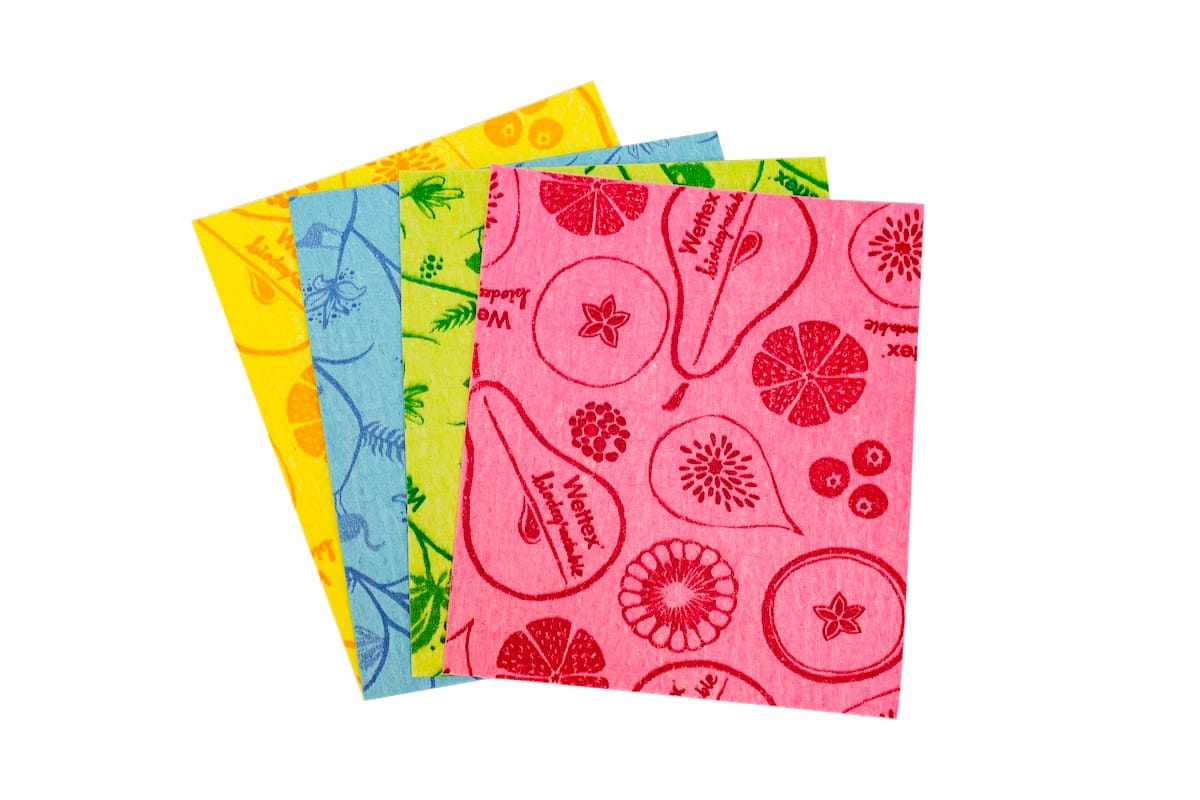
The Wettex Original Swedish Dishcloth is the category originator: the format was developed in Sweden in 1949 and the construction has not changed. Cellulose and cotton are the complete material list, disclosed on the Wettex product page. No synthetic fibers, no antimicrobial biocide treatment, no odor-control chemistry.
Swedish dishcloths absorb up to 17 times their weight in liquid, air-dry between uses, and last through hundreds of machine washes. Machine washable and dishwasher safe on the top rack. The 10-pack brings the per-cloth cost to about $2.50, the lowest on this list.
Materials: cellulose and cotton (source)
5. Public Goods Scrubber Sponge, 12-Pack: Best direct foam swap
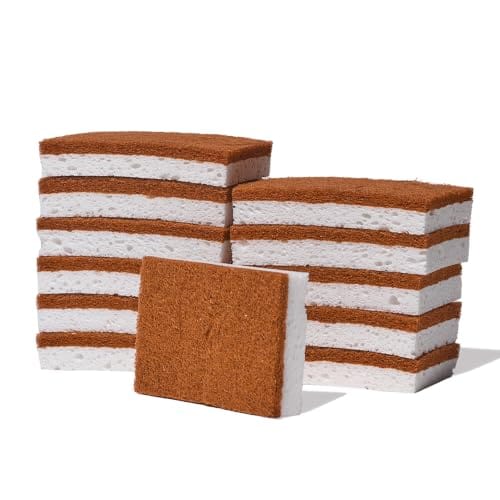
The Public Goods Scrubber Sponge is the most direct format swap for a conventional foam sponge: same rectangular shape, same use profile, no polyurethane. The wiping face is plant-based cellulose; the scrubbing side is coconut fiber rather than nylon or polyester. Both materials are named on the product page.
Unlike most mainstream brands that add triclosan as an antimicrobial treatment, Public Goods omits it entirely. No dye, no biocide finish. At $17.95 for 12, the per-sponge cost is competitive with conventional foam. Households transitioning from a foam sponge will find the format familiar enough to adopt without friction.
Materials: plant-based cellulose (wiping face), coconut fiber scrubbing abrasive (source)
6. Full Circle Plant-Based Cellulose Sponges, 8-Pack: Best value

The Full Circle Plant-Based Cellulose Sponges cover the core requirement: 100% plant-derived cellulose, no microplastic-shedding foam, no synthetic abrasive. Full Circle is one of the few brands that calls out "no microplastics" explicitly on the label, which is notable because the category currently has no federal labeling requirement for sponge microplastic disclosure.
At $4.49 for eight sponges, the per-unit cost is the lowest on this list. Plastic-free packaging. Safe for non-stick cookware.
Materials: 100% plant-based cellulose
7. Full Circle Plant-Based Loofah Sponges, 2-Pack: Best plain loofah

The Full Circle Plant-Based Loofah Sponges are straightforward: 100% plant-derived loofah, no synthetic foam backing, no microplastics, plastic-free packaging. Loofah is the dried fibrous interior of a Luffa aegyptiaca gourd. It composts readily and is one of the most aggressively biodegradable kitchen cleaning materials available.
Two sponges at $4.49 makes this the most affordable loofah option on the list. The natural abrasive texture of loofah removes dried food from cookware, cutting boards, and produce without scratching glass or non-stick surfaces.
Materials: 100% plant-based loofah
8. Vove Scrub Sponges, 8-Pack: Best hybrid
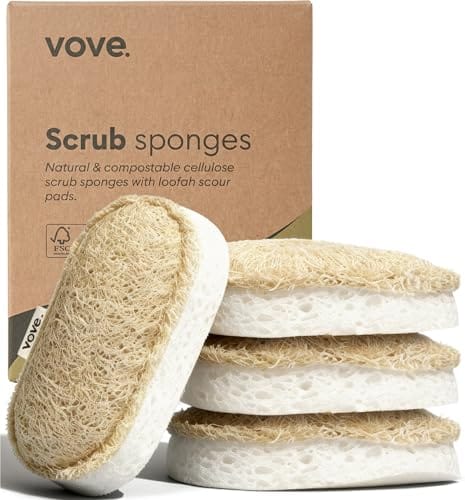
The Vove Scrub Sponges pair natural cellulose on the soft face with natural loofah on the scrubbing side, sewn together with cotton thread rather than synthetic adhesive. No synthetic foam, no plastic, no antimicrobial treatment. Both cellulose and loofah compost at end of life.
The construction detail matters: stitched cotton binding rather than glue means there is no undisclosed bonding chemistry. For households that want a soft side and a scrubbing side without any plastic in the cleaning stack, this is a straightforward choice. The 8-pack at $19.06 works out to about $2.38 per sponge.
Materials: natural cellulose (soft side), loofah (scrubbing side), cotton stitching (source)
9. Kamenoko Tawashi (Medium): Best for cast iron and produce
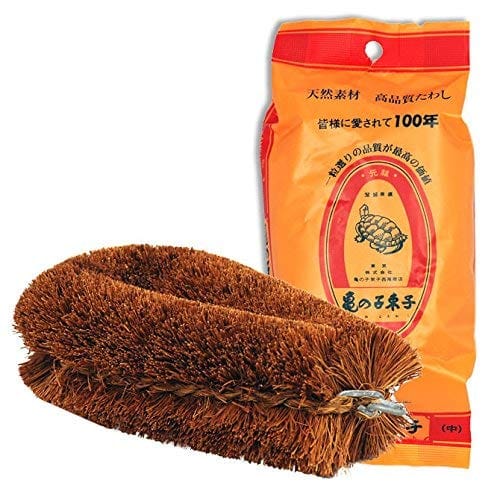
The Kamenoko Tawashi is in a different category from everything else on this list. It is a brush, not a sponge, made from natural palm fiber by a Japanese company with more than 100 years of continuous production. No synthetic fibers, no dye, no adhesives. The construction is simple enough that the complete material content is visible: palm fiber, twisted into a brush form.
Tawashi brushes clean cast iron, colanders, and root vegetables without soap and without scratching. The palm fiber is stiff enough to remove stuck food but soft enough not to damage seasoning or enameling. Fully compostable at end of life. The medium size is the most versatile for general kitchen use.
Materials: natural palm fiber
Dish Brushes
A dish brush reaches places a flat cloth cannot: the bottom of a tall glass, the interior of a mug, the rim of a pot. It also keeps your hand further from the dirty surface than a sponge does. The format belongs in most non-toxic cleaning stacks as a complement to dishcloths rather than a replacement.
1. Casa Agave Dish Brush: Best plant-fiber brush

The Casa Agave Dish Brush uses Moso bamboo for the handle, with medium-weight agave fiber bristles. Both are disclosed on the No Tox Life product page. No plastic handle, no synthetic bristles, no surface treatment.
Bamboo handles are dense and slow to absorb water, which reduces handle swelling and cracking over time. Agave fiber bristle has a medium stiffness: effective for removing food residue from plates, mugs, and most cookware without scratching glass or enameled surfaces. Sourced and made in Mexico from plants grown without irrigation or pesticides, per the brand materials documentation.
Materials: Moso bamboo handle, agave fiber bristles (source)
2. Iris Hantverk Everyday Hard Dish Brush: Best heritage brush

The Iris Hantverk Everyday Hard Dish Brush uses an untreated beechwood handle and hard tampico agave fiber bristles. Made in Sweden; the head is replaceable when bristles wear, extending the handle indefinitely.
Materials: untreated beechwood handle, tampico agave fiber bristles (source)
3. Buerstenhaus Redecker Coconut Fiber Dish Brush: Best German handcraft

The Buerstenhaus Redecker Coconut Fiber Dish Brush is handmade in Germany with untreated beechwood and coconut fiber bristles. Coconut fiber sits between tampico and sisal in stiffness: firm enough for stuck food, gentle enough on glass and enamel.
Materials: untreated beechwood handle, coconut fiber bristles (source)
4. Andree Jardin Handled Dish Brush: Best French craft

The Andree Jardin Handled Dish Brush is made in Nantes, France using raw beechwood and tampico agave fiber bristles. The head is replaceable. Andree Jardin has made brushes in France since 1947.
Materials: raw beechwood handle, tampico agave fiber bristles (source)
5. EcoCoconut Kitchen Cleaning Brush: Best FSC-certified pick

The EcoCoconut Kitchen Cleaning Brush uses FSC-certified rubber tree wood that has completed its latex-producing lifespan and coconut husk bristles bound with recyclable steel wire. Made in Sri Lanka.
Materials: FSC-certified rubber tree wood handle, coconut husk bristles, recyclable steel binding (source)
Copper Scrubbers
Copper mesh is the material for heavy-duty scrubbing jobs where loofah and cellulose are not aggressive enough: baked-on residue, mineral deposits, and grease buildup on stainless steel and enameled cast iron. Copper does not rust where steel wool does, and it carries no added antimicrobial biocide treatment.
Do not use copper scrubbers on bare aluminum cookware; copper can leave surface marks on bare aluminum. Stainless, enameled cast iron, ceramic, and glass are all fine.
1. Copper Scrubber, 2-Pack: Best value copper scrubber
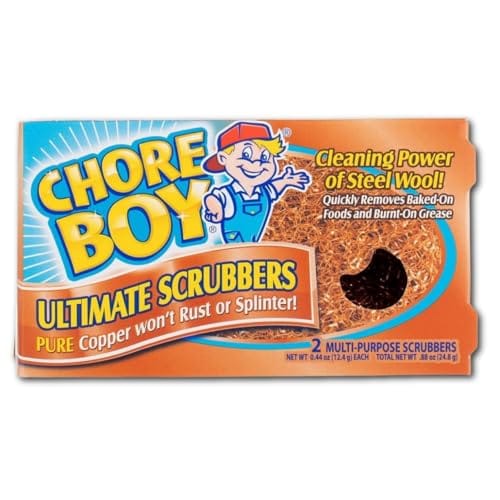
The Chore Boy Copper Scrubber is pure copper mesh with no steel content and no added coating. The 2-pack format has been sold at hardware stores since 1921, and the material specification has not changed. Copper is naturally antimicrobially active without any applied biocide treatment.
Steel wool rusts where copper does not. Rust leaves orange staining on enameled or light-colored cookware; copper does not stain in the same way. The loose mesh conforms to cookware curves and handles baked-on residue that plant-fiber scrubbers cannot remove.
Materials: pure copper mesh
2. Jumbo Copper Mesh Scourer, 2-Pack: Best jumbo format
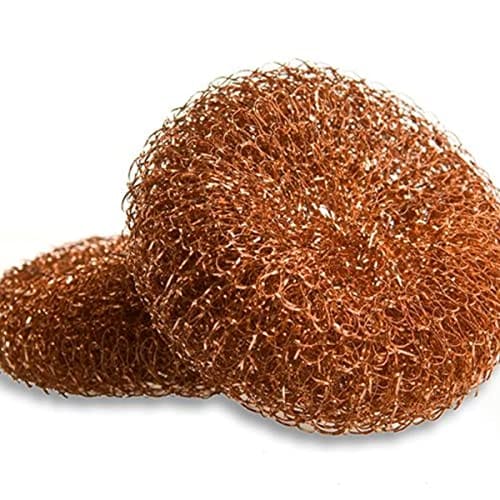
The Lola Jumbo Copper Mesh Scourer is the same material as the Chore Boy above in a larger pad format. The jumbo size covers more surface area in a single pass, which matters on sheet pans, large skillets, and roasting pans where a standard-size pad requires multiple repositions.
Single material: copper mesh. Made in the USA per the Lola product page. No steel components, no coating, no biocide treatment. At $9.88 for two jumbo pads, the per-pad cost is comparable to the Chore Boy with the size advantage as the differentiator.
Materials: copper mesh, made in USA (source)
What we passed on
U-Konserve Sponge Cloths claim LFGB food-contact certification, but we were not able to locate the specific SKU in the certification registry to confirm the claim against the issuer's records. We will revisit when documentation is available.
Conventional "eco" sponges with synthetic abrasive pads. A number of well-marketed plant-based sponge products use cellulose on one face and a thin polyester or nylon scouring pad on the other. This does not pass the no-synthetic-abrasive requirement. Products in this category include some offerings from Grove Collaborative and several Amazon marketplace entrants with "plant-based" front-label claims that omit the abrasive material from the ingredient list.
Antimicrobial-treated loofah. Several brands sell loofah sponges with silver-ion "odor control" finishes. The silver-ion treatment is the disqualifying element: it is a biocide applied to a product intended for food-contact surfaces, and it is not disclosed at the point of sale. We excluded all of them.
Etee Loofie Scrubbers are a loofah and cellulose blend with a cotton wrap. The format is close to the Vove Scrub Sponges and the Full Circle Loofah Sponge already on this list; a third loofah-cellulose entry does not add a meaningfully different option for most readers.
Care notes
Cellulose cloths last longer than foam sponges but require active maintenance. Run them through the dishwasher or washing machine every few days. They can be boiled for 2 to 3 minutes if you want to sanitize without chemicals. When a cloth begins to smell between cleanings, it has reached the end of its service life. Compost it.
Loofah and tawashi dry faster than foam sponges because they are open-structure rather than closed-cell. Rinse thoroughly after each use and store in a position that allows airflow. Both materials are more naturally mold-resistant than foam for this reason.
Dish brushes with natural wood handles benefit from hanging or propping upright to dry after use rather than resting flat in standing water, which accelerates handle splitting.
Copper scrubbers can be rinsed and reused until they lose structural integrity. Store dry. Do not soak in water between uses.
Cover image: Hannah Grapp via Pexels (Pexels License). Source.