
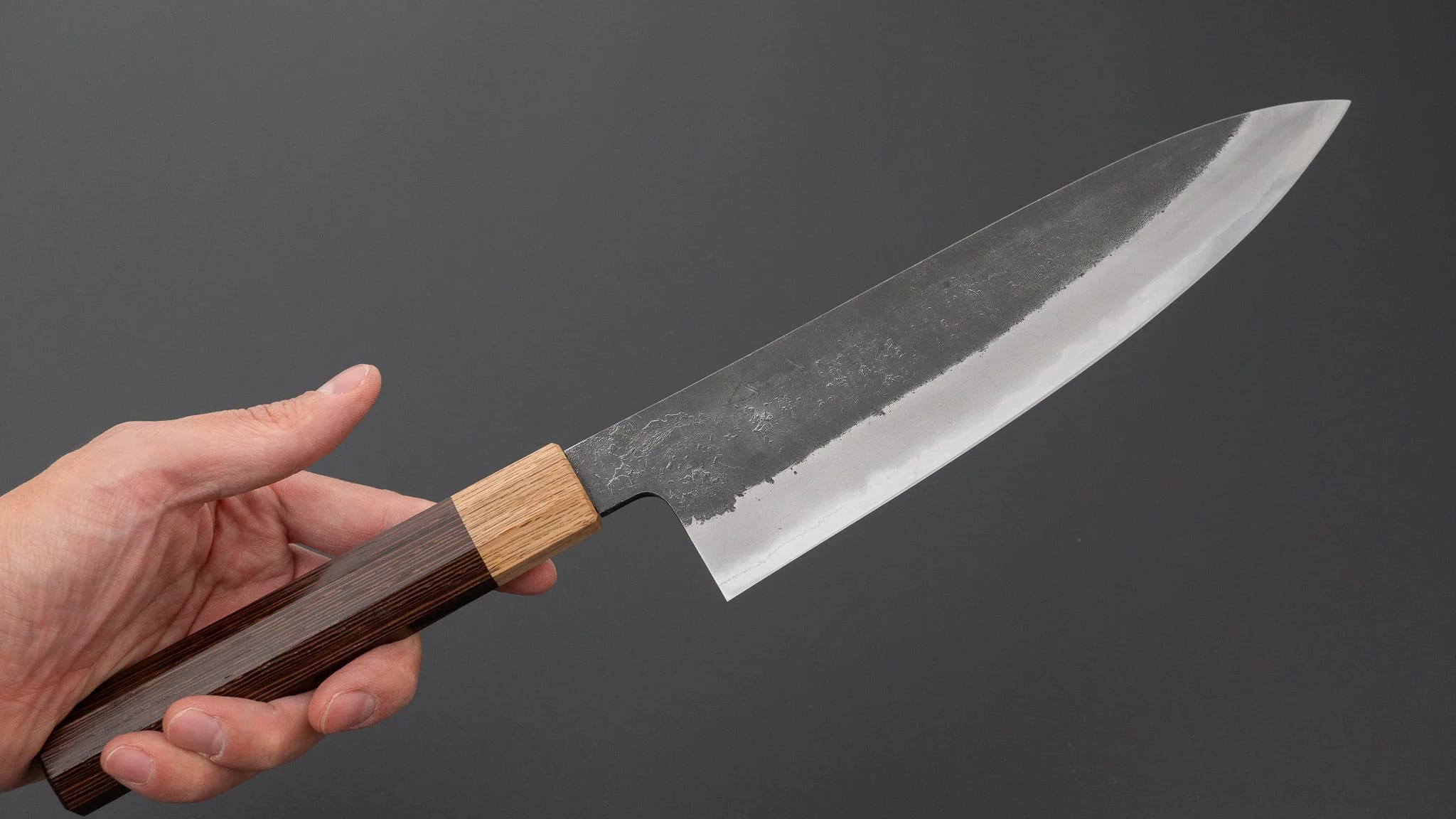
Most chef's knife guides treat "non-toxic" as a PTFE coating question. For chef's knives, the synthetic material concern starts earlier: at the handle. Plastic, G-10, pakkawood, and acrylic handles are ubiquitous in the mainstream market, and none of them discloses what is actually in contact with your grip and occasionally your food preparation surface. This guide ranks knives that skip synthetic handles entirely: natural wood (walnut, ironwood, rosewood, oak, beech, maple, olive, cherry, ash) or all-stainless construction. We also screened blades for applied coatings. Every knife here has a disclosed-alloy blade whose surface is the steel itself, not a coating on top of it.
The 16 picks below were ranked from the vetted published universe of the kitchen-knives category. No products were created for this guide; every pick was already cataloged, hero-imaged, and linked before this article went to draft.
What we look for
Handle material, spelled out. This is the single most differentiating screen. The Sani-Safe handle on a Dexter Russell is food-grade polypropylene; the G-10 composite on a Benchmade culinary knife is fiberglass and epoxy resin; Cutco's handle is a thermoplastic. None discloses the exact formulation because none needs to: synthetic handles are classified as incidental food-contact materials and regulated only on extractables, not on composition transparency. We require full disclosure of handle composition before a knife can be listed. That means the handle material is named (walnut, stainless, oak, ironwood) rather than described as "premium polymer" or "high-performance composite."
Steel identity, not just grade. "High-carbon stainless" is a spectrum. A knife that says only "Japanese steel" or "German steel" with no alloy designation falls on the same side of the screen as one with "proprietary blend" in its specs: the composition is undisclosed. Every knife here names the alloy: Shirogami White #2, Aogami Super, SG2/R2, SRS-13, VG-10, Gin-san/Silver #2, Cromova 18, X50CrMoV15, or an equivalent with a citation to the brand's spec page.
No applied blade coatings. DLC, titanium nitride, or "ceramic" coatings appear on some knives marketed as non-stick or anti-corrosion. Each adds material complexity rarely disclosed in detail. The finishes on knives in this guide are either the polished or satin-ground steel itself, a kurouchi (forge-scale) finish, which is the steel's own surface oxide left from forging and not an applied material, or a tsuchime (hammered) texture, which reduces food adhesion through mechanical surface relief rather than any coating.
Certifications are rare in this category. No NSF or FDA food-contact certification applies to blades the way it does to plastics. What matters here is that the brand publishes a spec page, TDS, or sourcing disclosure naming the steel alloy and handle material, and that the claim traces to a manufacturer or testing lab rather than marketing copy alone.
Price and accessibility. The vetted universe runs from under $50 (Opinel Les Forges) to around $70 (Imarku entry tier) to over $400 (Takeshi Saji artisan). A useful guide spans that range, which is why we included 16 picks across all three price tiers.
Our picks
1. Tokushu Knife Takeshi Saji SRS-13 Gyuto 180mm Ironwood Yo Handle - Best overall

The Tokushu Knife Takeshi Saji SRS-13 Gyuto is named-smith work from Echizen, Japan. Takeshi Saji is an individual blacksmith: Tokushu Knife publishes his name and location on the product page, not a factory code. SRS-13 is a high-speed powder stainless with cobalt (Co) and vanadium (V) additions. It outperforms VG-10 in edge retention while maintaining full corrosion resistance. HRC is confirmed at 63+. The handle is desert ironwood (Yo-style Western handle) with a stainless bolster, finished in natural oil. Desert ironwood is one of the densest and most moisture-stable natural handle materials available. No synthetic material appears anywhere in the construction. The blade's tsuchime hammered finish reduces food drag through texture, not coating.
At 180mm this is slightly shorter than a standard 210mm gyuto, which suits precision work and tighter cutting boards. Tokushu Knife sources directly from named Japanese smiths and discloses supplier relationships in a way most knife brands do not. This is the knife for a buyer who wants no compromises on materials, provenance, or performance.
2. Jikko Knives NEVER STAIN2 Gyuto (Chef Knife) SG2 Stainless Steel - Best all-stainless

The Jikko Knives NEVER STAIN2 SG2 Gyuto resolves a real tension in this category: SG2 (R2) powder stainless achieves 63+ HRC, delivering sharpness and edge retention approaching Shirogami carbon steel, while the seamlessly integrated stainless construction requires zero patina management. JIKKO has been making knives in Osaka since 1901. The handle is machined and polished as one continuous piece with the blade: no wood, no synthetic polymer, no handle-blade junction, nothing to leach, swell, or absorb kitchen odors. "NEVER STAIN2" is marketing copy, but the material claim is accurate. SG2 is full stainless with cobalt and tungsten additions that prevent the surface oxidation reactive carbon blades are prone to.
This is the pick for cooks who want Japanese cutting performance without the reactive-carbon maintenance regimen, or for professional environments where quick-dry protocols are standard.
3. Hitohira Hinode Nashiji White #2 Stainless Clad Gyuto 210mm Wenge Handle - Sharpest edge

The Hitohira Hinode Nashiji White #2 Gyuto is the pick for the cook who wants the sharpest possible edge and will manage the patina that comes with it. Shirogami White #2 (Shiro-2) is the most chemically pure blade steel Hitachi Metals produces: minimal alloying means the edge forms at a near-molecular level, producing sharpness that powder steels approach but rarely match on a freshly-sharpened stone. Stainless soft-iron cladding protects the blade body while the reactive core does its work at the cutting edge. The Nashiji (pear-skin) hammered texture reduces food adhesion without any applied finish. The handle is wenge with an oak ferrule, octagonal, and no resin or synthetic filler disclosed anywhere in the construction.
The tradeoff is real: White #2 forms a patina quickly and requires immediate drying after use. It is the most demanding knife in this ranking to maintain, and also the most rewarding to sharpen.
4. Hitohira Futana S3 Nashiji Gyuto 210mm Cherry Wood Handle - Best low-maintenance Japanese

The Hitohira Futana S3 Nashiji Gyuto occupies a specific niche: Yasuki Silver #3 (Ginsan) stainless delivers a sharpening experience nearly identical to carbon steel (fast to sharpen, takes a fine edge) without requiring the reactive-carbon care White #2 demands. Forged in Tosa-Kochi, Japan's traditional knife-making prefecture, by a named blacksmith. Handle is cherry wood with ebony ferrule, octagonal, no synthetic materials. Stainless soft-iron cladding, Nashiji texture.
Hitohira's second pick here because Silver #3 and White #2 represent a genuine choice a buyer makes: maximum sharpness with reactive-carbon care versus stainless performance with no patina obligation. They are not the same knife, and the right answer depends on how much you want to manage your blade.
5. Gude Alpha Olive Series Forged Double Bolster Chef's Knife 8.3-in, Olivewood Handle - Best German forged

The Gude Alpha Olive Chef's Knife is the German answer to this guide's thesis. Forged from a single continuous bar of X50CrMoV15 high-carbon stainless in Solingen: blade and double bolsters are one piece, no welds, no separate components. Olivewood handle scales are attached with stainless rivets and sealed with food-safe mineral oil per the brand's disclosed finishing process. No synthetic binding agents. Gude has been forging knives in Solingen since 1910 and discloses alloy, forging location, and handle treatment.
The German geometry differs from the Japanese gyuto picks elsewhere in this ranking: thicker spine, flat-to-convex profile, heavier weight, suited to push-cutting and full-bolster rocking. HRC is 57-58, intentionally softer than the Japanese entries for a different usage and resharpening profile. This is the pick if you want European forged tradition with fully natural materials.
6. Sakai Takayuki Takayuki AS Hammered Gyuto 210mm Octagonal Maple Handle - Best Aogami Super value
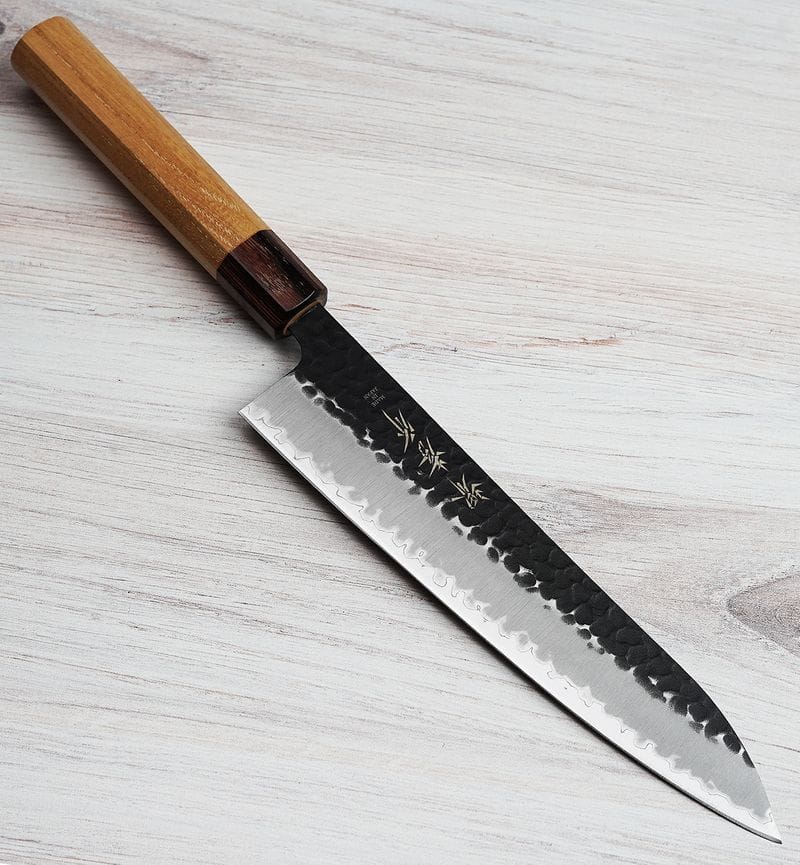
The Sakai Takayuki AS Hammered Gyuto delivers Aogami Super (AS) steel at a mid-tier price. Aogami Super adds tungsten and vanadium to the standard blue-steel base, producing measurably better wear resistance and edge retention than most gyutos at this price point. The San Mai construction wraps the reactive carbon core in stainless cladding. Made in Sakai, Japan's historic knife district. Octagonal maple Wa handle, no bolster, no synthetic material. Kurouchi hammered finish on the upper half leaves forge character intact.
The tradeoff is identical to White #2: the exposed carbon cutting edge will patina. At the price-to-steel ratio here, this is the hardest knife in the ranking to argue against for a buyer with some knife experience who understands reactive-carbon maintenance.
7. Musashi Hamono Gyuto VG-10 Copper Damascus Olive Handle 210mm (8.2") - Most visually distinctive

The Musashi Hamono Gyuto VG-10 Copper Damascus is visually unlike anything else in this category: alternating VG-10 stainless and copper layers produce a Damascus whose composition is literally readable in the pattern. The cladding chemistry is not hidden behind a uniform finish. VG-10 core is fully stainless at 60-61 HRC, no reactive care required. Octagonal olive wood Wa handle, no synthetic materials. Made by Musashi Hamono in Japan.
Copper Damascus is not purely aesthetic. Copper softens the stainless cladding layers, which affects how the blade flexes under load and how the pattern etches with use. It is a design choice with disclosed material tradeoffs, not a purely decorative finish. For a buyer who wants both material transparency and a blade pattern that shows its own construction, this is the pick.
8. Master Shin's Anvil #60 Kitchen Knife, Small - Best artisan provenance

The Master Shin's Anvil #60 Kitchen Knife is a different category of object from the other knives here. Shin In-Young is one of the last traditional blacksmiths working in the Anseong daejanggan style in South Korea. The blade is hand-forged from recycled Korean railroad track steel: a high-carbon alloy (approximately 0.7-0.8% carbon) whose composition is determined by its standardized industrial source rather than a named mill product, and which Ameico documents on the product page. The handle is chestnut or oak, shade-dried with no resin treatment. Distributed in the US by Ameico, which has worked with the Shin family workshop for decades.
This is a working knife, not a collector piece, but it is an irreplaceable artifact of a traditional craft. Every material is traceable, every process is disclosed, and there is no synthetic anything. The "Small" #60 designation covers a range of kitchen tasks: it is a utility blade, not a full 210mm gyuto, but it cuts and the provenance is unmatched in this ranking.
9. Global Knives Global 8" Classic Chef's Knife (G-2) - Best accessible all-stainless

The Global G-2 Chef's Knife has been available for decades because the materials story is clean and the knife works. Cromova 18, a chromium-molybdenum-vanadium stainless alloy developed specifically for Global, is disclosed and documented. The all-steel construction (hollow handle filled with sand for balance, dimple grip, seamlessly integrated with the blade) means no handle-blade junction to harbor food, no wood to swell, no polymer to wonder about. Made in Japan at 56-58 HRC. Widely stocked at kitchen stores and direct from Global.
The hollow handle is polarizing: it feels different from a traditional Western knife, and some cooks find the all-steel construction slippery in a wet hand. But the material disclosure is complete and the no-maintenance profile is genuine.
10. Hikari Knife Chef Knife Carbon Stainless Steel Rosewood Handle - Best kurouchi stainless

The Hikari Knife Gin-san Rosewood Chef Knife uses Gin-san (Silver Steel #2, also known as Hitachi Yasugi Silver Paper Steel): a high-purity high-carbon stainless that provides the sharpening responsiveness of reactive carbon while resisting corrosion. The kurouchi forge-scale finish on the upper spine is left intact, showing the blade's forge character. Octagonal rosewood Wa handle, no synthetic materials.
This is a cleaner option than many "high-carbon stainless" claims in the mass-market segment, where the phrase is marketing shorthand for an unnamed alloy. Gin-san is a named, traceable material with documented performance characteristics. The kurouchi finish brings the visual appeal of a carbon-steel blade to a steel that does not require the same reactive care.
11. Jikko Knives Gyuto Chef Knife VG10 Stainless Steel - Best Jikko entry

The Jikko VG10 Gyuto is the more accessible entry to JIKKO's Osaka lineage. VG-10 stainless with Damascus cladding, oak handle (no bolster, no synthetic elements), at a lower price than the NEVER STAIN2. The choice between them is real: VG-10 is a well-documented alloy at a lower hardness tier than SG2, and the oak handle with tang introduces a wood-steel junction that the all-stainless model eliminates. Both are defensible choices from the same historic maker (founded 1901).
This is the right pick if you want a JIKKO knife with a traditional wood handle rather than the seamless stainless construction, or if the NEVER STAIN2 price is a constraint.
12. Opinel Les Forges 1890 8 inch Chef Knife - Best value French forged

The Opinel Les Forges 1890 Chef Knife is the most value-dense option in this guide. Hot-forged at 1200 degrees Celsius from a single piece of X50CrMoV15 high-carbon stainless, not stamped, at 57-59 HRC. Thermostabilized beech handle (heat-treated for dimensional stability, no synthetic treatment), full tang, no synthetic materials. Made at Opinel's facility in the Savoie region of France. The 15-degree double bevel is conventional and forgiving for home cooks. Sold through Opinel's US storefront and at East Fork.
For someone buying their first serious chef's knife, this is the correct answer. A fully-forged blade at this price from a maker with over a century of material transparency is exactly what this guide was built to surface.
13. UZCO Knives Gyuto Walnut Edition (Japanese Damascus) - Best small artisan

The UZCO Knives Gyuto Walnut Edition is from a small knife brand (founded 2021) that publishes its construction explicitly: 67-layer stainless Damascus over a VG-10 core, HRC 60, walnut and cherry wood handle finished in food-grade mineral oil only. No synthetic material in the build. Available through the brand's storefront and Faire marketplace.
Small brands that disclose at this level are the kind of operation this guide exists to surface. The 67-layer Damascus is not purely aesthetic; the published layer count and core alloy give a buyer something to verify against the brand's spec page, which is the point.
14. Bravohandicrafts Santoku Chef Knife Handmade High Carbon Steel - Best handmade entry
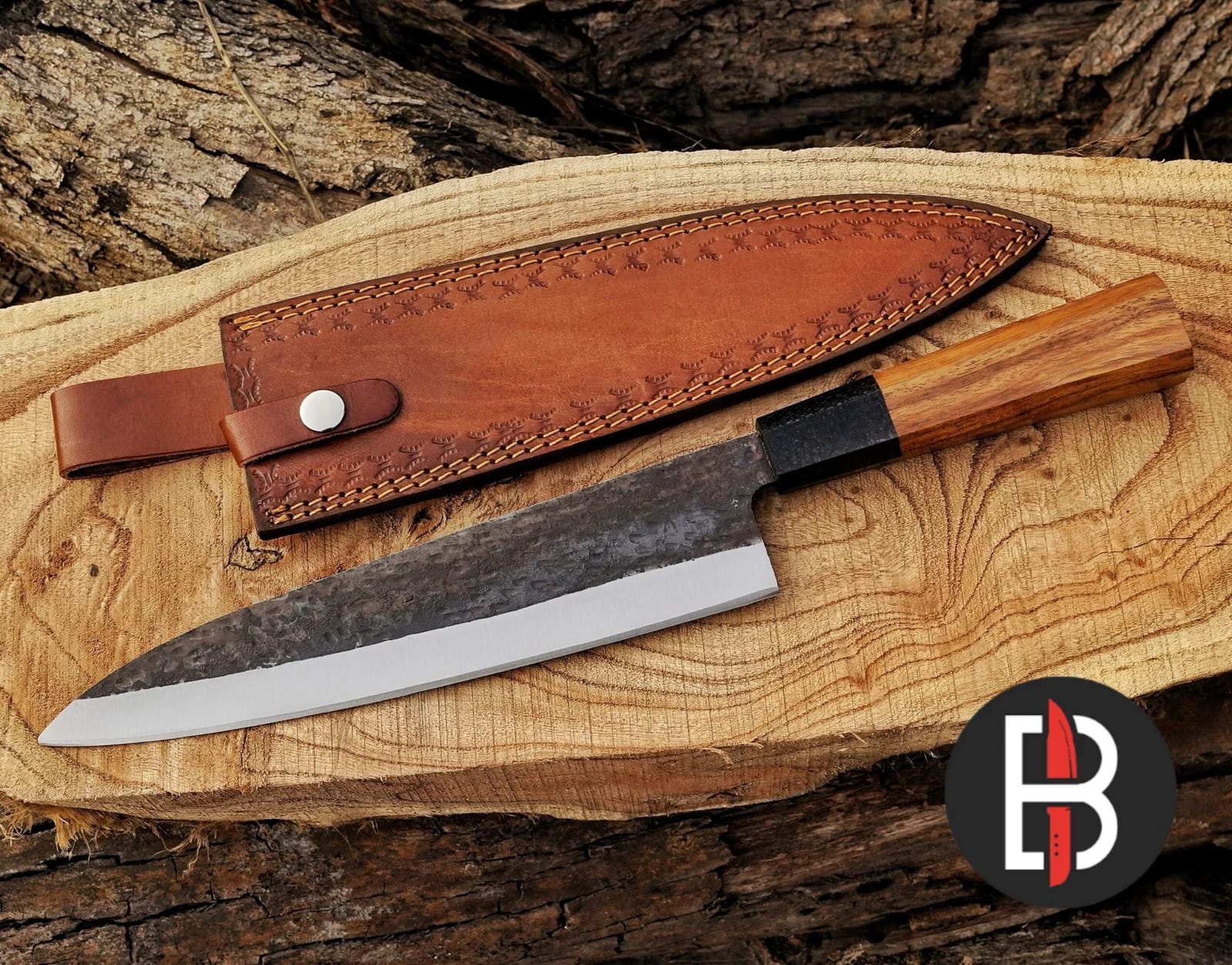
The Bravohandicrafts Santoku Handmade High Carbon Steel is a santoku-style blade (flatter profile, efficient for push-cutting vegetables) with a hammered high-carbon steel finish and genuine rosewood handle. No synthetic materials in the construction. An accessible entry point for someone who wants a handmade natural-handle knife without paying artisan-tier prices.
The blade is disclosed as high-carbon steel without a named grade. At this price, that is the honest answer: the manufacturing process is handmade, the materials are natural, and the metallurgical provenance is not what you are paying for here.
15. Imarku 8-Inch Japanese Chef Knife with One-Piece Stainless Steel Handle - Best budget all-stainless

The Imarku Gintama G01 One-Piece Stainless Chef Knife eliminates the blade-handle junction entirely: machined and polished from a continuous piece of high-carbon stainless with no rivets, no adhesives, and no wood or synthetic handle material to consider. At this price, that is a meaningful construction choice. No applied coating on the blade. Full stainless throughout.
For a cook who wants the cleanest maintenance profile (nothing to oil, nothing to swell, no junction to trap food) at an accessible price, this is the pick. The alloy is not named with the same specificity as the higher-ranked stainless options, but it passes every material screen in this guide.
16. Imarku 8.4" Japanese Chef Knife, Ultra Sharp High Carbon Stainless Steel, Ash Wood Handle - Best budget wood handle

The Imarku SK03 Ash Wood Handle Chef Knife is the budget-accessible wood-handle option. Hand-forged and oil-quenched to 57 HRC, 13-degree edge per side (notably acute for this price tier), carbonized ash wood handle (thermally treated for moisture resistance), triple-riveted, no synthetic coating on blade or handle. At the $ tier, this fills the same role the Opinel Les Forges fills at a slightly higher price: a forged, natural-handle chef's knife with no synthetic materials and a price accessible to any budget. The 8.4-inch length is a touch longer than most entries here.
What we passed on
Cutco falls at the first screen: the handle is a thermoplastic, never named on the product page. Benchmade's culinary line uses G-10, a fiberglass-epoxy resin composite. Durable, yes; disclosed, no. Not a natural material by any reading. Dexter Russell Sani-Safe explicitly names polypropylene in its commercial documentation. Great Jones uses a Lamson-made acrylic handle; Lamson names it, Great Jones does not. Hedley & Bennett's culinary knives have Western-style double-riveted synthetic polymer handles without naming the polymer.
We also reviewed the Made In 8 Inch Chef Knife (X50CrMoV15 NITRO+, forged in Thiers, France, ABT asymmetric edge). The olive wood version passes every screen here. The problem is that the product is sold as "available with black ABS or olive wood handle" and the product listing does not steer buyers to the natural-material configuration. A guide about knives with no plastic handles cannot cleanly link to a product whose listing includes a plastic-handle option without a variant-specific URL.
Care tips
Carbon steel blades (White #2, Aogami Super) need one thing: dry storage. Rinse immediately after use, dry thoroughly, and oil the blade before extended storage. The patina that forms is iron oxide from the steel reacting with food acids and moisture. It is stable and protective, not harmful, but you need to manage it rather than ignore it.
Stainless blades (SG2, SRS-13, Silver #3, Cromova 18, VG-10, X50CrMoV15) are more forgiving but benefit from the same discipline. "Stainless" means stain-resistant, not stain-proof: citrus and chloride exposure (dishwashers) will mark them over time. Hand-wash and dry.
Wood handles (walnut, rosewood, olive, cherry, wenge, maple, ash) benefit from a light coating of food-grade mineral oil or beeswax a few times a year. Avoid linseed and vegetable oils, which go rancid inside the wood. The handles in this guide are natural and were sealed with mineral oil or bare-treated at the factory; the same oil maintains them at home.
FAQ
Is high-carbon stainless the same as high-carbon steel?
No. "High-carbon steel" is reactive carbon steel (Shirogami, Aogami, 1095) that will rust if not dried after use. "High-carbon stainless" is an alloy with enough chromium (typically 13% or more) to resist corrosion while maintaining higher carbon than standard stainless. VG-10, SG2, X50CrMoV15, and Cromova 18 are all high-carbon stainless. Shirogami White #2 and Aogami Super are reactive carbon steel, not stainless. The distinction matters for maintenance: one requires patina management, the other does not.
Do knife blade coatings contain PFAS?
PTFE-coated knife blades exist but are uncommon. DLC (diamond-like carbon) and titanium nitride coatings appear on some budget and tactical knives. Neither is PFAS per se, but both add coating chemistry that is rarely fully disclosed. Every knife in this guide has an uncoated blade: bare polished steel, kurouchi forge scale, or tsuchime hammered texture.
What makes a knife handle "synthetic" under your screening?
Any polymer that is not a natural material: G-10 (fiberglass-epoxy), Micarta (linen or canvas in resin), pakkawood (wood-resin composite), acrylic, polypropylene, ABS, Zytel, and nylon are all synthetic by this definition. Thermostabilized wood (beech wood heat-treated for dimensional stability, as in the Opinel Les Forges) is still natural wood with a thermal treatment and no polymer added.
Are Japanese knives harder to maintain than Western knives?
Carbon steel Japanese knives (White #2, Aogami) need drying and occasional blade oil. Stainless Japanese knives (SG2, Silver #3, VG-10) do not. The sharpening approach is different for both: Japanese knives typically have harder, thinner edges that respond best to a waterstone rather than a pull-through sharpener. That is a skill acquisition, not a disadvantage, and the edge quality you get from a waterstone is noticeably better.
Can I put these knives in the dishwasher?
No knife in this guide should go in a dishwasher. The alkaline detergent, extreme heat cycles, and blade-against-utensil contact will damage the edge and, in the case of wood handles, the handle itself. Hand-wash and dry immediately. This applies to every knife here regardless of handle material.
Cover image: Lukas Blazek (Goumbik) via Pexels (Pexels License). Source.


