

Our picks at a glance
| Pick | Best for | Key certifications | Price | Details |
|---|---|---|---|---|
| Bearaby Cotton Napper | Best overall | OEKO-TEX Standard 100 | $$ | Review |
| Bearaby Tree Napper | Plant-based fibers | OEKO-TEX Standard 100 | $$ | Review |
| Baloo Living Weighted Blanket | Hot sleepers | OEKO-TEX Standard 100, GOTS Certified | $$ | Review |
| Earth Blankets Organic Coverless Weighted Blanket | Best glass-bead pick | GOTS Certified | $$ | Review |
| Avocado Green Weighted Blanket | Best knit without pellets | None | $ | Review |
| Gravity Original Weighted Blanket | Best value | None | $ | Review |
| Saatva Weighted Blanket | Best premium pick | Oeko-Tex Standard 100 | $$ | Review |
Weighted blankets have become a major bedding category. Most of them are made from polyester. The blanket you sleep under matters because you are in sustained contact with it for hours at a time, often with bare skin, and the materials that make up the cover and fill interact directly with your body. Understanding what goes into a weighted blanket is not complicated, but it requires reading past the marketing language.
What we look for
Fill material is the first filter. Most weighted blankets use small pellets or beads to add mass. Glass beads are chemically inert, but they are almost always enclosed in a polyester shell. Plastic pellets, commonly ABS or polypropylene, are the cheaper alternative and the worse option for sustained skin contact. Both pellet types mean the outer fabric is doing most of the work on comfort, and that fabric is typically polyester. We excluded every product where the primary fill material was plastic pellets, or where the outer cover was made from polyester.
Knit construction sidesteps the pellet problem. The Bearaby blankets skip pellets entirely. The weight comes from dense loops of yarn, which means the material touching your skin is also the material providing the mass. There is no separate fill layer to question.
Chemical screening, finished product. Beyond materials, we looked for certifications that cover the finished blanket, not just the raw fiber. OEKO-TEX Standard 100 tests every component of a textile for over 100 regulated substances including phthalates, heavy metals, formaldehyde, and certain pesticide residues. GOTS certification (Global Organic Textile Standard) covers the full supply chain from farm to finished product and is the stronger credential for anything claiming organic cotton, because it certifies the claim at the farming stage and through every processing step.
No flame retardant treatments. Thick textiles can attract fire safety marketing that involves chemical coatings. We excluded any product using chemical flame retardants, including chlorinated TDCPP and brominated compounds. The three picks here pass fire standards through inherent material properties, not applied chemistry.
Full material disclosure. We only looked at brands that name every material on the product page. Descriptions like "natural fill" or "eco-friendly fibers" without specifying the fiber type were disqualifiers regardless of price or certification count.
Our picks
1. Bearaby Cotton Napper: Best overall

The Bearaby Cotton Napper uses a chunky hand-knit construction in 100% GOTS-certified organic cotton. The weight, available in 10 lb, 15 lb, 20 lb, and 25 lb, is a function of yarn density rather than any added fill material. That matters because the fiber providing the mass is the same fiber certified for harmful chemical residues.
OEKO-TEX Standard 100 certification covers the finished blanket, tested against phthalates, heavy metals, formaldehyde, and over 100 other regulated substances. The blanket is machine washable on a cold, gentle cycle.
One consideration: the open-knit construction breathes well and works across seasons in most climates, but it retains warmth. If you sleep hot, the Baloo (pick 3) may suit you better.
2. Bearaby Tree Napper: Best plant-based option

The Bearaby Tree Napper uses the same chunky-knit construction as the Cotton Napper but in TENCEL lyocell, a fiber derived from sustainably harvested eucalyptus pulp. The fiber is smooth, has good drape, and is generally described as cooler-feeling than cotton against skin.
OEKO-TEX Standard 100 certification covers the finished blanket. Available in 8 lb, 15 lb, 20 lb, and 25 lb.
Availability note: The Tree Napper is periodically out of stock from the brand's own site. Bearaby restocks on a seasonal basis. If availability is currently limited, check the product page for updates.
3. Baloo Living Weighted Blanket: Best for hot sleepers
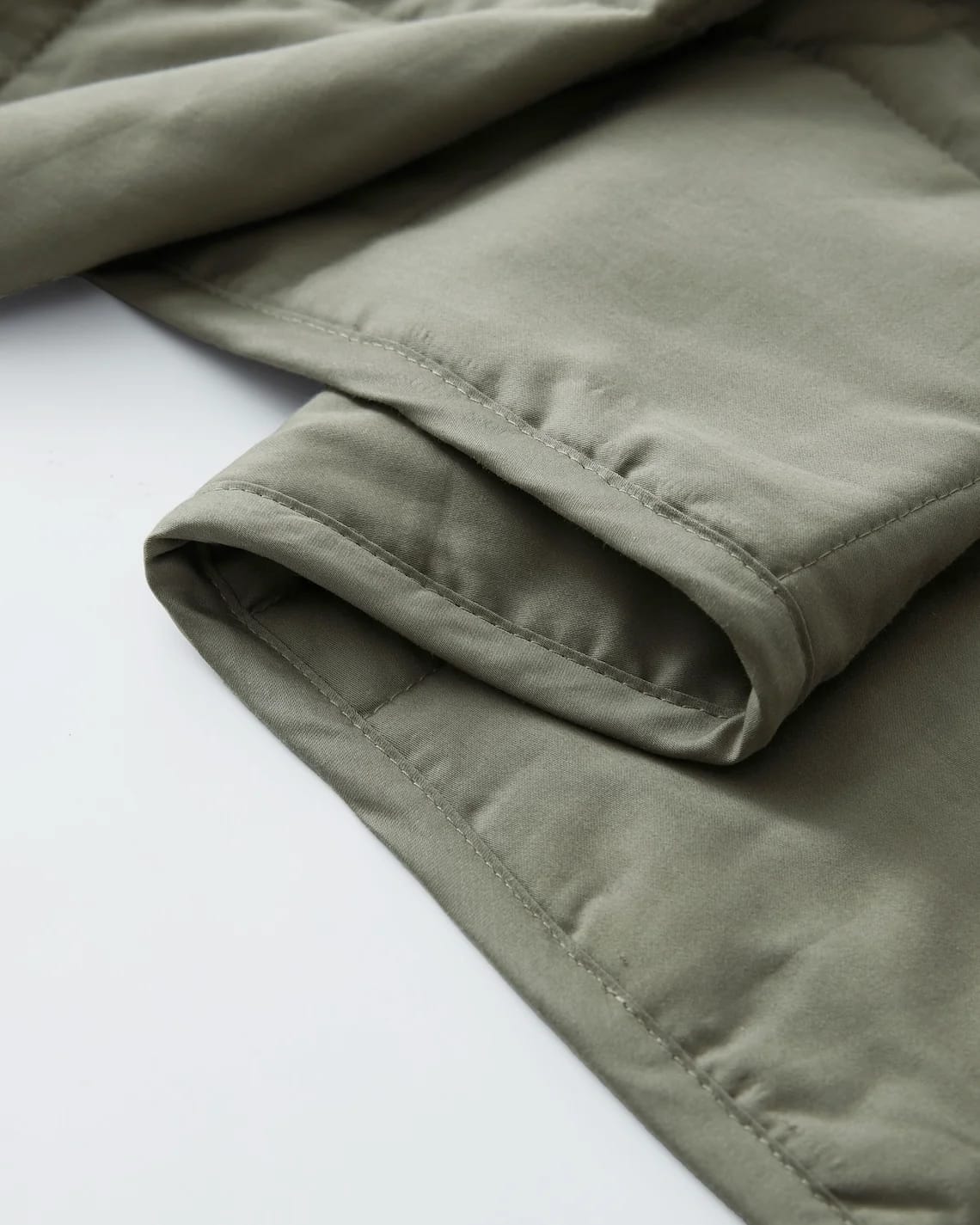
The Baloo Living Weighted Blanket is a more traditionally constructed blanket: a double layer of organic cotton fabric with organic cotton fill inside. Unlike the Bearaby blankets, which are single-material knit constructions, the Baloo has a distinct cover and fill layer, both from organic cotton. GOTS certification covers the entire product including the fill.
The double-layer cotton construction allows more airflow than a dense yarn knit. The weight also distributes differently, spreading more evenly across the body rather than concentrating along the knit loops.
OEKO-TEX Standard 100 certified in addition to GOTS. Available in 12 lb, 15 lb, 20 lb, and 25 lb. Machine washable through the 15 lb size; the heavier versions require a commercial-capacity machine.
If you are shopping for blankets more broadly, see our guides to non-toxic throw blankets and organic blankets for options outside the weighted category.
4. Earth Blankets Organic Coverless Weighted Blanket: Best glass-bead pick
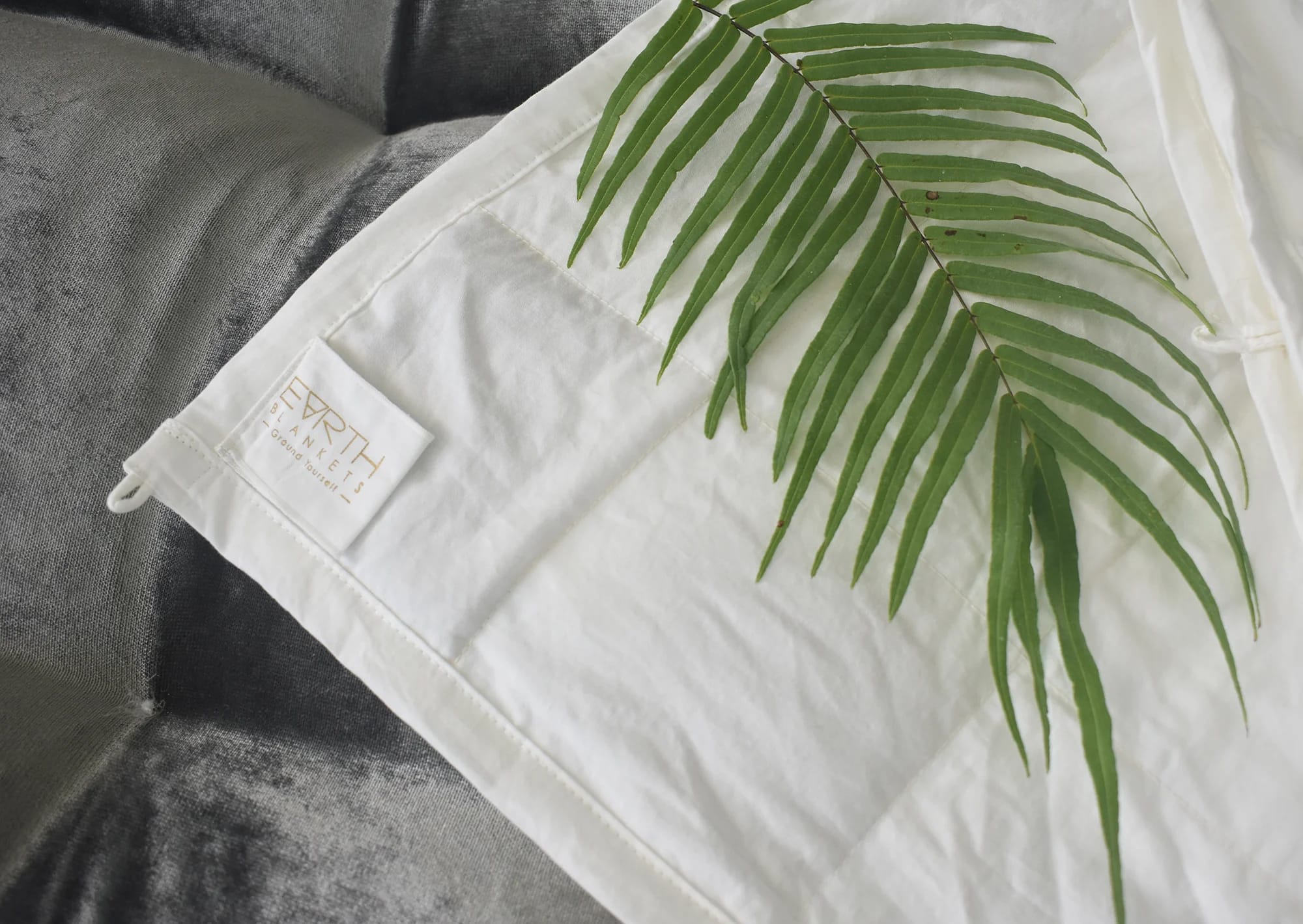
The Earth Blankets Organic Coverless Weighted Blanket is constructed from GOTS-certified organic cotton with glass beads quilted directly into the channels of the fabric. Because the design is coverless, there is no separate inner liner: the cotton outer shell is the fill enclosure, and the glass beads do not contact a polyester layer at any point.
This is the most direct cotton-plus-glass-beads construction in the guide. The GOTS certification stated on the product page covers the cotton shell. Note that this blanket requires handwashing; the coverless design means no separate duvet insert to launder independently. Available in multiple weights starting at $219.99.
5. Avocado Green Weighted Blanket: Best knit without pellets
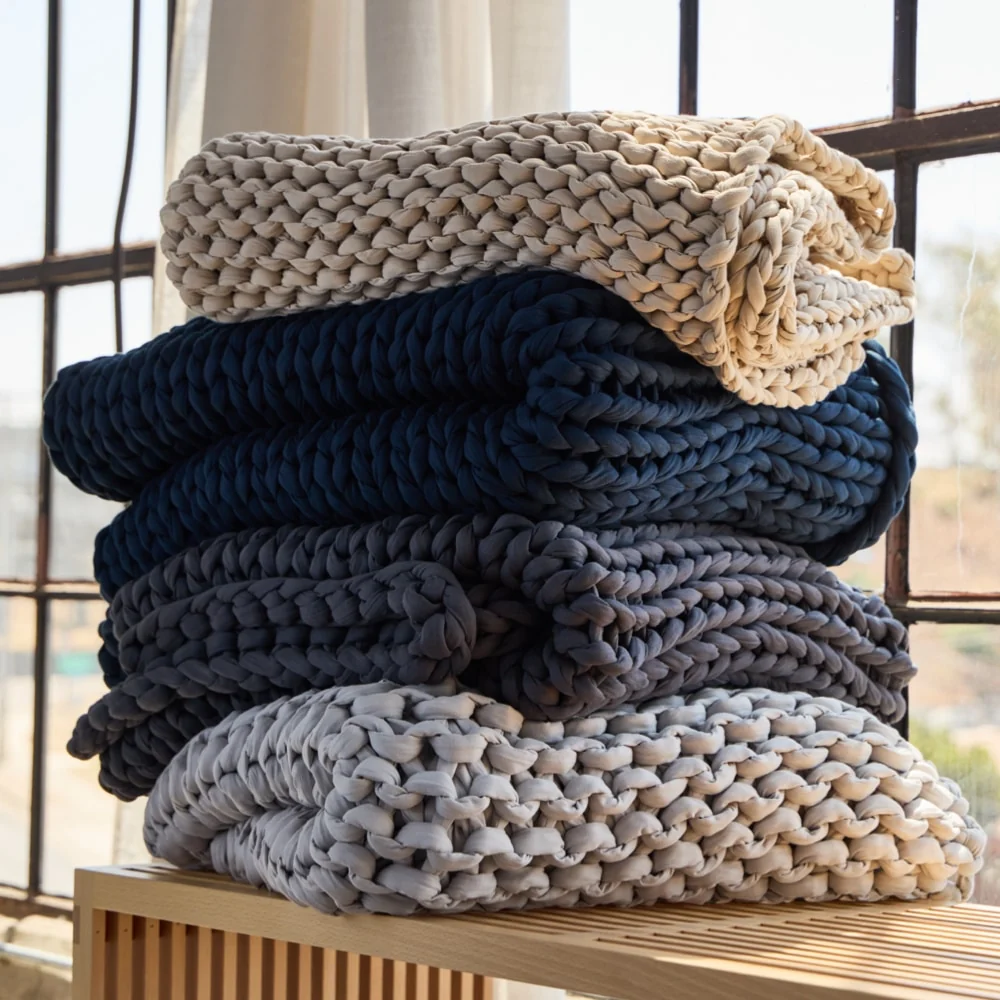
The Avocado Green Weighted Blanket uses the same pellet-free approach as the Bearaby blankets: a hand-knit cotton construction where the density of the yarn provides the weight. There is no glass bead fill, no plastic pellet fill, and no separate inner layer. The fiber is BCI (Better Cotton Initiative) cotton, which verifies responsible farming practices without the supply-chain certification that GOTS provides.
Avocado is B Corp certified at the brand level. A solid second option for buyers who want a knit-weight construction but prefer Avocado's supply chain or design language.
6. Gravity Original Weighted Blanket: Best value
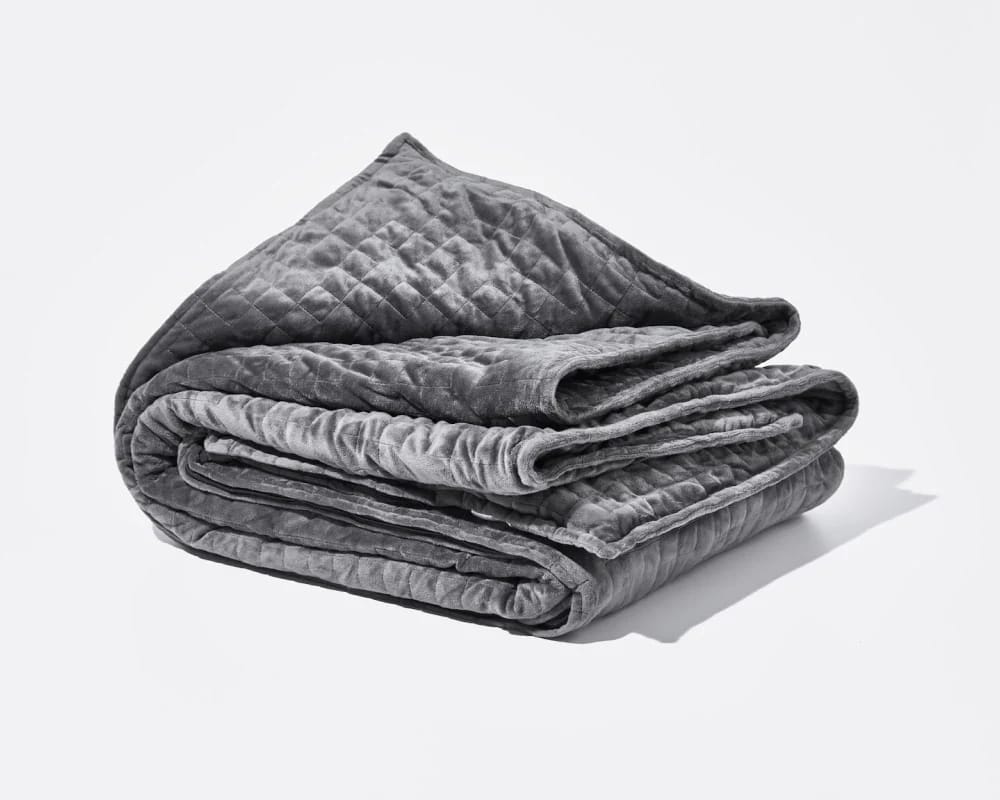
The Gravity Original Weighted Blanket is the value pick in this guide at $149 for the 15 lb size. The outer cover is cotton velvet and the fill is glass beads, with no polyester in the primary shell construction. The brand states the blanket is free from harmful chemicals and off-gassing.
One note: the Amazon listing for this product uses the term "microfiber" to describe the duvet cover material, which conflicts with the brand site's description of "cotton velvet." We sourced this pick from the brand's own product page. Buyers purchasing through a third-party retailer should verify the material description at checkout.
7. Saatva Weighted Blanket: Best premium pick

The Saatva Weighted Blanket uses an organic cotton velvet outer with a mixed fill of 67% glass beads and 33% organic cotton. The dual-fill construction adds loft alongside the weight, making it warmer-feeling than a pure glass-bead blanket. OEKO-TEX Standard 100 certified, as stated in the product FAQ section on the Saatva website.
At $345 to $495 depending on size, this is the highest-priced pick in the guide. The organic cotton fill layer and the velvet outer come from the same certified material, making this the most fully organic construction among the glass-bead options here.
What we passed on
YnM: A widely reviewed sub-$100 option on Amazon. The standard product line uses polyester covers and polyester fill layers. A few SKUs are marketed as "natural fiber" but use polyester-cotton blends without full composition disclosure.
Zonli: Similar situation to YnM. Polyester outer and fill layers. Bamboo-blend versions reviewed still used polyester in the liner construction.
Luna: Machine washable and well-reviewed for construction, but the cover is a polyester-cotton blend with the polyester percentage undisclosed on the product page.
FAQ
What weight should I choose?
A common occupational therapy starting point is approximately 10% of body weight. A 150-pound adult typically starts with a 15-pound blanket. The picks in this guide are available in a range covering most adults. For children, consult with a pediatrician or occupational therapist before purchasing. Weighted blankets are not recommended for children under age 2, and the appropriate weight for older children requires more precise consideration than a percentage rule alone provides.
Does OEKO-TEX Standard 100 cover the whole blanket?
Yes. OEKO-TEX Standard 100 certifies the finished article. Every component is tested: the outer fabric, any fill material, thread, and dyes. This is different from certifications that apply only to the raw fiber before processing. The tested product must meet limits for phthalates, heavy metals, formaldehyde, certain pesticides, and over 100 other regulated substances.
What is the difference between OEKO-TEX and GOTS?
OEKO-TEX Standard 100 is a safety certification: it tests the finished product for harmful chemical residues against established limits. GOTS (Global Organic Textile Standard) is a supply-chain certification: it verifies that the fiber was grown without synthetic pesticides and that every processing step from farm to finished textile met defined environmental and labor standards. A product can hold both. Baloo Living holds OEKO-TEX and GOTS. For a cotton product, GOTS closes the supply chain from the field forward. OEKO-TEX tests what the consumer actually receives.
Are glass bead fills safe?
Glass beads themselves are chemically inert and do not leach substances into fabric. The concern with most glass-bead weighted blankets is the polyester shell enclosing them. This guide now includes three picks where glass beads are enclosed in cotton rather than polyester: Earth Blankets (GOTS organic cotton coverless construction), Gravity (cotton velvet shell), and Saatva (organic cotton velvet with mixed organic cotton fill). For a pick with no bead fill at all, the Bearaby and Avocado knit constructions use yarn density alone for weight.
Can these be machine washed?
Washing varies by pick. The Bearaby Cotton Napper is machine washable (cold, gentle cycle, air or low-heat dry). The Baloo Living is machine washable through the 15 lb version; heavier sizes require a commercial machine. The Bearaby Tree Napper recommends hand washing. Earth Blankets requires handwashing for all sizes. For the Avocado Green, Gravity, and Saatva blankets, washing instructions vary by size and construction; follow the care label on each specific blanket.
Cover image via Unsplash (Unsplash License). Source.

