
Why four common ingredients are the filter, not the feature
Most laundry detergents fail not because of what they leave out, but because of what they put in. Optical brighteners, isothiazolinone biocides, ethoxylated surfactants, and fragrance catchalls do not clean clothes. Each one is added for a secondary reason: appearance, shelf stability, scent appeal, or cost. Each one also disqualifies the majority of both mainstream and "natural" brands when you look closely at labels. This explainer maps each ingredient to its function, its risk profile, and the label phrases you need to know.
Optical brighteners
What are optical brighteners?
Optical brighteners (also called fluorescent brightening agents, or FBAs) are UV-absorbing dye compounds that deposit on textile fibers and re-emit visible light in the blue spectrum. They make fabric appear brighter and whiter under UV light. They do not remove dirt. Common forms include stilbene derivatives (Tinopal CBS-X, Tinopal ABP) and benzimidazole compounds.
Why are they a problem?
Optical brighteners are not readily biodegradable. They accumulate in aquatic environments, where they are acutely toxic to certain aquatic organisms at low concentrations. On the skin side, they remain deposited on fabric after washing and transfer to skin with every wear and sleep cycle; this raises concerns about contact sensitization for users who wash frequently or have compromised skin barriers. The EU's Scientific Committee on Consumer Safety has evaluated stilbene brighteners and found that residue levels on skin can exceed safety thresholds for sensitive individuals.
Organic certifications (GOTS, OEKO-TEX Standard 100) ban optical brighteners outright from finished textiles and the detergents used to process them. Most infant-clothing certifications follow the same line.
How do I spot them on a label?
Look for any of these:
- "optical brighteners," "fluorescent brightening agents," "FBA," or "OBA" listed directly
- "brightening" anywhere in the ingredient list
- Stilbene-derived trade names: Tinopal, distyrylbiphenyl disulfonate
Many liquid detergents omit the full INCI list and describe only the actives. If the product description says "brightens whites" and no optical brighteners appear in the ingredient list, contact the brand for the full formulation before trusting the label.
Which Nontoxic Nook-vetted detergents avoid them?
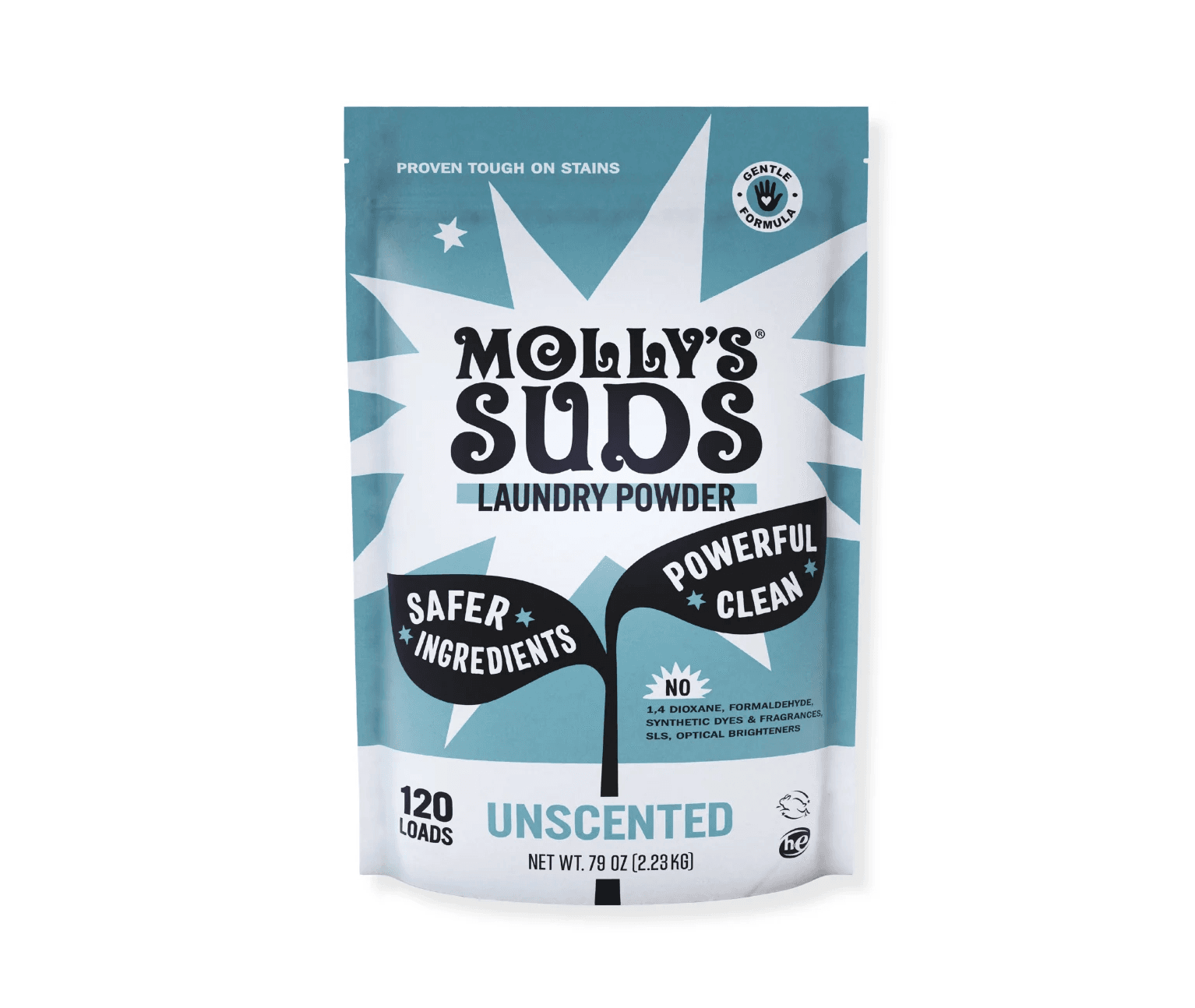
Every published product in our laundry category is screened for optical brighteners. The Molly's Suds Original Laundry Powder, Meliora Laundry Powder, and Branch Basics Laundry Detergent each publish their full ingredient lists and confirm no OBAs. The Blueland Laundry Tablets are third-party verified OBA-free via EWG.
MIT and BIT biocides
What are MIT and BIT?
Methylisothiazolinone (MIT) and benzisothiazolinone (BIT) are synthetic biocide preservatives used to prevent microbial growth in liquid formulations. They are effective at very low concentrations, which made them attractive replacements for parabens after paraben concerns became public in the 2000s. A related compound, methylchloroisothiazolinone (CMIT), is often paired with MIT; the combination appears on labels as "CMIT/MIT."
Why are they a problem?
The EU's Scientific Committee on Consumer Safety concluded in 2014 that MIT is not safe for leave-on skin products at any concentration. Rinse-off products received a temporary lower-limit approval, which the EU later tightened after evidence that rinse cycles do not fully eliminate sensitization risk. MIT is now classified as a category 1 skin sensitizer in the EU: a substance that can cause contact allergy at trace concentrations, with no established safe threshold once sensitization has occurred.
Residue in laundry is a specific concern because rinse cycles do not remove 100% of detergent actives from fabric. Sensitized individuals can react to residues at concentrations below what typical consumer testing would flag.
How do I spot them on a label?
Look for:
- "methylisothiazolinone" or "MIT"
- "benzisothiazolinone" or "BIT"
- "methylchloroisothiazolinone" or "CMIT/MIT"
- "Kathon CG" (trade name for the CMIT/MIT blend)
"Preservative" without further specification is a soft red flag. If a brand will not disclose which preservative is used, the disclosure gap itself fails the precondition screen on this site.
Which Nontoxic Nook-vetted detergents avoid them?
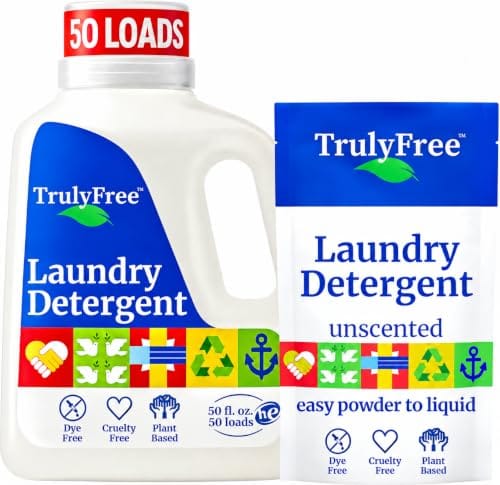
Powder and tablet formats do not require liquid preservatives, so MIT and BIT are rarely present in them. For liquid concentrates, Branch Basics uses no synthetic preservatives in any formulation. Dirty Labs Bio Enzyme Laundry Detergent publishes a full INCI list confirming no isothiazolinones. Truly Free Laundry Wash discloses all preservatives by name and none are isothiazolinones.
Ethoxylated surfactants and 1,4-dioxane
What are ethoxylated surfactants?
Surfactants are cleaning agents that lower surface tension between water and grease. Ethoxylated surfactants are a broad class that includes sodium laureth sulfate (SLES), polyethylene glycols (PEGs), polysorbates, and any ingredient with "-eth-" in its INCI name (laureth-7, trideceth-9, and similar). They are derived through a reaction with ethylene oxide, and 1,4-dioxane forms as a byproduct of that reaction.
Why is 1,4-dioxane a problem?
1,4-Dioxane is a probable human carcinogen (EPA Group B2, IARC Group 2B). It is not intentionally added: it is a manufacturing residue that remains when the ethoxylation process is not followed by vacuum-stripping to remove byproducts. Vacuum-stripping is not universal. Third-party testing by the Campaign for Safe Cosmetics and the EWG found 1,4-dioxane in roughly two-thirds of personal care and household cleaning products tested. The state of New York established a 1 ppm legal limit for cleaning products in 2023.
There is no ingredient label that declares 1,4-dioxane directly, because it is a residue, not an added ingredient. You must either look for surfactants that bypass the ethoxylation route entirely, or look for certifications that require residual testing.
How do I spot them on a label?
Look for:
- SLES (sodium laureth sulfate) vs. SLS (sodium lauryl sulfate). SLS is not ethoxylated and does not carry the 1,4-dioxane risk.
- "PEG-" followed by any number
- "-eth-" anywhere in a surfactant name
- "polysorbate 20," "polysorbate 80," or any polysorbate
- Ingredients ending in "-oxynol"
Note: USDA Certified Biobased status does not address 1,4-dioxane. Look for NSF/ANSI 305 certification, which prohibits ethoxylated surfactants outright at the highest tier, or for brands that publish third-party batch results showing 1,4-dioxane below detection limits.
Which Nontoxic Nook-vetted detergents avoid them?
Soap-based powders avoid ethoxylated surfactants by construction. Meliora Laundry Powder is sodium carbonate and saponified coconut oil: no ethoxylation pathway. Molly's Suds uses washing soda and sodium lauryl sulfate (not laureth). Truly Free Laundry Wash formulates around plant-based surfactants and publishes an ingredients list free of SLES and PEGs.
Undisclosed fragrance catchalls
What is "fragrance" on a label?
"Fragrance" (also "parfum" or "natural fragrance") is a trade-secret exemption in U.S. and EU regulations that allows a company to omit the identity of any ingredient used for scent. A single "fragrance" entry can represent a blend of dozens to hundreds of distinct chemicals, including known sensitizers, phthalate fixatives, synthetic musks, and high-VOC volatile compounds.
Why is it a problem?
Fragrance is the single most common cause of contact dermatitis from cleaning products. The EU's Scientific Committee on Consumer Safety has identified 82 fragrance allergens that are individually regulated or require declaration above threshold concentrations in rinse-off products. None of those 82 are individually declared when a U.S. label reads "fragrance."
Beyond contact allergy: phthalate plasticizers used as fragrance carriers and fixatives are endocrine disruptors. DEHP and DBP appear as undeclared fragrance components in third-party testing. The only way to rule them out is full ingredient disclosure or a certified phthalate-free claim backed by a named analytical method.
How do I spot it on a label?
Flag any ingredient listed as:
- "fragrance" or "parfum"
- "natural fragrance" (no list of component botanicals or named compounds)
- "scent blend"
- "essential oil blend" (without naming which oils)
One important distinction: "unscented" is not the same as "fragrance-free." Unscented formulas sometimes contain masking fragrances to neutralize the smell of functional ingredients. Look specifically for "fragrance-free" or "no added fragrance" and confirm it in the INCI list.
Which Nontoxic Nook-vetted detergents avoid them?
Every product in our laundry category is screened against the undisclosed-fragrance disqualifier. Confirmed fragrance-free options include Molly's Suds Original Powder, Meliora, Branch Basics, Dirty Labs Free and Clear, Blueland Free and Clear, and ATTITUDE Unscented. Each lists named ingredients only, with no "fragrance" or "parfum" entry.
Brand verdict table
One-sentence assessment for each published pick in our laundry category:
| Brand | OB-free | MIT/BIT-free | No SLES/PEG | Fragrance-free | Format |
|---|---|---|---|---|---|
| Molly's Suds Unscented | Yes | Yes | Yes (SLS only) | Yes | Powder |
| Meliora Unscented | Yes | Yes | Yes (soap-based) | Yes | Powder |
| Branch Basics Fragrance Free | Yes | Yes | Yes | Yes | Liquid concentrate |
| Dirty Labs Free and Clear | Yes | Yes | Third-party tested | Yes | Liquid |
| Blueland Free and Clear | Yes | Yes | Yes | Yes | Tablet |
| ATTITUDE Unscented | Yes | Yes | Disclosed surfactants | Yes | Liquid |
| HealthyBaby Laundry System | Yes | Yes | Yes | Yes | Liquid |
| Truly Free Unscented | Yes | Yes | Yes | Yes | Liquid |
The broader picture
Mainstream laundry detergent brands rarely publish a full INCI list. These four ingredients do not appear in every product, but the combination of disclosure gaps and common formulation practices means each one is present in most products that do not explicitly screen for it. The absence of a warning label is not evidence of absence.
For a complete list of vetted picks with sourcing notes, see the Best Non-Toxic Laundry Detergent guide.