
Our picks at a glance
| Pick | Best for | Key certifications | Price | Details |
|---|---|---|---|---|
| Square Baby Daily Nutrition Subscription | Overall transparency | USDA Organic, Clean Label Project Purity Award | $$ | Full review |
| White Leaf Provisions Organic Biodynamic Purees | Biodynamic sourcing | Demeter Biodynamic Certified, USDA Organic | $ | Full review |
| Once Upon a Farm Organic Smart Blend Infant Pouches | HPP cold-pressed | USDA Organic, 1,000 Day Promise Certified | $ | Full review |
| Little Spoon Babyblends | Broadest contaminant scope | USDA Organic, EU Organic | $$ | Full review |
| Cerebelly Organic Veggie and Bean Variety Pack | Legume-forward protein | USDA Organic, Clean Label Project Purity Award | $ | Full review |
| Serenity Kids Organic Meat and Veggie Variety Pack | Meat-based protein | USDA Organic, Clean Label Project Purity Award | $ | Full review |
Ninety-five percent of commercial baby foods tested in a 2021 Congressional investigation contained at least one toxic heavy metal. The finding was not about cheap imports or fringe brands. Enfamil, Gerber, Earth's Best: all were in the sample, all with detectable lead, arsenic, cadmium, or mercury. A USDA Organic label on the pouch did nothing to change those results.
The reason is chemistry. Organic farming restricts synthetic pesticides, but it does not restrict the metals that accumulate naturally in soil and groundwater. Rice, sweet potatoes, carrots, spinach, and cassava are heavy accumulators regardless of how they are grown. The organic seal controls inputs, not uptake. A product can be 100% USDA Organic and still concentrate cadmium or arsenic from the field.
What we look for
This guide uses California AB 899, the first US baby food heavy metals disclosure law, as its ranking framework. AB 899 established a 6 ppb floor for lead by 2024 and a 5 ppb floor by 2027. More importantly, it created a two-tier transparency structure:
AB 899 Tier 1 means a brand publishes batch-level heavy metals results voluntarily, without requiring you to enter a lot code from the package. You can verify any production run without having the product in hand.
AB 899 Tier 2 means results are published, but access is gated behind a lot code printed on the package. You get the data only after you already bought the product.
Brands outside both tiers publish no test data at all. Those are not listed here.
95%
of commercial baby foods tested
contained at least one toxic heavy metal (Congressional report, 2021)
3 ppb
detection threshold
used by Square Baby, versus California law's 6 ppb floor
500+
contaminants per batch
tested by Little Spoon, including PFAS on packaging
Ingredients by risk level
The risk is not uniform across categories. High-uptake ingredients include rice (the single largest source of inorganic arsenic in infant diets, per HBBF 2019), cassava, sweet potatoes, carrots, and spinach. Low-risk ingredients include bananas, citrus, eggs, meat purees, and sorghum. Brands that center their formulations on legumes or meats for protein instead of high-risk root vegetables reduce exposure through ingredient selection alone.
Rice-based puffs and cassava snacks warrant particular attention. Consumer Reports testing in June 2024 found one brand's cassava puffs contained up to 30 ppb lead: roughly five times California's current standard. That specific SKU is excluded from coverage in this guide even though the brand appears elsewhere on the list.
Certifications: what they cover and what they do not
USDA Organic is a meaningful standard for pesticide reduction, but it is silent on heavy metals. The following certifications add something distinct:
- Demeter Biodynamic: the most rigorous US soil-health standard; requires closed-loop farming practices that reduce heavy metal availability in the growing medium.
- Clean Label Project Purity Award: indicates a brand tested in the top third of its category for contaminant absence. This means top third, not zero-detect.
- 1,000 Day Promise Certified: an independent third-party certification covering 400+ contaminants, including PFAS migration from packaging material.
- AB 899 Tier 1 disclosure: the single most verifiable signal, because it means you can confirm actual batch results without purchasing first.
For the full regulatory and scientific background, see heavy metals in baby food: what parents need to know.
Our picks
1. Square Baby Daily Nutrition Subscription: Best overall transparency

The Square Baby Daily Nutrition Subscription sends frozen 4oz containers with dry ice on a weekly schedule. The brand tests every production batch for arsenic, lead, cadmium, and mercury at a 3 ppb threshold, well below the 6 ppb floor California adopted in 2024. Results are posted batch-by-batch without requiring a lot code from the package; any parent can verify any production run before purchasing.
Packaging is BPA/BPS/phthalate/plasticizer-free using 100% post-consumer recycled materials. The brand holds both USDA Organic and Clean Label Project Purity Award. The frozen format means no retort processing and no high-temperature pouching, removing the variables that heat-sensitive ingredient chemistry introduces in conventional shelf-stable products. The practical limitation: frozen delivery requires someone home for the drop, and the subscription structure does not suit families who travel frequently.
Best for: families with consistent weekly routines who prioritize the most independently verifiable test data.
2. White Leaf Provisions Organic Biodynamic Purees: Only biodynamic US brand

The White Leaf Provisions Organic Biodynamic Purees are sourced exclusively from Demeter Biodynamic-certified farms, making them the only US baby food brand at this tier. Demeter certification requires soil-health practices that go substantially beyond USDA Organic: cover cropping, composting, and closed-loop nutrient cycling that reduce heavy metal availability at the source.
Batch-level results are published without a lot code. Most lots test non-detect below 3 ppb for lead. One lot (Carrot Sweet Potato Pea) disclosed 11.7 ppb cadmium, a number above comfortable ranges that the brand published rather than quietly discontinuing the SKU. That transparency is the editorial reason this product appears here. The full range covers fruit and vegetable purees only, no complete meals or snacks.
White Leaf also holds EU Organic and Glyphosate Residue Free certifications alongside USDA Organic. The product line uses no rice as a primary ingredient.
Best for: families who want the deepest soil-health provenance and honest disclosure even when individual results are imperfect.
3. Once Upon a Farm Organic Smart Blend Infant Pouches: HPP cold-pressed with 1,000 Day Promise
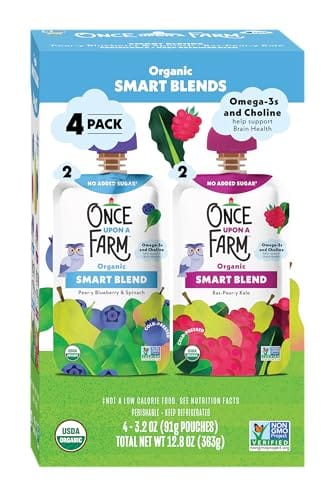
The Once Upon a Farm Smart Blend infant pouches use High Pressure Processing (HPP), a cold-preservation method that extends refrigerated shelf life without heat, retaining more of the original ingredient structure compared to retort-processed shelf-stable products. Coverage here applies to the refrigerated Smart Blend infant line only. The brand's Oat Bar and Tractor Wheels snack products are outside the scope of this guide; independent testing published in 2024 found elevated metals in those product lines.
The 1,000 Day Promise certification is the most comprehensive third-party program the brand carries: 400+ contaminants including PFAS migration from the pouching film, mycotoxins, and pesticide residues beyond the standard heavy metals panel. Heavy metals limits are lead at or below 10 ppb and arsenic at or below 20 ppb. Results are published at AB 899 Tier 1, no lot code required.
Best for: families who want a refrigerated, store-accessible option backed by third-party PFAS-on-packaging testing.
4. Little Spoon Babyblends: Broadest contaminant scope
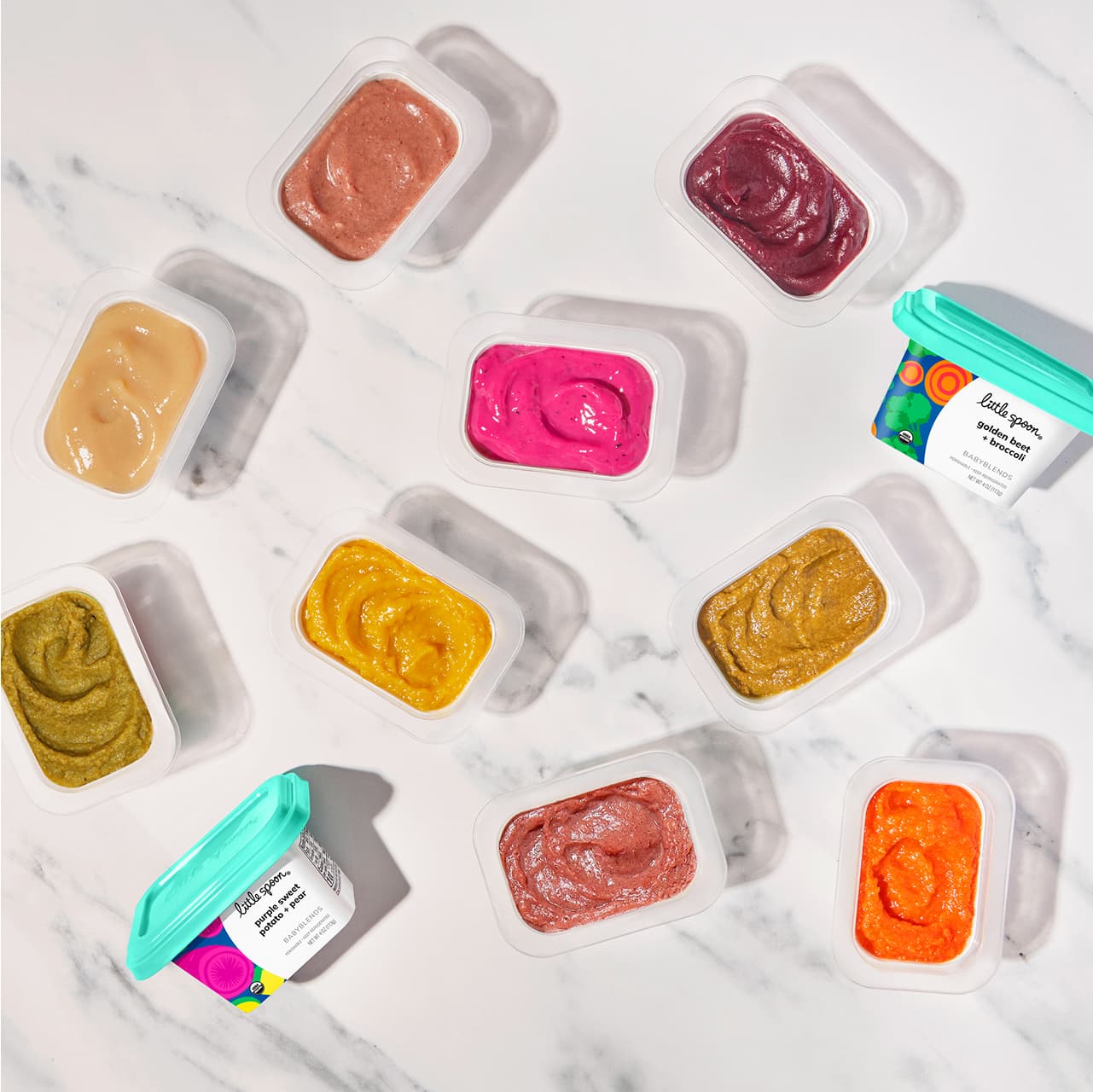
The Little Spoon Babyblends subscription is the only brand in this guide that systematically tests for PFAS migration from packaging material alongside the standard heavy metals panel. The combined scope reaches 500+ contaminants per batch, including pesticides, plasticizers, and endocrine-disrupting compounds. No batch ships without clearing all categories simultaneously.
Heavy metals limits: lead at or below 10 ppb, arsenic at or below 20 ppb, cadmium at or below 40 ppb, mercury at or below 3 ppb. Little Spoon is the first US baby food brand to hold both USDA Organic and EU Organic simultaneously. The EU certification overlaps only partially with the USDA system and carries additional restrictions on processing aids, making the dual certification more meaningful than either alone. Test results are AB 899 Tier 2: you need the lot code from the cup lid to access specific batch data.
Refrigerated 4oz cups ship on DTC subscription only; there is no retail availability. Containers are PET #1 with PP #5 lids, BPA/BPS/phthalate-free.
Best for: families who want the broadest contaminant scope, particularly PFAS on packaging, and are comfortable with lot-code-gated results access.
5. Cerebelly Organic Veggie and Bean Variety Pack: Legume-forward protein
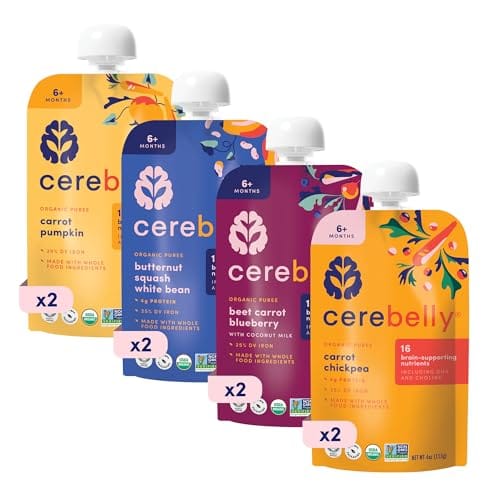
The Cerebelly Organic Veggie and Bean Variety Pack uses white bean, chickpea, and black bean as primary protein sources instead of the high-uptake root vegetables that dominate most brands' protein bases. This ingredient approach meaningfully reduces exposure to arsenic and cadmium compared to sweet-potato-first or rice-first formulations. The 8-count variety pack covers Butternut Squash White Bean, Black Bean Sweet Potato, Carrot Chickpea, and related blends.
Batch-level results are published with Prop 65 limit comparisons, AB 899 Tier 1, no lot code required. The Clean Label Project Purity Award covers the brand's line, which means Cerebelly tested in the top third of its category for contaminant absence. One important clarification: the Purity Award does not mean zero-detect. Cerebelly's smoothie SKUs are not included here; a 2025 independent review found lead and arsenic in the smoothie pouch line, and the veggie puree and bean line has a different formulation and testing profile.
Best for: families who want protein variety with reduced reliance on high-arsenic, high-cadmium root vegetables.
6. Serenity Kids Organic Meat and Veggie Variety Pack: Only meat option
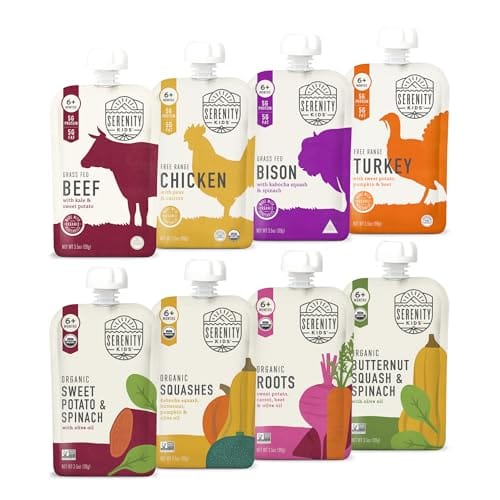
The Serenity Kids Organic Meat and Veggie Variety Pack is the only brand in this guide featuring elevated-practice animal protein: grass-fed beef and bison, free-range chicken and turkey, paired with organic vegetables. Meat purees are among the lowest-risk categories for heavy metal accumulation, which gives this line a structural advantage for families introducing protein alongside vegetables.
The meat components are not USDA Organic certified because no NOP pathway exists for these sourcing standards. Organic vegetables are USDA Organic certified. The brand holds a Clean Label Project Purity Award covering this product line.
This guide covers the meat and veggie pouches specifically. The brand's cassava puff products are excluded: Consumer Reports testing in June 2024 found up to 30 ppb lead in those SKUs, roughly five times California's current lead limit. The toddler formula line is also outside the scope here.
Best for: families introducing meat-based protein, or those seeking alternatives to high-risk root vegetable formulations.
What we passed on
Earth's Best, Happy Baby, Beech-Nut, and Gerber each appeared in the 2021 Congressional report with documented results above what the committee considered acceptable thresholds. None publish AB 899 Tier 1 data without a lot code.
Plum Organics and Sprout Organics rely substantially on high-uptake root vegetables (sweet potato, carrot) without the contaminant testing transparency needed to verify actual exposure. Disclosure falls below AB 899 Tier 1.
Yumi and Amara Organic market transparency without independent third-party certification covering heavy metals. Claims are not verifiable against a published testing standard.
Cerebelly smoothie SKUs, Serenity Kids cassava puffs, and Once Upon a Farm snack lines are specific product lines from brands that do appear in this guide, excluded because independent testing found results above acceptable thresholds. Brand choice is not enough here; SKU-level selection matters.
FAQ
Does USDA Organic certification mean a baby food is free of heavy metals?
No. USDA Organic restricts synthetic pesticides and fertilizers but says nothing about metals that accumulate naturally in soil and groundwater. Those accumulate regardless of farming method because they are elemental, not synthetic. The 2021 Congressional investigation found detectable lead, arsenic, cadmium, and mercury in products from Earth's Best, Gerber, and Enfamil, all of which carry organic lines.
What does AB 899 Tier 1 mean?
California AB 899 established two transparency tiers for heavy metals disclosure in baby food. Tier 1 means a brand publishes batch-level test results without requiring a lot code from the package: any parent can verify any production run before purchasing. Tier 2 gates access behind a lot code printed on the label, meaning you can only verify after you have already bought the product. Brands outside both tiers publish no data at all.
Which ingredients accumulate the most heavy metals?
Rice is the largest single source of inorganic arsenic in infant diets, per Healthy Babies Bright Futures 2019 data. Other high-uptake ingredients include cassava, sweet potatoes, carrots, and spinach. These crops absorb metals present in soil and groundwater regardless of farming method. Low-risk alternatives include bananas, citrus, eggs, meat purees, and sorghum.
Are rice-based baby snacks and cassava puffs safe?
Consumer Reports testing in June 2024 found one brand's cassava puffs contained up to 30 ppb lead, roughly five times California's current standard. Rice-based puffs carry the same structural risk as other rice-first products. This guide covers pouches and jars specifically; any snack SKU requires its own evaluation. Brand-level certifications for purees do not automatically extend to a brand's snack lines.
What is the 1,000 Day Promise certification?
The 1,000 Day Promise is an independent third-party certification covering 400-plus contaminants per batch, including PFAS migration from packaging material, mycotoxins, and pesticide residues beyond the standard heavy metals panel. The program sets limits at lead at or below 10 ppb and arsenic at or below 20 ppb. It is the most comprehensive contaminant scope of any certification represented in this guide.
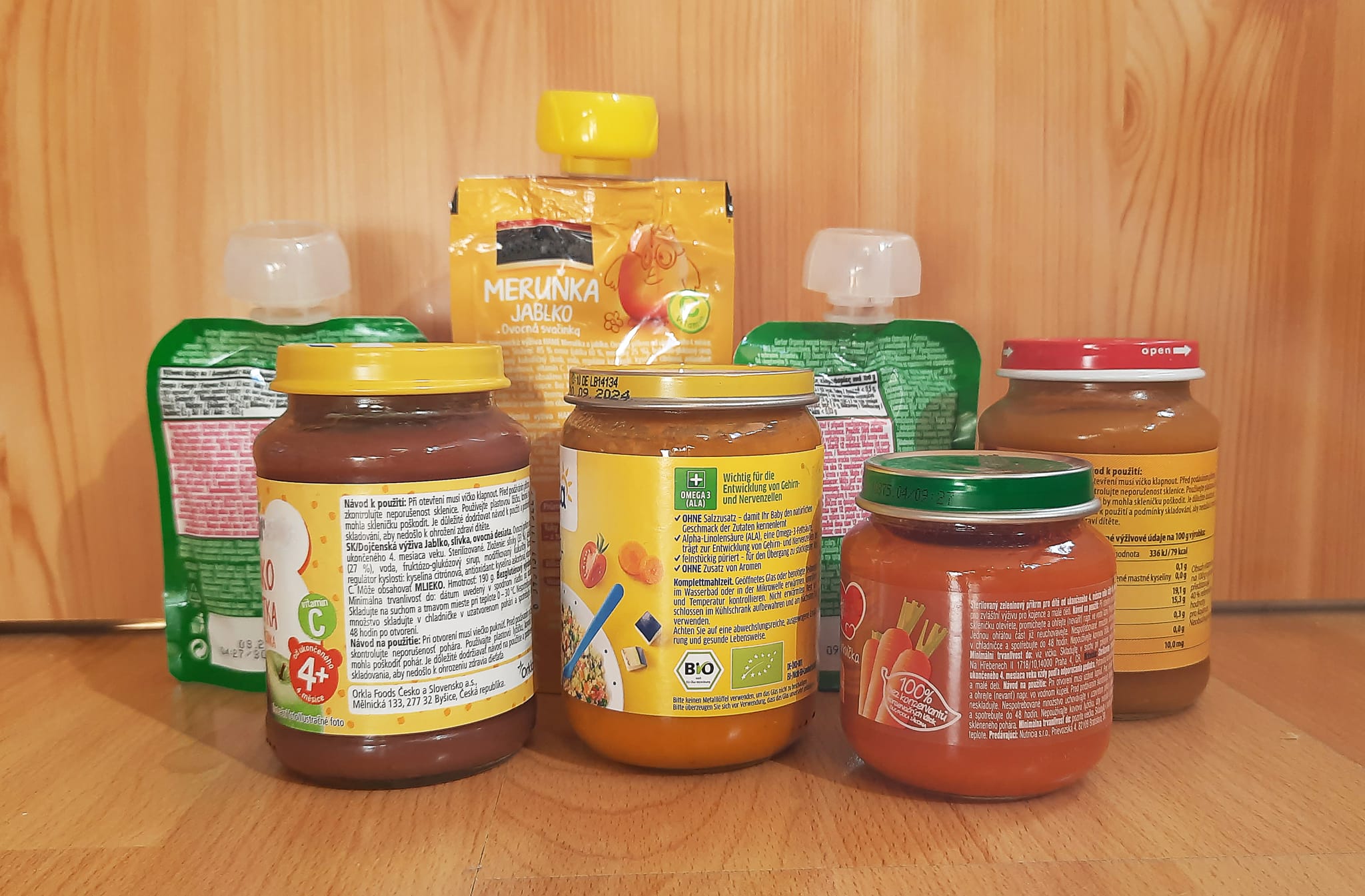
Cover image: MAKY.OREL via Wikimedia Commons (CC0 1.0 Universal). Source.

