

Our picks at a glance
| Pick | Best for | Key certifications | Price | Details |
|---|---|---|---|---|
| Betterway Bamboo Toilet Paper | Lab-verified PFAS-free, fiber-sourcing certification | FSC Certified | $$ | Full review |
| Who Gives A Crap 100% Recycled Toilet Paper | Post-consumer recycled fiber, plastic-free packaging | B Corp | $ | Full review |
| Reel Premium 3-Ply Bamboo Toilet Paper | Best value, FSC bamboo, TCF bleaching | None listed | $ | Full review |
| Public Goods Tree-Free Bamboo Toilet Paper | Unbleached fiber, most minimal formulation | None listed | $ | Full review |
| Caboo Tree-Free Bamboo and Sugarcane Toilet Paper | Retail availability, FSC bamboo and sugarcane | None listed | $ | Full review |
| PlantPaper Organic Cotton Toilet Paper | Cotton fiber, GOTS certified, no wood-fiber supply chain | USDA Organic | $$ | Full review |
Toilet paper is in contact with some of the most sensitive skin on your body. Until recently, it was rarely tested for chemical contaminants. PFAS have been detected in finished toilet paper rolls through manufacturing-process contamination: pulp processing equipment with PFAS-coated surfaces and packaging materials can transfer trace fluorine compounds into the fiber. The practical question is: which rolls are actually clean?
What we look for
PFAS in toilet paper does not come from intentional addition. It enters through the manufacturing process: paper pulp is processed on equipment with PFAS-coated conveyor belts and press rollers, and trace fluorine compounds absorb into the fiber along the way. Finished rolls can also pick up PFAS from packaging materials and print inks. The upshot is that "unscented" and "fragrance-free" are not enough. You need a brand that either tests finished product for PFAS or avoids the supply-chain vectors where PFAS enters.
Our screen covers four areas:
PFAS and fluorinated compounds. We look for brands that independently test for PFAS in finished rolls, or that source from mills with documented PFAS-free processing. A PFAS-free claim backed by third-party lab results carries more weight than a statement on a packaging label.
Bleaching chemistry. Chlorine bleaching of paper pulp generates dioxins, persistent organic pollutants that accumulate in tissue. Elemental chlorine-free (ECF) bleaching is the industry standard and still produces dioxins at lower levels. We look for totally chlorine-free (TCF) or process chlorine-free (PCF) processing, or unbleached fiber. Brands that do not disclose their bleaching method do not pass this screen.
Fragrance and additives. Any roll listing "fragrance," "lotion," or "aloe" fails. Named plant extracts and specific essential oils are fine on paper, though unnecessary in toilet paper, but most "fragrance" in tissue products is a proprietary blend that can carry phthalates. We want blank rolls: just fiber, nothing else.
Fiber source. We look at the raw material: bamboo, sugarcane, post-consumer recycled paper, or cotton. Bamboo and sugarcane grow rapidly, require no replanting, and avoid old-growth forest depletion. Recycled paper closes a loop on paper waste but relies on the quality of incoming feedstock. Cotton is rare but eliminates the wood-fiber supply chain entirely. We check for FSC certification or an equivalent fiber-sourcing standard where applicable.
Our picks
1. Betterway Bamboo Toilet Paper, 24 Rolls - Best overall
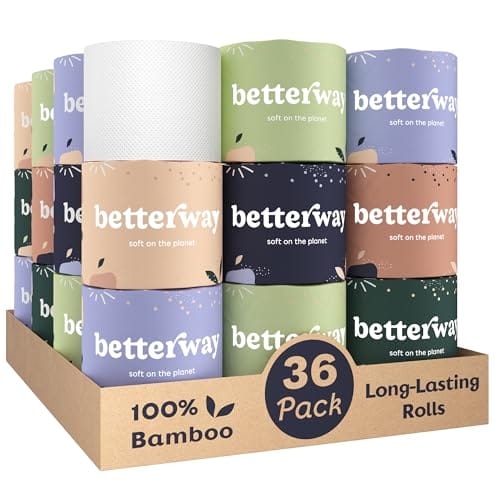
The Betterway Bamboo Toilet Paper earns the top spot because it did the work other brands have not: it paid for independent PFAS testing and published the results publicly. That kind of verifiable transparency is uncommon in this category.
The fiber is FSC-certified bamboo processed TCF. No fragrance, no dye, no lotion. The 3-ply construction is soft for a tree-free roll without relying on any chemical softeners. Betterway also discloses its manufacturing partners and bleaching chemistry on its product page, a higher transparency standard than most competitors.
At $67.99 for a 24-roll pack (about $2.83 per roll), it sits at the mid-range for premium bamboo toilet paper. For households that want lab-backed assurance and are buying just one brand, this is the one.
2. Who Gives A Crap 100% Recycled Toilet Paper, 24 Rolls - Best recycled

The Who Gives A Crap 100% Recycled Toilet Paper is the only post-consumer recycled option in our picks to ship without individual plastic wrapping. Rolls are wrapped in paper, the outer box is cardboard, and no single-use plastic appears in the packaging chain.
The recycled fiber is processed PCF. The brand lists no fragrance, dye, or lotion anywhere in its formulation. WGAC publishes a supplier code of conduct and third-party audits through its B Corp certification. While the brand has not published independent third-party PFAS test results for this specific product, PCF processing of recycled fiber meaningfully reduces the dioxin and persistent-chemical load relative to ECF or unspecified bleached alternatives.
Fifty percent of profits fund sanitation infrastructure projects in low-income communities. That mission is real, audited, and reported publicly. At $49.99 for a 24-roll pack (about $2.08 per roll), it is priced below Betterway.
3. Reel Premium 3-Ply Bamboo Toilet Paper, 24 Rolls - Best value

The Reel Premium 3-Ply Bamboo Toilet Paper is the least expensive bamboo option in our picks. At $43.99 for 24 rolls, it undercuts several competitors on per-roll cost without sacrificing the basics: FSC-certified bamboo, TCF bleaching, no fragrance or dye.
Reel has not published independent third-party PFAS lab results. But FSC bamboo fiber processed TCF reduces both supply-chain vectors where PFAS typically enters paper products. The 3-ply construction holds up well. The brand provides transparent manufacturing disclosures on its website.
Rolls are wrapped in paper with no external plastic. Reel ships in a plain cardboard box with minimal branding, which suits households that prefer unadorned packaging in the bathroom.
4. Public Goods Tree-Free Bamboo Toilet Paper, 24 Rolls - Best unbleached

The Public Goods Tree-Free Bamboo Toilet Paper is the most minimal option in our picks: unbleached bamboo fiber, no fragrance, no dye, no processing additives. The rolls are naturally tan-beige rather than white, which signals the absence of brightening chemistry.
Public Goods does not certify its bamboo through FSC, though the brand describes it as sustainably sourced. It has not published independent PFAS lab results. It earns its spot here because unbleached fiber skips the bleaching step entirely, which is the vector responsible for dioxin formation in conventional paper manufacturing. Unbleached rolls are structurally the simplest and most additive-free option available.
At $49.95 for 24 rolls, it is slightly above average for the category. The plain packaging suits a no-fragrance, no-fuss household.
5. Caboo Tree-Free Bamboo + Sugarcane Toilet Paper - Best for retail availability

The Caboo Tree-Free Bamboo + Sugarcane Toilet Paper is the most widely available tree-free option in this group. It is sold at Costco, Target, Walmart, and most major grocery chains, in addition to Amazon and brand-direct. For households that do not subscribe to direct-to-consumer toilet paper deliveries, Caboo is the one you can pick up locally.
The fiber blend combines bamboo and sugarcane bagasse (a sugarcane-processing byproduct). Both are certified FSC and processed TCF. No fragrance, no dye, no lotion. Caboo has not published independent PFAS lab results, but the fiber sourcing and bleaching chemistry are both on the cleaner end of what the paper industry offers.
At $39.99 for 24 rolls on Amazon, it is the most affordable pick in the group. The 2-ply construction is slightly thinner than the 3-ply options, but adequate for everyday use.
6. PlantPaper Organic Cotton Toilet Paper, 32 Rolls - Most distinctive material

The PlantPaper Organic Cotton Toilet Paper is the only cotton-fiber roll in our picks and one of the only cotton toilet papers available to consumers. Cotton eliminates the wood-fiber supply chain entirely: bamboo cultivation, pulp processing, and tree harvesting are all removed from the equation.
The fiber is GOTS-certified organic cotton, unbleached, and processed without fragrance, dye, or additives. PlantPaper publishes its supply chain from field to roll. PFAS in paper primarily enters through pulp processing equipment. A cotton-fiber roll processed without that equipment is a structural difference from bamboo or recycled paper, not just a marketing distinction.
The tradeoff is cost and availability. At $69 for 32 rolls, it is competitive at roughly $2.16 per roll, but it is sold direct-to-consumer only: no Amazon, no retail. It is the right pick for households that want to step entirely outside the wood-fiber paper supply chain and buy from a brand whose sourcing is traceable at every stage.
What we passed on
Charmin, Angel Soft, and most mass-market rolls use ECF bleaching or do not disclose bleaching chemistry. They rely on virgin wood fiber from unspecified forestry sources, and several carry fragrance variants alongside unscented lines without clear factory separation. Independent testing has found PFAS in several conventional name-brand rolls; none of those brands have published remediation steps or independent lab results since.
Seventh Generation 100% Recycled is PCF and a generally credible environmental brand, but its lotion variants and unclear factory separation between scented and unscented lines created ambiguity we could not resolve without explicit brand documentation.
Bamboo rolls on Amazon without certification appeared frequently in our research. Without FSC certification, disclosed bleaching chemistry, or any material documentation, they do not clear the disqualifier gate regardless of the marketing claims on the packaging.
If you are ready to start shopping, the product directory is filtered against the same criteria these picks were screened against.
FAQ
How does PFAS get into toilet paper?
PFAS is not intentionally added to toilet paper. It enters through the manufacturing process: paper pulp is processed on equipment with PFAS-coated conveyor belts and press rollers, and trace fluorine compounds absorb into the fiber. Finished rolls can also pick up PFAS from packaging materials and print inks. That is why the fiber source alone does not determine PFAS content.
What do TCF, ECF, and PCF mean on toilet paper labels?
TCF (totally chlorine-free) means no chlorine compounds were used at any stage of bleaching. ECF (elemental chlorine-free) is the current industry standard and still generates dioxins, though at lower levels than older chlorine processes. PCF (process chlorine-free) applies to recycled fiber: no chlorine was added during reprocessing, though the original feedstock fiber may have been bleached previously. TCF and PCF are the preferred options in this guide.
Is bamboo toilet paper automatically PFAS-free?
No. FSC-certified bamboo processed totally chlorine-free reduces two of the supply-chain vectors where PFAS typically enters paper products, but without independent lab testing of finished rolls, no PFAS-free claim can be independently verified. Among the picks in this guide, only Betterway has published independent lab test results confirming PFAS not detected.
Why does unbleached toilet paper look tan or beige?
Unbleached rolls skip the whitening step entirely. The natural tan-beige color signals the absence of optical brighteners and bleaching chemistry. Bleaching paper pulp is the process responsible for dioxin formation in conventional paper manufacturing; skipping it eliminates that vector entirely.
Which picks can I buy in a store rather than by subscription?
Caboo is the most widely stocked option: it is sold at Costco, Target, Walmart, and most major grocery chains. Who Gives A Crap and Reel are available via Amazon in addition to their own direct-to-consumer subscriptions. Betterway, Public Goods, and PlantPaper are primarily sold direct to consumer.
Cover image: Curtis Adams via Pexels (Pexels License). Source.
