

Our picks at a glance
| Pick | Best for | Key certifications | Price | Details |
|---|---|---|---|---|
| Coyuchi Pebbled Handstitched Organic Quilt | Best overall | GOTS Certified | $$ | Full review |
| Saatva Organic Cotton Channel Quilt | Best channel stitch | GOTS Certified | $$ | Full review |
| Boll & Branch Shoreline Quilt Set | Best set value | GOTS Certified | $$ | Full review |
| Boll & Branch Signature Textured Stitch Quilt | Best texture | GOTS Certified | $$ | Full review |
| Pact Organic Quilt | Best budget GOTS | GOTS Certified | $$ | Full review |
| Quince Organic Cotton Hand Stitched Quilt | Best hand stitch under $150 | OEKO-TEX Standard 100 | $ | Full review |
Most quilts on the market use polyester batting. It keeps the fill cheap and the warmth consistent, but polyester is a petroleum-derived synthetic with no ingredient disclosure requirements. The brands here took a different path: organic cotton fill, documented from field to finished textile.
The core screening criterion is GOTS certification that covers the fill layer. Many brands certify the shell fabric but leave the batting unaddressed. Five of the six picks here hold GOTS at both levels. The sixth, Quince, uses OEKO-TEX Standard 100, which verifies the finished textile is free of harmful substances, with a meaningful caveat explained below.
What we look for
GOTS certification at the fill level
The Global Organic Textile Standard covers the full supply chain: the farming of the cotton, the spinning, the dyeing, and the finishing. When a brand says its quilt is "made with organic cotton," that phrase can legally apply to the shell while polyester fills the inside. GOTS certification on the fill requires the batting itself to be traced through the certification chain, not just the outer fabric. Every GOTS pick here has its fill certified, and that claim is sourced to the certifier's registry, not the brand's marketing page.
No polyester batting
Polyester batting is the default fill in most consumer quilts, including many positioned as "natural" or "eco." Recycled polyester (often sold as "Repreve" or described as "made from plastic bottles") is still polyester fiber and still lacks ingredient disclosure at the fiber level. The site's exclusions cover all plastic fills in bed-contact products. This is the single most common reason a quilt is dropped from consideration.
Stitch type and construction
Cotton batting shifts with use, so stitch density matters. Hand stitching (kantha or pebbled patterns) creates shorter stitch intervals that hold the fill in place better than minimal machine stitching. Machine channel stitching uses parallel rows that run the full length of the quilt, which distributes fill evenly but leaves wider unsupported sections between rows. Hand-stitched options tend to have a more textured hand; channel-stitched options lay flatter and feel crisper.
Warmth expectations
Cotton quilts are light-to-medium weight. They work best as a layering piece over sheets in warmer months, or under a heavier blanket in winter. None of these picks are equivalent to a down or wool duvet in warmth. If you sleep cold year-round, a cotton quilt alone is not the right primary bed layer; it works as a coverlet, not a replacement for insulating fill.
Dye disclosure
Synthetic dyes and restricted azo dye residues are among the common exposure routes in conventional textiles. GOTS limits which dyes can be used and requires wastewater treatment at every processing stage. The undyed colorway (where available) removes dye exposure entirely. The Coyuchi pick is the only one here offering a full undyed option.
Our picks
1. Coyuchi Pebbled Handstitched Organic Quilt: Best overall

The Coyuchi Pebbled Handstitched Organic Quilt is the only pick in this guide with full GOTS certification at every level of construction, plus a dye-free option. The pebbled surface texture comes from the hand stitching itself, which runs at short intervals across the quilt face. That stitch density holds the organic cotton batting in place through repeated washing without adhesives or synthetic thread.
The undyed colorway carries no dye at any stage: the cotton is grown, processed, and finished without color treatment. Coyuchi's certifications are verified through Control Union, one of the major GOTS accreditation bodies, and the certificate is searchable in the Control Union registry. At $$, this is the premium pick in the guide. The price reflects the handwork in the stitching and the full-chain certification overhead.
2. Saatva Organic Cotton Channel Quilt: Best channel stitch

The Saatva Organic Cotton Channel Quilt uses a parallel channel-stitch construction in GOTS-certified organic cotton percale. The percale shell is crisp and lays flat straight out of the package, suited to sleepers who prefer a smooth coverlet over a textured hand.
Channel stitching runs in evenly spaced parallel rows along the quilt length. Each channel is a separate pocket of batting, which means the fill does not migrate across the quilt with use. The GOTS certification covers both fill and shell and is documented on Saatva's certifications page. The quilt comes in white only, which also means no dye on the shell layer.
3. Boll & Branch Shoreline Quilt Set: Best set value

The Boll & Branch Shoreline Quilt Set is the only pick here sold as a complete set: quilt and two standard shams in GOTS-certified 100% organic cotton. If you are outfitting a bed rather than just adding a layer, the set approach reduces the cost per piece compared to purchasing separately.
The tile stitch pattern creates a boxy grid across the quilt face, with each square holding a small pocket of organic cotton batting. The stitch runs through both shell layers and into the fill, keeping batting positioned through the wash cycle. Boll & Branch's GOTS certifications cover the full supply chain including the fill batting, documented on their certifications page.
4. Boll & Branch Signature Textured Stitch Quilt: Best texture

The Boll & Branch Signature Textured Stitch Quilt uses a higher stitch density than the Shoreline model, which creates an embossed surface that is more tactile and visually distinct. The stitching runs at closer intervals across the quilt face, creating a raised pattern without any synthetic filling or binder.
The fill, shell, and stitching are all GOTS-certified organic cotton. The denser stitching also means the batting has less room to migrate between washes, a practical advantage for a quilt used as a primary bed layer. This and the Shoreline share the same GOTS certifications and supply chain; the primary difference is construction and surface feel.
5. Pact Organic Quilt: Best budget GOTS
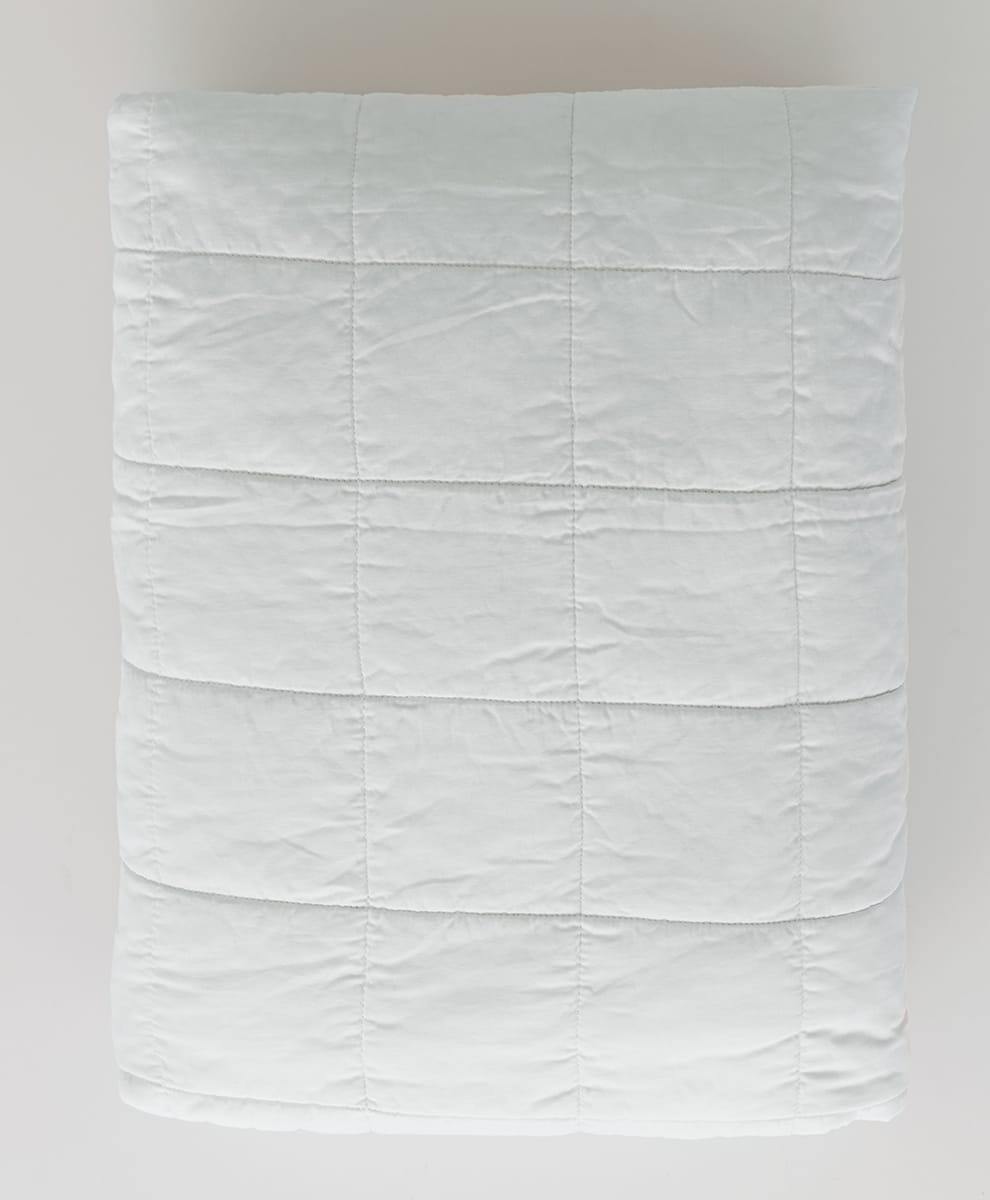
The Pact Organic Quilt is the most accessible GOTS-certified option at $187 for a full/queen. Pact is primarily a clothing brand with a well-documented GOTS supply chain, and that certification extends to its home bedding line.
The construction is machine channel stitch, with parallel rows of stitching holding the organic cotton fill in place. Pact's certifications page documents the GOTS certification number for its textiles. Available in Bone, Charcoal, and White. For buyers who want GOTS certification at the fill level without the $300+ price points of the premium picks, this is the clearest answer.
6. Quince Organic Cotton Hand Stitched Quilt: Best hand stitch under $150
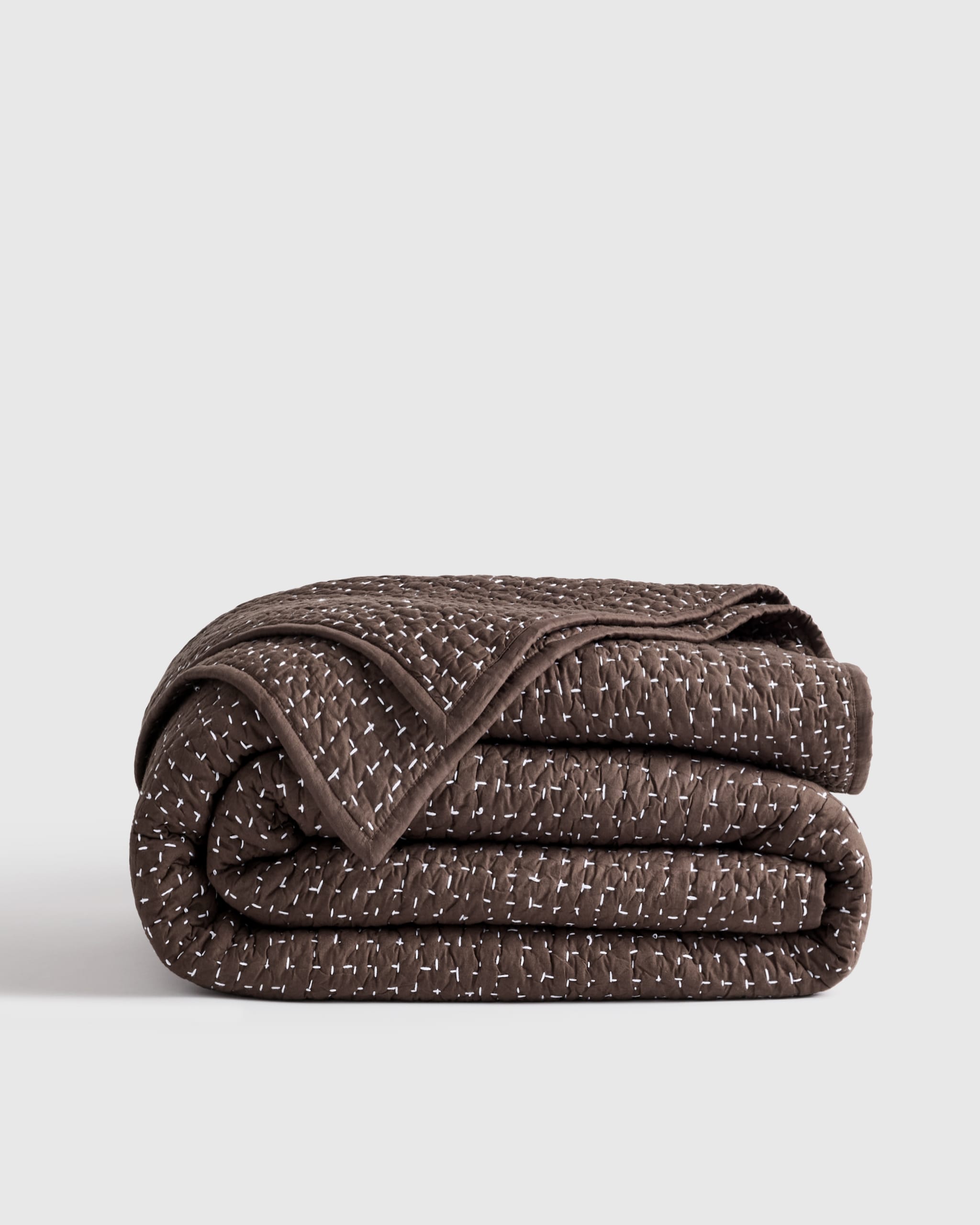
The Quince Organic Cotton Hand Stitched Quilt is the only hand-stitched pick at a sub-$150 price point. The kantha-style hand stitching runs in dense rows across the quilt face, creating a tight, textured surface at roughly a third of the price of the Coyuchi pick.
The certification here is OEKO-TEX Standard 100. OEKO-TEX tests the finished textile for harmful substances above threshold levels, including heavy metals, formaldehyde, pesticide residues, and restricted dyes. What it does not do is certify the farming or processing supply chain against organic standards. A quilt can pass OEKO-TEX Standard 100 while still using conventionally grown cotton, as long as residues are below threshold in the final product.
That is a meaningful gap. For buyers where GOTS is the hard requirement, this pick does not qualify. For buyers where the primary concern is harmful-substance residue in the finished textile, OEKO-TEX Standard 100 directly addresses that. Available in Espresso, Natural, Sage, and other colorways at $124 for full/queen.
What we passed on
Parachute uses polyester batting in its quilt fill. Polyester is a petroleum-derived synthetic with no ingredient disclosure requirements and does not meet the site's no-plastics criterion for a sleep-surface product.
West Elm quilted comforters in the organic cotton line use Repreve recycled polyester as fill. Repreve is recycled plastic fiber, which is still polyester and still fails the no-plastic-fill criterion regardless of recycled content.
Avocado Natural Linen Quilt passes the chemistry criteria and holds GOTS certification. It was excluded because it was out of stock at the time of research.
Care and washing
All six picks are machine washable. Cotton quilts should be washed cold and tumble dried on low or line dried. High heat shrinks cotton batting and can damage stitching, particularly on hand-stitched options.
If batting shifts over time (more common in channel-stitch than hand-stitch designs), tumble dry on low with dryer balls before the next wash to redistribute the fill. Cotton quilts should not be stored compressed for extended periods; fold flat or store loosely in a breathable cotton bag.
FAQ
Are cotton quilts warm enough for winter?
Cotton quilts are light-to-medium weight, closer in warmth to a coverlet than a down duvet. In winter, most people need to layer: a cotton quilt over sheets under a wool blanket or heavier insert works well. On its own, a cotton quilt suits mild winters or warmer sleepers. None of these picks are marketed as all-season duvets.
What does GOTS actually certify in a quilt?
GOTS certifies the entire textile production chain from farming through finishing. For a quilt, that means the organic status of the cotton, the processing chemistry (dyes, bleaches, auxiliaries), and labor conditions at each stage. Critically, GOTS certification must cover the fill batting layer, not just the outer shell fabric. A shell-only GOTS claim leaves the batting unaddressed. All five GOTS picks here have fill-level certification documented to their brand certification pages.
Is OEKO-TEX the same as GOTS?
No. OEKO-TEX Standard 100 tests the finished textile for harmful substances above defined thresholds. It is a product safety standard that measures what is in the finished quilt, not how the cotton was grown or processed. GOTS is a supply-chain standard that limits the inputs at every stage of production. Both are meaningful; they answer different questions. If the priority is verified absence of harmful residue in the product, OEKO-TEX Standard 100 directly addresses that. If the priority is certified organic agriculture and restricted chemical inputs across the supply chain, only GOTS answers it.
Can I use a cotton quilt instead of a down duvet?
For warmth alone: generally no, not directly. Cotton quilts are lighter and breathe more than down duvets. If you run warm, a cotton quilt may be all you need in mild weather. For cold-weather sleep, a cotton quilt works better as a supplemental layer under or over a down or wool insert. For those avoiding down for ethical or allergy reasons, a layered cotton approach can reach equivalent warmth.
Do cotton quilts shed microplastics?
All six picks use cotton fill and shell. Cotton does shed fibers during washing, but cotton fiber is cellulosic: it breaks down in the environment rather than persisting as a synthetic microplastic. Polyester batting sheds persistent plastic microfibers with each wash cycle. Shifting from polyester to cotton fill eliminates the persistent-microplastic shedding problem.
Cover image: Kristin Vogt via Pexels (Pexels License). Source.