

The kitchen towel is the most-handled textile in most homes. It wipes hands between tasks, dries produce, blots cast iron, and catches spills. That contact frequency is also the reason the chemistry of the cloth matters: a towel treated with a wrinkle-resistant finish or manufactured from a synthetic blend is releasing that chemistry onto hands and food surfaces dozens of times a day.
Conventional kitchen towels arrive with a range of undisclosed inputs. Wrinkle-resistant and easy-care finishes are applied via formaldehyde-releasing resins. Stain-repellent coatings often rely on PFAS treatments. Blended fabrics (cotton-polyester) shed microplastics into wash water and dry food surfaces with a fiber that does not belong in food contact. And naturally bright white fabric typically means optical brighteners, which transfer to skin and are not required to be disclosed on a product label.
For readers shopping now: the product directory filters for towels and linens we have cleared against the criteria we screen for.
What we look for
Material
We only consider towels made from a single, fully disclosed natural fiber: 100% cotton (preferably organic or GOTS-certified) or 100% linen. Both absorb well, improve with washing, and biodegrade at end of life. We exclude polyester blends, nylon reinforcements, acrylic pile, and bamboo-viscose (which is a chemically processed rayon). Pure linen is particularly suited to the kitchen: it dries fast, becomes more softened with each wash cycle, and is naturally lint-free.
Finish and treatment transparency
The brand must state, on the product page or a linked spec sheet, that no stain-resistant coating, wrinkle-free treatment, or other finish has been applied. Easy-care language on a cotton product is a flag for formaldehyde-releasing resins. We treat undisclosed finishes the same way we treat PFAS: a finish that is not named does not exist in our record, and the product does not make the list.
Certifications
Two certifications do real work at the kitchen-towel level:
GOTS (Global Organic Textile Standard) covers the full supply chain from fiber through processing, dye, and finishing. A GOTS certificate on a cotton kitchen towel means the fiber was organically grown and the processing steps excluded a long list of restricted chemicals, including most conventional dyes and finishing agents. We require the brand to link to a verifiable cert entry on the GOTS public database for the specific product or production site.
OEKO-TEX Standard 100 tests the finished product for residual harmful substances. It is not an organic standard, but it closes the gap between organic fiber and clean finished product by testing for PFAS, heavy metals, formaldehyde, and restricted amine dyes on the textile as it ships. Useful when a GOTS certificate is not available.
What we do not count
Sustainable, eco-friendly, natural, and made from organic cotton without a certificate are marketing language, not auditable claims. We trace every certification to the issuing body's public registry entry before including it.
Our picks
1. Coyuchi Organic Waffle Kitchen Towels, Set of 6: Best overall
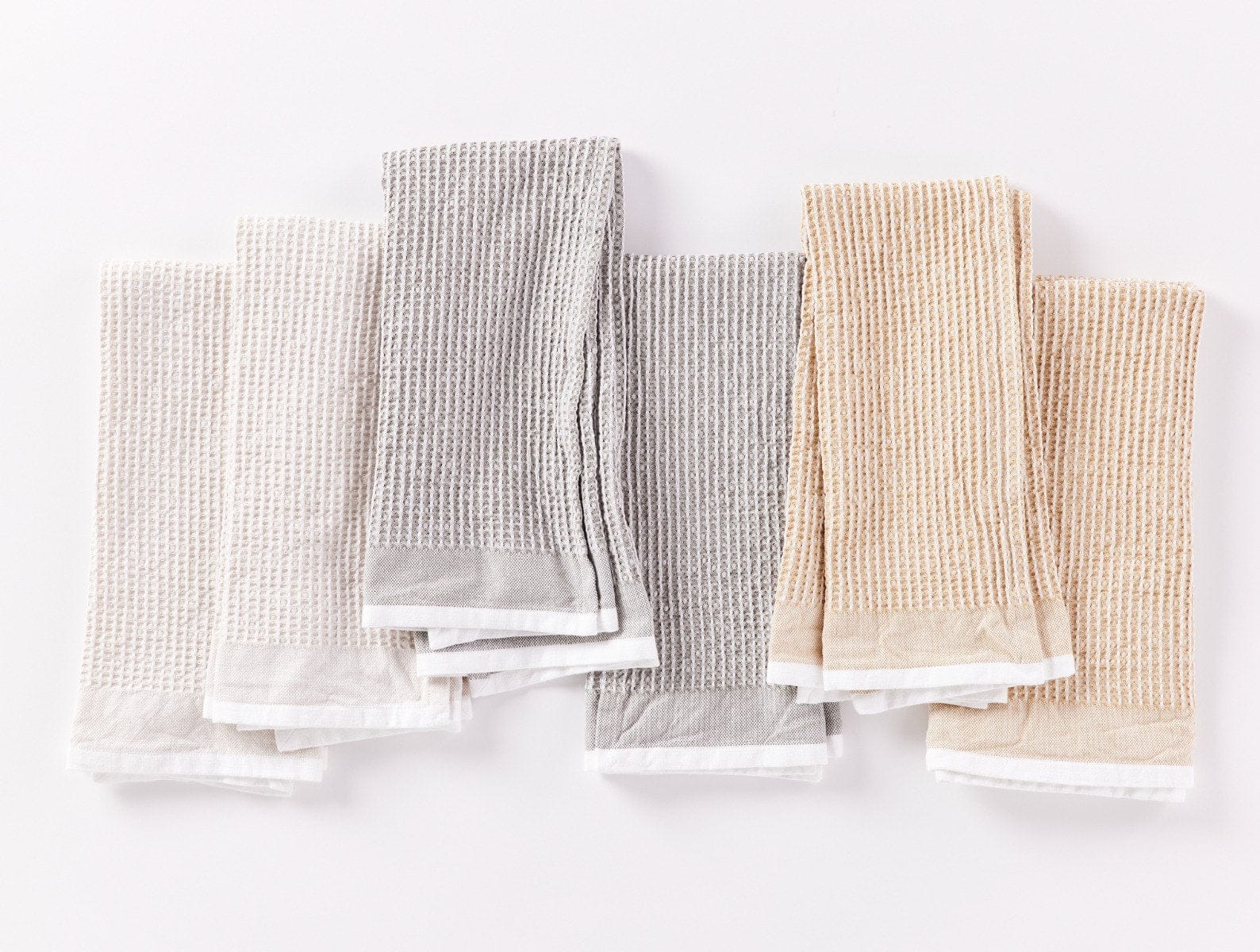
The Coyuchi Organic Waffle Kitchen Towels are made from 100% GOTS-certified organic cotton, traceable to the brand's certification entry in the GOTS public database. Coyuchi discloses the certification number on its product page, and the listing notes no stain-resistant or easy-care finish. The waffle weave is structural: the grid pattern is woven, not chemically treated, and gives the cloth both absorbency and a texture that holds dishes and glassware without slipping.
At $58 for six, the per-towel cost is under $10. That places them at the high end of cotton kitchen towels and at the low end of any towel with a verified organic supply chain. They absorb well from the first wash and improve over the first several cycles as cotton fibers open up. No optical brighteners, no wrinkle finish, no synthetic content.
2. Linen Tales Natural Linen Kitchen Towel: Best linen, best value

The Linen Tales Natural Linen Kitchen Towel is made from 100% European linen with no stated finish, at $48 per towel. Linen Tales (operating as MagicLinen) discloses linen fiber sourcing from European flax on the product page and lists no stain-resistant treatment or easy-care coating. The natural, undyed colorways avoid dye chemistry entirely for the color options we evaluated.
Linen outperforms cotton on a few kitchen-specific metrics: it dries approximately twice as fast after a wash, produces less lint on glassware, and becomes progressively more absorbent and softened with each washing cycle. The initial stiffness of raw linen is not a defect; it softens to a pleasant drape after three to four washes. At $18 for a single large towel, this is the most accessible entry point on this list to a clean linen option.
3. Wild & Stone Organic Cotton Tea Towels, Set of 2: Best organic cotton value

The Wild & Stone Organic Cotton Tea Towels are made from 100% GOTS-certified organic cotton, with dyes certified under OEKO-TEX Standard 100. Wild & Stone states this on the product page and backs it with a SEDEX-audited factory in Tamil Nadu. The plain-weave construction is unfussy and practical: it absorbs quickly, hangs evenly, and washes clean without any finish to degrade.
At $17.99 for a set of two, this is the most accessible certified organic cotton entry on this list. For households that want GOTS coverage on the full supply chain but are not looking to spend $58 for a six-towel set, these are the straightforward option.
4. Boll & Branch Turkish Waffle Hand Towels, Pair: Best at-the-sink cotton

The Boll & Branch Turkish Waffle Hand Towels are woven from 100% Turkish organic cotton certified under GOTS. Boll & Branch lists its GOTS certification on the product page with a traceable certificate. The waffle weave traps water efficiently, the 15-by-22-inch format hangs cleanly from a hand-towel bar, and the pair at $59 works well at the kitchen sink where a fresh towel matters every few uses.
Turkish cotton has a longer staple length than conventional cotton varieties, which contributes to durability: these towels hold up to repeated washing without pilling. The GOTS certificate covers dye and finishing steps, excluding the formaldehyde-based wrinkle-resist treatments that appear on a number of cotton textiles labeled organic fiber.
5. Fog Linen Work Kitchen Cloth, White: Best minimalist option

The Fog Linen Work Kitchen Cloth is a 100% Lithuanian linen cloth at $22, sourced and produced in Lithuania where Fog Linen Work has manufactured since the brand's founding in Japan in the 1990s. The white colorway is undyed: the natural color of the linen fiber without optical brighteners or bleach treatment. Fog Linen Work discloses the fiber and production country on the product page with no stated finish.
The format is compact, roughly 18 by 24 inches, which makes it the right size for wiping countertops and drying single items rather than for stacking service sets. For readers who want one excellent linen cloth in the kitchen rather than a set, this is the right pick.
6. Mungo Pocket Weave Tea Towel: Best artisan mill
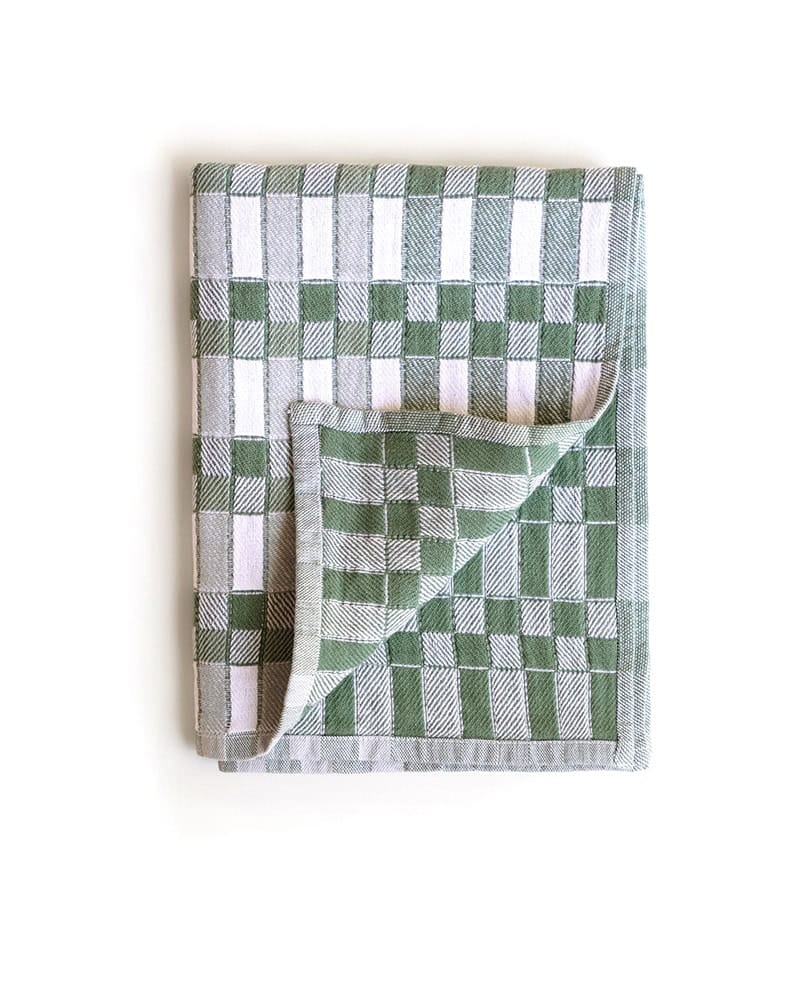
The Mungo Pocket Weave Tea Towel comes from Mungo's mill in Plettenberg Bay, South Africa, where the brand weaves on heritage looms and discloses 100% cotton fiber composition and local production on the product page. The pocket weave refers to a structural weave pattern that creates dimensional texture without chemical treatment. Mungo is one of the few brands on this list where every step from yarn to finished cloth happens in the same facility.
Available direct from the Mungo online store with international shipping; not carried by major North American retailers. Pricing is in South African rand; check the Mungo site for the current amount. For readers interested in artisan textile production with full chain-of-custody transparency, this is the clearest example on the list.
7. Solino Home Fete Kitchen Towels, Set of 2: Most accessible set
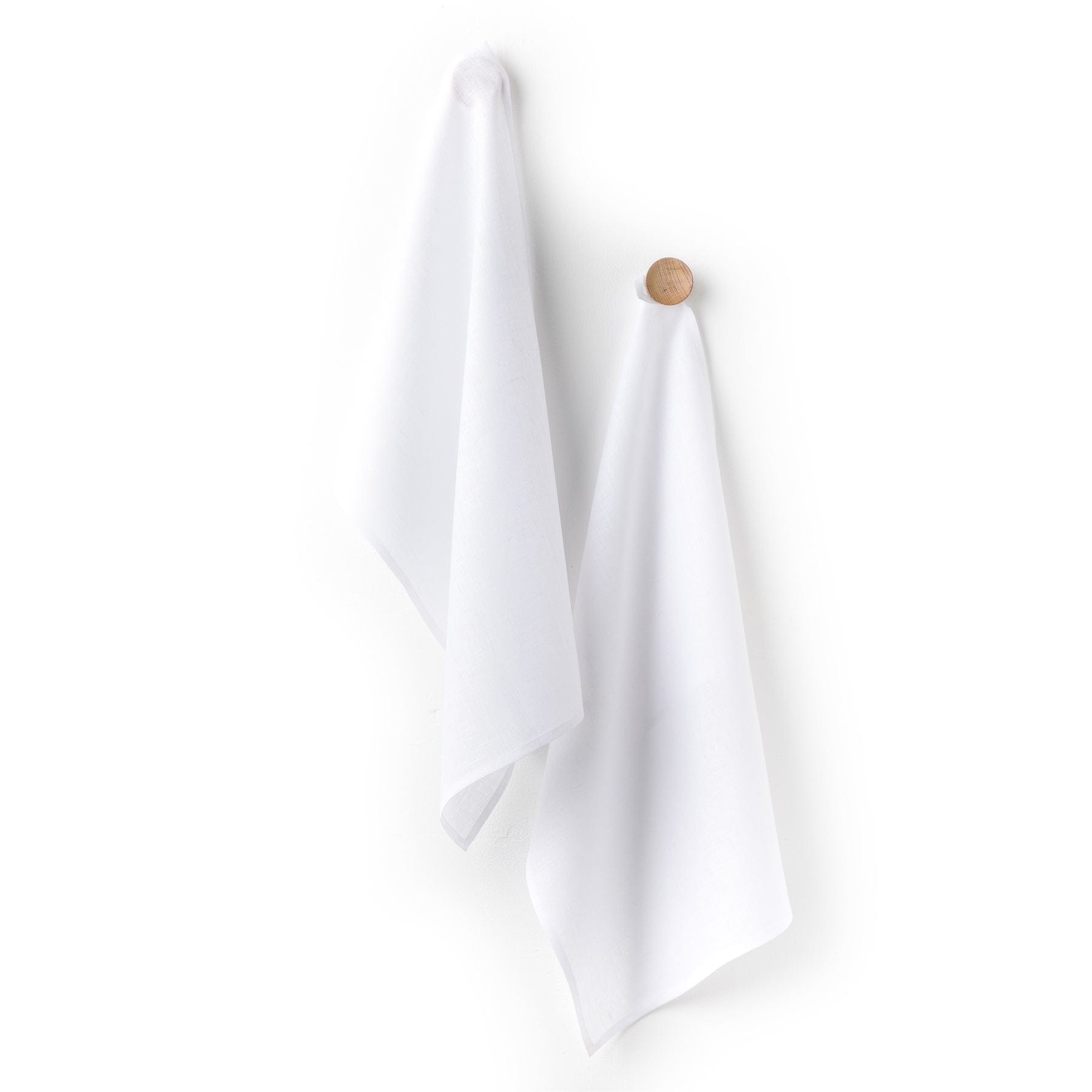
The Solino Home Fete Kitchen Towels use a linen-cotton blend (55% linen, 45% cotton) and sit at the most accessible price point for a set on this list: $25 for two. Solino Home discloses fiber percentages on the product page. The linen-cotton blend absorbs more readily than pure linen on first use while still offering the lint-free characteristic of linen at the surface.
One note: Solino Home does not hold an OEKO-TEX or GOTS certification on this product at the time of research. We included it because fiber disclosure is complete and the blend avoids synthetics entirely, but readers who require a certified supply chain should look to the Coyuchi or Boll & Branch picks instead.
What we passed on
Cotton-polyester blends marketed as sustainable via recycled fiber did not pass our criteria: recycled PET is still plastic, and polyester in direct food contact is a disqualifier. Several brands with easy-care or wrinkle-resistant language on otherwise natural-fiber products were also excluded; the chemistry behind those claims involves formaldehyde-releasing resins applied during finishing, and when a brand declines to name the specific treatment, the product is out. Pact kitchen towels were on the initial research list but the full kitchen category was out of stock at the time of this writing.
Cover image: Ron Lach via Pexels (Pexels License). Source.