Our picks at a glance
| Pick | Best for | Key certifications | Price | Details |
|---|---|---|---|---|
| Coyuchi Organic Crinkled Percale Duvet Cover | Triple-certified percale | GOTS, MADE SAFE, Fair Trade | $ | Full review |
| Boll & Branch Organic Sateen Duvet Set | Complete sateen set | GOTS, Oeko-Tex 100, Fair Trade | $$ | Full review |
| Under the Canopy Organic Cotton Percale Duvet Set | Best value complete set | GOTS, Oeko-Tex 100, B Corp | $ | Full review |
| Pact Cool-air Percale Duvet Cover | Budget GOTS | GOTS, Fair Trade | $ | Full review |
| SIJO LuxeSoft Cotton Duvet Cover | Standalone sateen | GOTS, Oeko-Tex 100 Class 1 | $ | Full review |
| Avocado Organic Cotton Duvet Cover | Broadest cert stack | GOTS, MADE SAFE, EWG Verified | $ | Full review |
| Quince Organic Crisp Percale Duvet Cover | Most affordable | Oeko-Tex 100 | $ | Full review |
Organic cotton bedding is a category where "natural" and "certified" do not mean the same thing. Most percale and sateen sold at major retailers carries some form of chemical finish: wrinkle-resistance treatments (formaldehyde-based resins), optical brighteners, or water-repellent coatings. Some also use azo dyes that can cleave to restricted arylamines under alkaline washing conditions. GOTS certification rules out all of these at the fiber-to-finish level, including at the mill where the fabric is dyed and finished.
This guide covers the duvet cover specifically: the zippered or buttoned textile shell that goes over the insert. It is the part that touches your skin, washes most frequently, and receives the lion's share of the dye and finish chemistry in most bedding sets. If you are shopping for the fill itself, see our guide to non-toxic comforters and duvets. For the sheets underneath, see our guide to non-toxic sheets.
What we look for
The site's 15 standard disqualifiers apply to all textiles. For duvet covers, four of them drive most of the purchasing decisions in this category:
No formaldehyde-based finishes
Wrinkle-free and easy-care treatments on cotton textiles use formaldehyde-releasing resins: urea-formaldehyde, DMDHEU (dimethylol dihydroxy ethylene urea), and closely related compounds. These resins are what let conventional sheets come out of the dryer looking pressed. They are not disclosed on the label, they off-gas at room temperature, and they are classified as carcinogens at occupational exposure levels. GOTS prohibits them. The practical implication: any GOTS-certified duvet cover has never been treated with these compounds. Any "100% cotton" cover without GOTS certification may or may not have been treated, and there is no way to know from the product page.
No optical brighteners
Fluorescent whitening agents make cotton look whiter under visible and UV light. They are not disclosed on product labels in the United States and persist through repeated washing. GOTS prohibits them at every stage of the textile processing chain.
Full dye chain disclosure
GOTS controls the permitted dye classes at the mill. Azo dyes that cleave to restricted arylamines under alkaline conditions are prohibited. So are heavy metals used as intentional dye inputs: lead, cadmium, chromium VI, nickel, and antimony. The GOTS dye restriction is why the same organic cotton, dyed at a non-GOTS mill, does not qualify.
No PFAS water-resistance treatments
A subset of cotton covers, including some marketed as "organic," carry a PFAS-based water-resistance or stain-resistance finish applied after weaving. PFAS-based finishes are a disqualifier on any textile we publish, regardless of the base fiber certification.
We verify each brand's GOTS certificate against the GOTS public registry rather than relying on the hang tag alone. Every product below passed the full 15-disqualifier screen.
If the chemistry is not disclosed and the certificate cannot be verified, it does not go on the site.
Our picks
1. Coyuchi Organic Crinkled Percale Duvet Cover - Best overall

The Coyuchi Organic Crinkled Percale Duvet Cover carries three certifications that together cover chemistry, labor, and the full supply chain from field to finished product: GOTS (TC 836390), MADE SAFE, and Fair Trade Certified. The MADE SAFE certification is the differentiating layer here: it means every ingredient in the product was screened against a hazard list that includes flame retardants, phthalates, bisphenols, and optical brighteners, not just the fiber.
The crinkled texture is a weave structure built into the fabric during production. Many "textured" linens achieve their look through post-weave mechanical or chemical finishing. Here the crinkle is permanent and deepens with washing, which is the opposite of what happens with conventionally finished percale. Most flat percale arrives looking crisp and loses that quality after the first wash; crinkled percale starts relaxed and improves.
The cover is available as a standalone duvet cover or as a set with shams. Sizes run from Twin to California King.
Who it is for: Warm sleepers, buyers who want the deepest available ingredient screening in this category, and anyone who has given up ironing flat percale.
Certifications: GOTS TC 836390 (fiber-to-finish chain audited), MADE SAFE (full ingredient hazard screen), Fair Trade USA (verified wage premium at the mill).
2. Boll & Branch Organic Sateen Duvet Set - Best sateen set

The Boll & Branch Organic Sateen Duvet Set is the sateen option for buyers who want a complete set with two shams included. Percale and sateen are not interchangeable: sateen is woven with more threads per inch on the face of the fabric, which produces a heavier, smoother, more draped surface with a slight sheen. Percale is matte and crisper; sateen is softer immediately out of the package. For buyers who sleep cold or want a heavier feel without adding a separate blanket, sateen is the right construction.
Boll & Branch uses long-staple organic cotton woven at 300 threads per inch. The set ships with two shams and a hemmed edge finish, making it the only complete sateen bedding package in this guide. OEKO-TEX Standard 100 adds a lab-confirmed residual-substance test on top of the GOTS fiber-chain certification: a third party tested the finished textile for residuals of pesticides, processing chemicals, and restricted dye compounds. The two certifications are complementary rather than redundant.
Who it is for: Buyers who prefer sateen's weight and sheen over percale's crispness, cold sleepers who want a warmer cover without a separate blanket, and anyone who wants a complete sateen set (cover plus shams) in one purchase.
Certifications: GOTS certified, OEKO-TEX Standard 100, Fair Trade Certified.
3. Under the Canopy Organic Cotton Percale Duvet Set - Best value

The Under the Canopy Organic Cotton Percale Duvet Set is the only pick here from a certified B Corp. B Corp certification means Under the Canopy's supply chain, labor practices, and corporate governance were audited at the organizational level by B Lab. That is a different kind of accountability than a product-level textile certification: it covers how the company treats workers, what it does with its profits, and whether its environmental claims are auditable. It stacks on top of the product-level certifications rather than replacing them.
The 300-thread-count percale uses GOTS-certified organic cotton and OEKO-TEX Standard 100 covers the finished product for residual substances. At $91 for a Queen-size set that includes two pillowcases, it is the most affordable complete set in this guide by a meaningful margin.
Who it is for: Value-focused buyers who want GOTS certification and a broader organizational accountability layer, and anyone who wants a complete set rather than the cover alone.
Certifications: GOTS certified, OEKO-TEX Standard 100, B Corp certified.
4. Pact Cool-air Percale Duvet Cover - Most affordable GOTS-certified
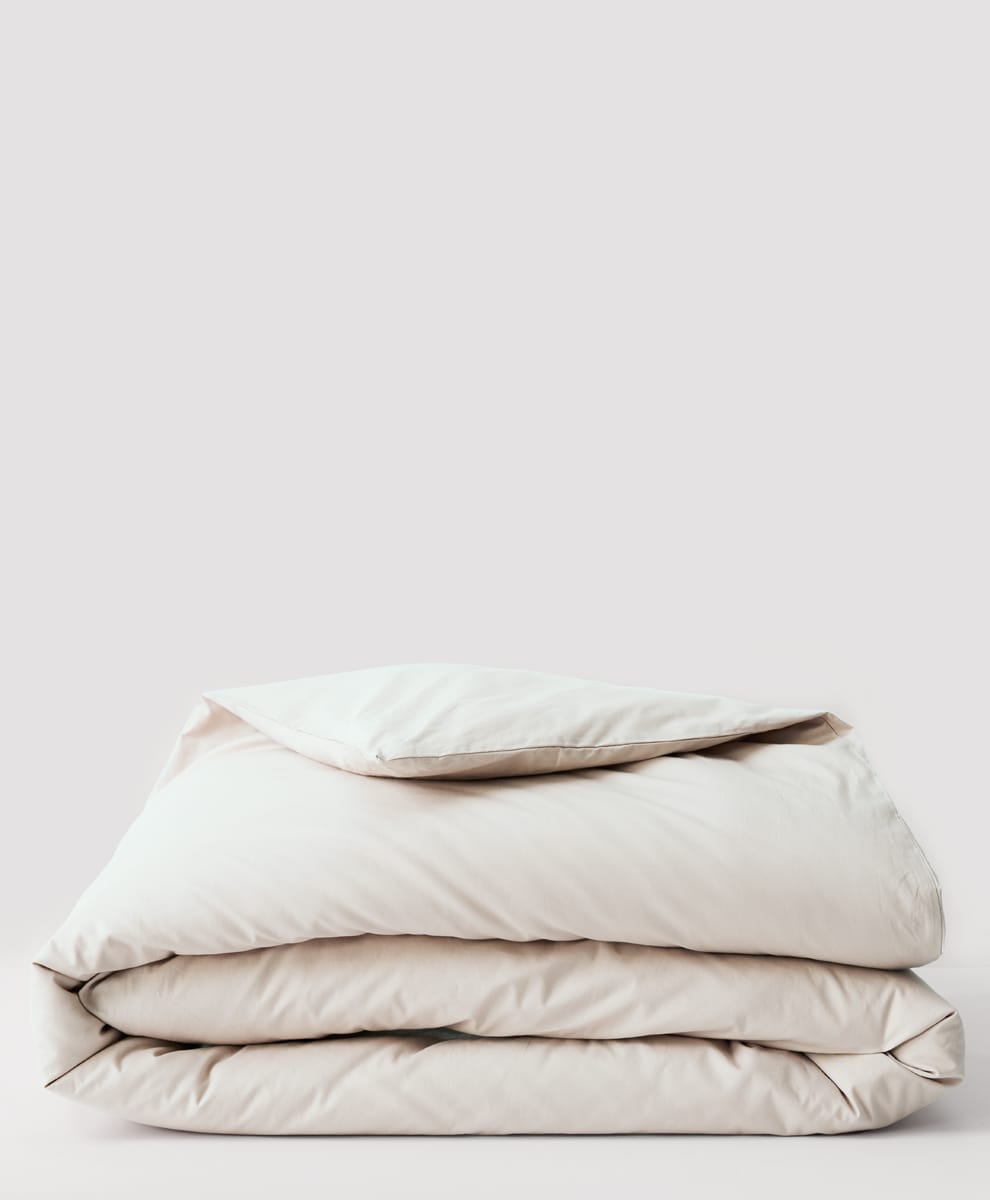
The Pact Cool-air Percale Duvet Cover is the most affordable GOTS-certified option in this guide. Pact's approach to transparency goes beyond the certification: they publish mill names, audit results, and wage data by production region on their website, which lets buyers trace the supply chain further than the certification alone requires.
The "Cool-air" construction is a lighter-weight percale weave. This is the right cover for warm climates, summer use, or hot sleepers. Where the sateen picks run warm, this one runs cool.
Who it is for: Budget-conscious buyers, warm sleepers, and summer bedding shoppers who want GOTS certification at the lowest available price in that class.
Certifications: GOTS certified, Fair Trade Certified.
5. LuxeSoft Cotton Duvet Cover - Best standalone sateen

The SIJO LuxeSoft Cotton Duvet Cover is the sateen option for buyers who want a standalone cover rather than a full set. The 400-thread-count weave uses long-staple organic cotton, GOTS-certified (IDFL 018832) and OEKO-TEX Standard 100 Class 1, the most stringent OEKO-TEX tier and the one applied to infant textiles. Class 1 means the finished textile passed residual-substance testing at thresholds stricter than those for most adult bedding.
Sateen construction surfaces more threads on the face of the fabric, producing a heavier, smoother drape than percale. The practical difference for duvet covers: sateen holds a flat drape across the bed without needing to be straightened as frequently as percale. It also feels noticeably warmer to the touch, which makes it the right pick for cold sleepers who want a substantial outer shell without a heavy fill.
Who it is for: Cold sleepers who prefer a standalone sateen cover (no shams), buyers who want sateen construction with both GOTS chain-of-custody and Class 1 OEKO-TEX residual testing.
Certifications: GOTS certified (IDFL 018832), OEKO-TEX Standard 100 Class 1.
6. Organic Cotton Duvet Cover - Broadest certification stack

The Avocado Organic Cotton Duvet Cover carries three certifications that together cover different layers of product chemistry: GOTS audits the full supply chain from fiber to finished textile, MADE SAFE screens every ingredient against a hazard list covering flame retardants, phthalates, and bisphenols, and EWG Verified adds independent lab testing on the finished product itself. Of the picks in this guide, this is the only one to carry EWG Verified certification.
The set includes two pillow shams. The percale weave is medium-weight and washes well: organic cotton softens with repeated washing without the surface degradation common in conventionally finished cotton.
Who it is for: Buyers who want the broadest available certified ingredient screening, including the EWG Verified finished-product lab test. Buyers who want a complete percale set with two shams.
Certifications: GOTS certified (CU863637), MADE SAFE, EWG Verified.
7. Organic Crisp Percale Duvet Cover - Most affordable

The Quince Organic Crisp Percale Duvet Cover is the lowest-price option in this guide with an independently verified residual-substance screen. The 280-thread-count organic cotton percale carries OEKO-TEX Standard 100 certification (cert 15.HIN.75800 via Hohenstein HTTI), covering over 100 restricted substances including formaldehyde, heavy metals, pesticide residues, and restricted azo dyes on the finished textile. GOTS chain-of-custody certification has not been confirmed for this SKU: the OEKO-TEX finished-product screen is the basis for inclusion here.
The cover ships with a button-front closure and corner ties for securing the insert. The "Crisp" designation reflects the weave: this is the crispest-feeling percale in the guide, with a hand that softens over the first several washes.
Who it is for: Price-sensitive buyers who want a finished-product residual-substance screen and are comfortable with OEKO-TEX rather than GOTS as the primary certification.
Certifications: OEKO-TEX Standard 100 (cert 15.HIN.75800).
What we passed on
Parachute Cloud Cotton and Percale Duvet Covers use conventionally sourced cotton and carry OEKO-TEX Standard 100 but not GOTS. OEKO-TEX Standard 100 tests the finished textile for residual substances, which matters. But it does not audit the permitted dye classes at the mill, the fiber supply chain, or the finishing chemistry applied after weaving. For conventionally sourced cotton, we require GOTS because it covers all three. (Covers on organic-fiber cotton with OEKO-TEX Standard 100 are considered on a case-by-case basis, as with the Quince pick above.) Parachute is a strong brand with real supply chain commitments, but conventional cotton without GOTS is the reason they are not in this list.
A note on bamboo and "bamboo viscose" covers
Several highly rated duvet covers on major retail platforms are made from bamboo viscose or bamboo lyocell. Bamboo viscose (also marketed as "rayon from bamboo") is a synthetic fiber produced through a chemical process that dissolves bamboo pulp using carbon disulfide or similar solvents. The FTC has cited multiple brands for misleading "bamboo" claims on viscose products. Bamboo lyocell (like TENCEL Lyocell) is a less chemically intensive process, but it is still a synthetic fiber, not a natural one. Neither is a natural fiber under the GOTS standard. We do not include them in this guide.
How to care for organic cotton bedding
Organic cotton percale and sateen share the same basic care requirements. Wash on a cold or warm cycle (not hot). Tumble dry on low or line dry. High heat breaks down the cotton fibers faster and causes premature pilling. Do not use dryer sheets: most contain fragrance compounds and surface lubricants that coat the fibers and reduce breathability over time. Distilled white vinegar added to the rinse cycle (half a cup in place of fabric softener) removes mineral buildup and leaves no residue.
Organic cotton does not need to be washed before first use to remove "sizing" chemicals, because GOTS prohibits the chemical sizing agents used in conventional cotton finishing. A cold rinse before first use is still a reasonable practice.
VerifiedFAQ
What is the difference between GOTS and OEKO-TEX Standard 100?
GOTS (Global Organic Textile Standard) audits the entire supply chain from raw fiber through finished product, controlling permitted dye classes, prohibited finishing chemistries (including formaldehyde-releasing resins and optical brighteners), and labor conditions at the mill. OEKO-TEX Standard 100 tests the finished textile for residual substances including pesticide residues, heavy metals, restricted azo dyes, and formaldehyde, but does not audit the processing inputs or supply chain. Both certifications are meaningful; they answer different questions: GOTS is a process audit, OEKO-TEX is a product test.
Do GOTS-certified duvet covers contain formaldehyde-based wrinkle treatments?
No. GOTS prohibits formaldehyde-releasing resins such as urea-formaldehyde and DMDHEU at every stage of the processing chain. Any duvet cover certified under GOTS has never been treated with these compounds. Conventional cotton sold as "easy-care" or "wrinkle-free" typically relies on these finishes, and U.S. labeling law does not require their disclosure; the certification is the only way to verify their absence.
Do I need to wash an organic duvet cover before first use?
Organic cotton certified under GOTS does not require a pre-wash to remove chemical sizing agents, because GOTS prohibits the chemical sizing compounds used in conventional cotton finishing. A cold rinse before first use is still a reasonable practice, but it is not the decontamination step it would be for conventionally finished bedding.
What is the practical difference between percale and sateen construction?
Percale uses a plain weave that produces a matte finish and a crisp hand that loosens with washing. Sateen surfaces more threads on the face of the fabric, producing a heavier, smoother drape with a slight sheen. Percale runs cooler; sateen runs warmer. For buyers who sleep cold or want a more substantial feel without adding a separate blanket, sateen is the right choice. For warm sleepers or summer use, percale is preferred.
Why does the Quince cover not carry GOTS certification?
The Quince Organic Crisp Percale Duvet Cover carries OEKO-TEX Standard 100 certification, which confirms finished-product residual-substance testing against over 100 restricted substances, but GOTS chain-of-custody certification has not been confirmed for this SKU. The OEKO-TEX screen is the basis for its inclusion. Buyers who specifically require GOTS supply chain auditing should choose one of the other six picks in this guide.
Cover image: Susan Wilkinson via Unsplash (Unsplash License). Source.