
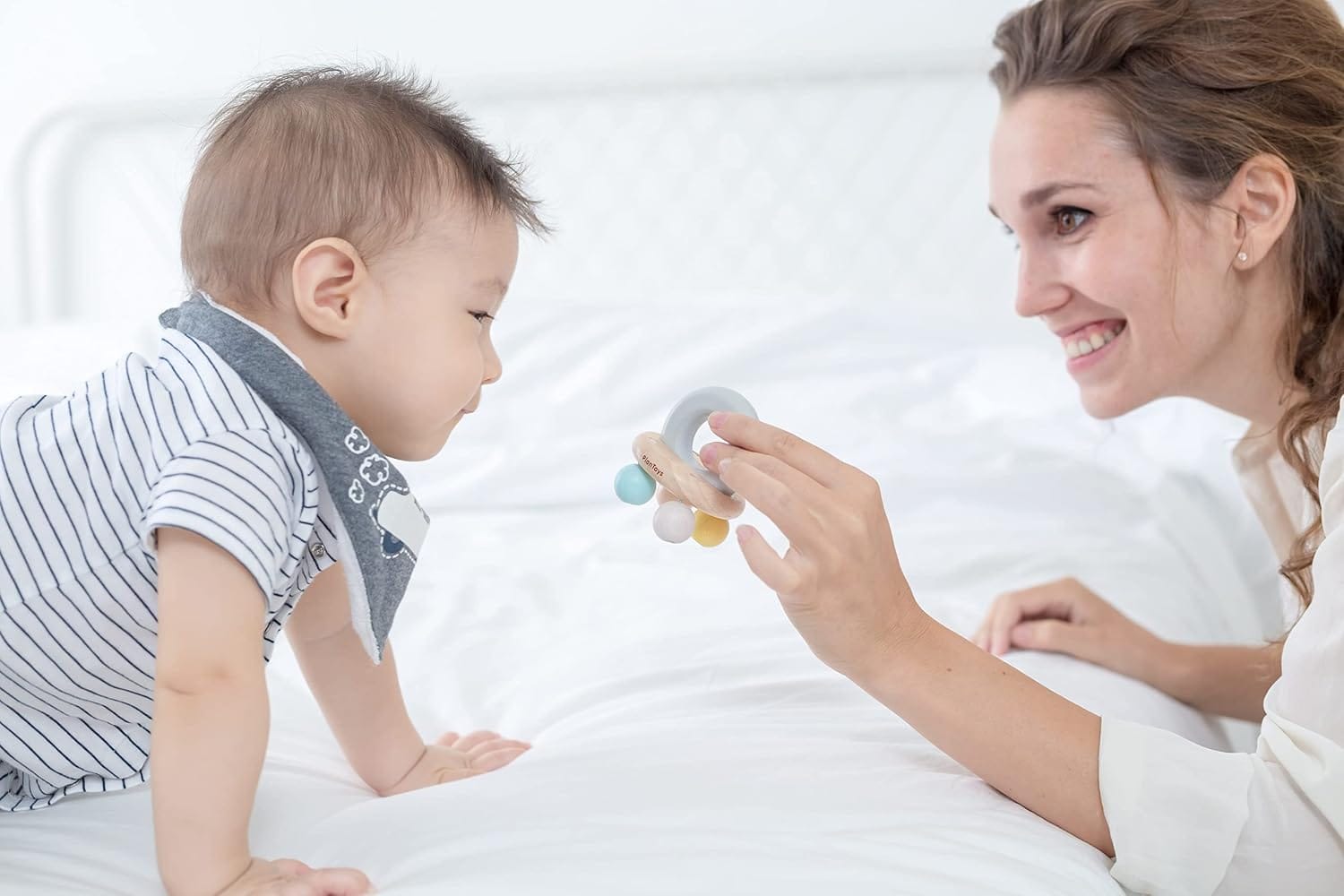
Babies teeth early and mouth everything. The chemistry of the materials they gnaw matters more than most parents expect. A teether that passes the standard visual safety check can still contain undisclosed colorants, plasticizers, or finishing resins that migrate with saliva and heat. This guide covers seven teethers that passed our full disqualifier screen: no PFAS, no phthalates, no bisphenols, no PVC, no formaldehyde releasers, no undisclosed pigments, no antimicrobial biocide treatments. Every pick's material chain is publicly disclosed on the brand's own product page.
What we look for
The three material categories that make up almost every teether are natural rubber, food-grade silicone, and wood. Each has a different failure mode.
Natural rubber carries the highest sensory fidelity for teething: it has give, texture, and a surface that responds to pressure in a way that hard plastics do not. The failure mode is undisclosed additives. Most "natural rubber" products on the market contain colorants, mineral fillers, or processing aids that are not listed anywhere in the product's public documentation. We require full ingredient transparency: the brand must name what is in the compound beyond the base latex.
Food-grade silicone resists bacteria, tolerates the dishwasher, and holds precise shapes. The failure mode is grade and cure method. Platinum-cured silicone is inert; peroxide-cured silicone can off-gas residual byproducts after cure. We require brands to state "food-grade" and "platinum-cured" explicitly, and to hold LFGB certification (the stricter German food-contact standard) or equivalent. "BPA-free" alone is not a pass: it addresses one bisphenol and says nothing about phthalates, cure method, or fillers.
Wood provides texture and density that softer materials cannot replicate. The failure modes are finish and binding. A polyurethane or lacquer finish on a gnawable surface is a disqualifier. We require the finish to be named: food-grade mineral oil, beeswax, or unsealed are the accepted answers. For engineered wood composites such as MDF, particleboard, or bamboo board, the binder chemistry must be disclosed and formaldehyde-free.
Beyond materials, we checked each product against the full disqualifier list published on our promise page: no PFAS, no phthalates, no bisphenols, no PVC, no formaldehyde or releasers, no heavy metals as intentional inputs. Teethers also fall under EU Toy Safety Directive (EN71), ASTM F963 in the US, and EN1400 (the pacifier standard, sometimes applied voluntarily to teethers) for nitrosamine release.
A teether does not need a certification to be safe, but certifications reduce the research burden on our end. When a brand holds GOTS, LFGB, or has voluntarily applied EN1400, at least one third party has independently reviewed the material chain. We note certifications where they exist and flag the absence where they do not.
Our picks
1. HEVEA Panda Soothing Toy Teether: Best overall

The HEVEA Panda Soothing Toy Teether is the clearest materials story of any teether we found: 100% natural rubber from sustainably sourced Hevea brasiliensis, GOTS-certified, no colorants, no fillers, no processing aids beyond the GOTS-covered scope. The panda shape gives babies four distinct surfaces to gnaw, the ears and nose providing different textures from the rounded body. HEVEA is a B Corp and publishes third-party test results on their website; the Danish-made compound has been independently verified against phthalates, nitrosamines, and heavy metals. At $13.95, it hits the midpoint of the price range without compromise on transparency.
2. Sophie la Girafe Original Teether: Best for newborns
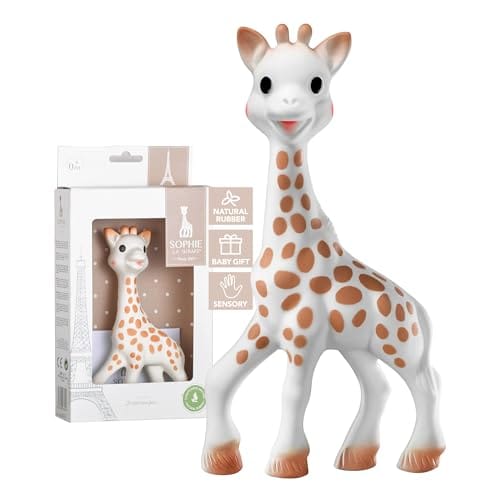
The Sophie la Girafe Original Teether has been made in Rumilly, France since 1961 using the same core process: natural Hevea rubber, hand-painted with food-grade paints derived from natural and mineral pigments, then individually tested. The giraffe's small legs, ears, horn, and spotted body provide at least five distinct textures for gums to explore, making it one of the most versatile shapes for babies who are still finding what feels good. Vulli publishes lot-level EN71 and ASTM F963 test certificates on request, which is unusual for a mass-market brand. The combination of a 64-year production history and batch-traceable documentation puts it in a different category from most competitors.
3. Oli & Carol Wally the Watermelon Teether: Best shape

The Oli & Carol Wally the Watermelon Teether is 100% natural rubber with no dyes, no BPA, and no phthalates, and the watermelon shape gives babies a distinct ridged rind to work against alongside the smoother round flesh. Oli & Carol manufactures in Spain using sustainably harvested rubber and meets EU toy safety standards throughout the range. The dual-texture surface makes this one of the more adaptable picks for babies moving through early, middle, and later teething stages, where different gum areas become sensitive at different times.
4. Loulou Lollipop Lemon Silicone Teether: Best silicone

The Loulou Lollipop Lemon Silicone Teether is the strongest silicone option in the price range. LFGB-certified and platinum-cured, with no BPA, phthalates, PVC, or lead. The lemon shape has a textured outer surface mimicking the peel and a smoother center for gentler relief, giving babies two levels of gum stimulation in one piece. Dishwasher safe on the top rack. At under $13, it is the most accessible price point on this list, and the LFGB standard is meaningfully stricter than US FDA 21 CFR food contact requirements.
5. PlanToys Bell Rattle Pastel: Best rattle-teether

The PlanToys Bell Rattle adds an auditory layer that pure teethers do not: a single wooden ball in the rattle chamber produces a soft, clear sound when shaken, adding a cause-and-effect dimension to the teething function. The handle and bell are made from PlanWood, PlanToys' proprietary formaldehyde-free composite of rubberwood sawdust, finished with water-based, zero-VOC pigments. FSC chain of custody runs through PlanToys' own factory in Thailand, and the material chain is disclosed down to the binding agent, which is rare for a wood composite product. A notable option for families who want one toy that serves both sensory and developmental purposes.
6. Manhattan Toy Skwish Natural Rattle & Teether: Best developmental

The Manhattan Toy Skwish Natural Rattle & Teether is a three-dimensional maple bead structure unlike any other pick here. Natural maple rods and natural rubber cord let babies squeeze and flex the whole piece, building grip strength alongside teething stimulation. The natural maple is left unsealed with no finish, no dye, and no added color. ASTM F963 compliant. The flexible geometry teaches cause and effect as babies discover that squeezing changes the shape, and it transitions naturally from a teether into an early manipulative toy as teething pressure decreases.
7. Apple Park Frenchy Fox Teething Rattle: Best gift

The Apple Park Frenchy Fox Teething Rattle combines a natural rubber teether with a GOTS-certified organic cotton plush in a single piece. The fox's rubber head is the teething surface; the organic cotton body and ears give babies something soft to hold and squeeze. Apple Park publishes GOTS certification covering both the cotton and the textile processing aids, which means the stuffing, dye, and finishing are within the certification scope, not just the outer fabric. ASTM F963 tested. At $16, it is the highest-priced pick on this list, but it is also the most complete sensory object, and the packaging positions it naturally as a baby shower or newborn gift.
What we passed on
CaaOcho Mia the Lamb is 100% natural rubber and passes the disqualifier check, but the catalog already carries a CaaOcho natural rubber teether covering the same material profile. Two picks from the same brand would not serve readers comparing options by material or brand. Ecopiggy Calmies EcoTeether Ball is a clean natural rubber pick, but covers essentially the same sensory profile as HEVEA and Natursutten already on this list. The price tier spread was already well represented without it. Moonjax Natural Rubber Teether did not have batch-level test documentation publicly available at time of writing; the brand's materials page describes the compound clearly but does not link to a certifier's registry entry for this specific SKU.
FAQ
What makes a teether non-toxic?
A non-toxic teether discloses its full material chain, passes at minimum one independent third-party safety test, and contains none of the standard disqualifiers: PFAS, phthalates, bisphenols, PVC, formaldehyde releasers, heavy metals as intentional inputs, or antimicrobial biocide treatments. "BPA-free" alone is not a sufficient screen because it only addresses one bisphenol and says nothing about phthalates, colorants, or processing aids.
Is natural rubber safer than silicone for teethers?
Neither material is inherently safer; both can be clean or problematic depending on formulation. Natural rubber at the GOTS or EN1400 level is well-characterized and has a long history of safe use. Food-grade platinum-cured silicone tested to LFGB is also well-characterized. The key question is whether the specific product discloses its formulation clearly enough to evaluate. A natural rubber teether that will not name its colorants fails on the same terms as a silicone teether without a stated cure method.
Can I sterilize teethers by boiling them?
It depends on the material. Natural rubber teethers should not be boiled or steam-sterilized. Heat degrades the rubber and can cause swelling or surface cracking that creates new texture where bacteria accumulate. Wipe or rinse with warm water instead. Food-grade silicone is heat-stable: dishwasher-safe options like the Loulou Lollipop Lemon can go on the top rack. Wood should never be submerged in water.
Are colored natural rubber teethers safe?
Only when the colorant is specifically disclosed as food-grade and the batch has been independently tested to confirm no migration. Sophie la Girafe's paints are food-grade mineral pigments tested per EN71 with lot-level traceability. An undisclosed "natural color" on a competing product is not equivalent. For anyone who prefers to avoid colorant questions entirely, the HEVEA Panda is uncolored natural rubber.
When should babies start using teethers?
Most babies begin teething between 4 and 7 months, though some start earlier. A teether can be introduced as soon as a baby is showing consistent chewing behavior, which sometimes precedes visible teeth by several weeks. All picks on this list are suitable from birth for sensory exploration; none require visible teeth to be useful, and several including the HEVEA Panda and Sophie la Girafe are specifically designed for pre-tooth gum stimulation.
Cover image: Dijana Tandel via Pexels (Pexels License). Source.


