

Most cookware sold as "nonstick" or "easy-clean" uses PTFE (polytetrafluoroethylene), the fluoropolymer class that includes Teflon. PTFE belongs to the broader PFAS family, and the EPA classifies most PFAS compounds as hazardous at levels once considered negligible. Fully clad stainless steel offers a stable, non-reactive cooking surface with no coating to wear off, chip, or off-gas at high heat.
What we look for
18/10 or 18/8 stainless steel interior. The numbers refer to chromium and nickel content in the steel alloy. 18/10 (304 grade) is the standard for quality cookware: the 10% nickel stabilizes the steel and resists corrosion. 18/8 is the same 304 grade with slightly less nickel and is functionally identical. What matters is that the cooking surface is stainless steel, not aluminum, copper, or a ceramic-style coating.
Fully clad construction, not base-only. A base-only pan bonds multiple metals at the bottom only, leaving the walls as bare single-ply stainless. Fully clad construction runs all three to seven layers from the base up through the walls. The aluminum core in a fully clad pan distributes heat evenly across the entire cooking surface and eliminates hot spots that cause sauces to scorch at the edges. For saucepans that spend time stirring thick sauces, full cladding matters.
No nonstick coating of any kind. This disqualifies PTFE (Teflon and equivalents), ceramic-style coatings (glass-resin hybrids, not food-contact ceramic), and any coating described as "easy-release" without naming the polymer. Even non-PFAS coatings degrade over time and release particles. A bare stainless interior never degrades.
No bare aluminum food contact. Aluminum on the interior surface reacts with acidic foods (tomato, lemon, wine) and can leach at elevated concentrations. An aluminum core sealed between steel layers is fine; the steel is the only metal that touches food.
All-metal handles, welded to the body. Some budget pans use handles with plastic inserts or adhesive bonding that can off-gas under broiler heat. Welded all-stainless handles have no rivets to trap grease and no polymers that might release at temperature.
Lid fit and stainless lid. A well-fitting lid is a heat-management tool. Glass lids allow visual monitoring without lifting; stainless lids are oven-safe to higher temperatures. Glass lids with a stainless rim are common and acceptable.
Our picks
1. ZWILLING Demeyere Industry 5 2.25 qt Sauce Pan with Lid, 18/10 Stainless Steel: Best overall
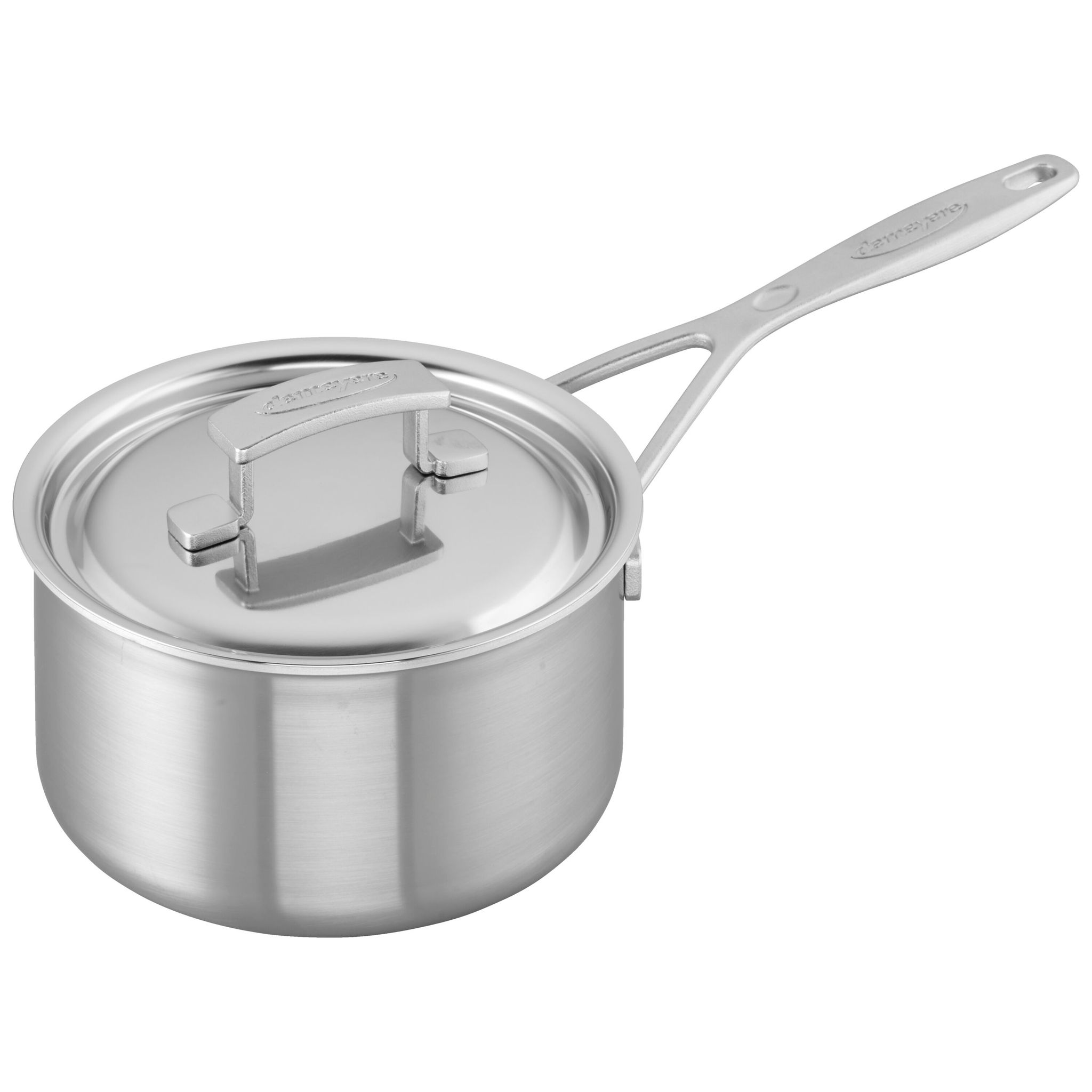
The Demeyere Industry 5 Sauce Pan earns the top spot because Demeyere's materials documentation is unusually specific. The brand states 18/10 stainless steel from rim to rim, identifies the Silvinox treatment as a surface finishing process rather than a coating, and discloses Belgian manufacturing. Five-ply cladding runs the full height of the pan, distributing heat across the walls as well as the base. At 2.25 qt, the pan handles single sauces, reductions, and small batches efficiently. The cast stainless handle is welded with no rivets, keeping the exterior smooth and food-safe. The lid is included. At the $$$ tier, there is a reason this brand appears in professional kitchens: the construction quality and materials specificity set a standard budget pans do not reach. If you buy one saucepan, this is it.
2. Mauviel 1830 M'COOK 5-Ply Sauce Pan with Lid, Cast Stainless Steel Handle, 3.4 Qt: French precision

The Mauviel M'COOK Sauce Pan is a 3.4 qt, 5-ply pan made in France. The ply stack is 18/10 stainless steel on the interior, three aluminum layers in the middle, and ferritic stainless steel on the exterior. No nonstick coating at any layer. The cast stainless handle is entirely metal with no rivets or polymers, and the included lid has a cast stainless knob. Mauviel discloses the ply breakdown on its product page. At 3.4 qt, this pan is slightly larger than the Demeyere saucepan, which makes it more versatile for stocks and grains. The $$$ price reflects the brand's history and French origin. If you prefer a slightly larger saucepan and want French provenance, this is the right alternative.
3. Heritage Steel Eater x Heritage Steel 2 Quart Saucepan with Lid: US-made 5-ply

The Heritage Steel Eater x Saucepan is made in Clarksville, Tennessee. The brand discloses 304 (18/10) stainless steel as the cooking surface, fully clad 5-ply construction, and no nonstick coating. The Eater series is a collaboration with the food media outlet Eater. At 2 quarts, this is sized for reducing sauces, warming small amounts of liquid, and steaming vegetables. The brushed stainless finish shows fewer water spots than a polished surface. For cooks who prioritize US manufacturing over European origin and want 5-ply at the $$ tier, Heritage Steel is the clear choice. The brand's factory, materials, and construction methods are all disclosed on its website.
4. Misen 3 QT Stainless Steel Saucier: Best value 5-ply

The Misen 3 QT Saucier is a saucier rather than a saucepan. The difference is the shape: curved sides instead of straight walls make stirring easier and reduce sticking in the corners. Misen discloses 5-ply stainless steel and aluminum construction, 3.0mm total thickness, and fully clad construction from base to rim. No nonstick coating, no PFAS, no PFOA. At the $$ tier, this is the strongest value case for 5-ply cladding. The direct-to-consumer model keeps the price below what a comparable European pan would cost. The saucier shape makes this particularly good for cream sauces, risotto, and anything that benefits from constant stirring without catching on squared corners.
5. Legend Cookware Stainless Steel 5-Ply Saucepan, 3 Quart: Budget 5-ply

The Legend Cookware 5-Ply Saucepan is a 3-quart fully clad pan with a 304 stainless steel cooking surface and 430 stainless steel exterior for induction compatibility. Legend discloses the alloy grades explicitly and states no PTFE, no PFOA, no PFAS, no lead, no cadmium, and no BPA. At the $ tier, this is the most detailed materials disclosure in the budget segment. Five-ply cladding at this price is not typical; most budget saucepans are either base-only or 3-ply. This pan fills the gap between the value tier and the premium European options above. If budget is the primary constraint and 5-ply cladding is a requirement, this is where to start.
6. Tramontina Triverge 3 Quart Tri-Ply Clad Stainless Steel Sauce Pan with Lid: Entry-level value

The Tramontina Triverge Sauce Pan is a 3-quart, tri-ply clad stainless steel pan. Tramontina discloses 18/10 stainless steel over an aluminum core with no nonstick coating, and explicitly labels the pan PFOA and PFAS free. NSF certification is listed on the product page. Three-ply construction has two stainless layers instead of five, which means slightly less even heat distribution than the 5-ply pans above. For most stovetop tasks, the difference is not significant. What Tramontina offers is fully clad stainless at a price that removes the financial barrier entirely. This pan is widely available, backed by a brand with decades of cookware manufacturing, and passes every material disqualifier without exception.
7. Viking Culinary Viking Contemporary 3-Ply 3.4-Quart Sauce Pan with Glass Lid: Glass lid included

The Viking Contemporary 3-Ply Sauce Pan has a 304 stainless steel interior over an aluminum core with a magnetic stainless exterior. Viking discloses the 3-ply build and identifies the interior as 304 grade. The pan ships with a glass lid, which allows visual monitoring without lifting the lid and releasing steam. At 3.4 quarts, the capacity matches the Mauviel above at a significantly lower price. The conical body profile promotes evaporation during reductions. This is the right pick for someone who wants a glass-lidded saucepan with disclosed stainless grades and no $$$ outlay. Available on the Viking brand site and through major retailers.
8. ZWILLING Demeyere Industry 5 8.5 qt Stock Pot with Lid, 18/10 Stainless Steel: Best overall stock pot
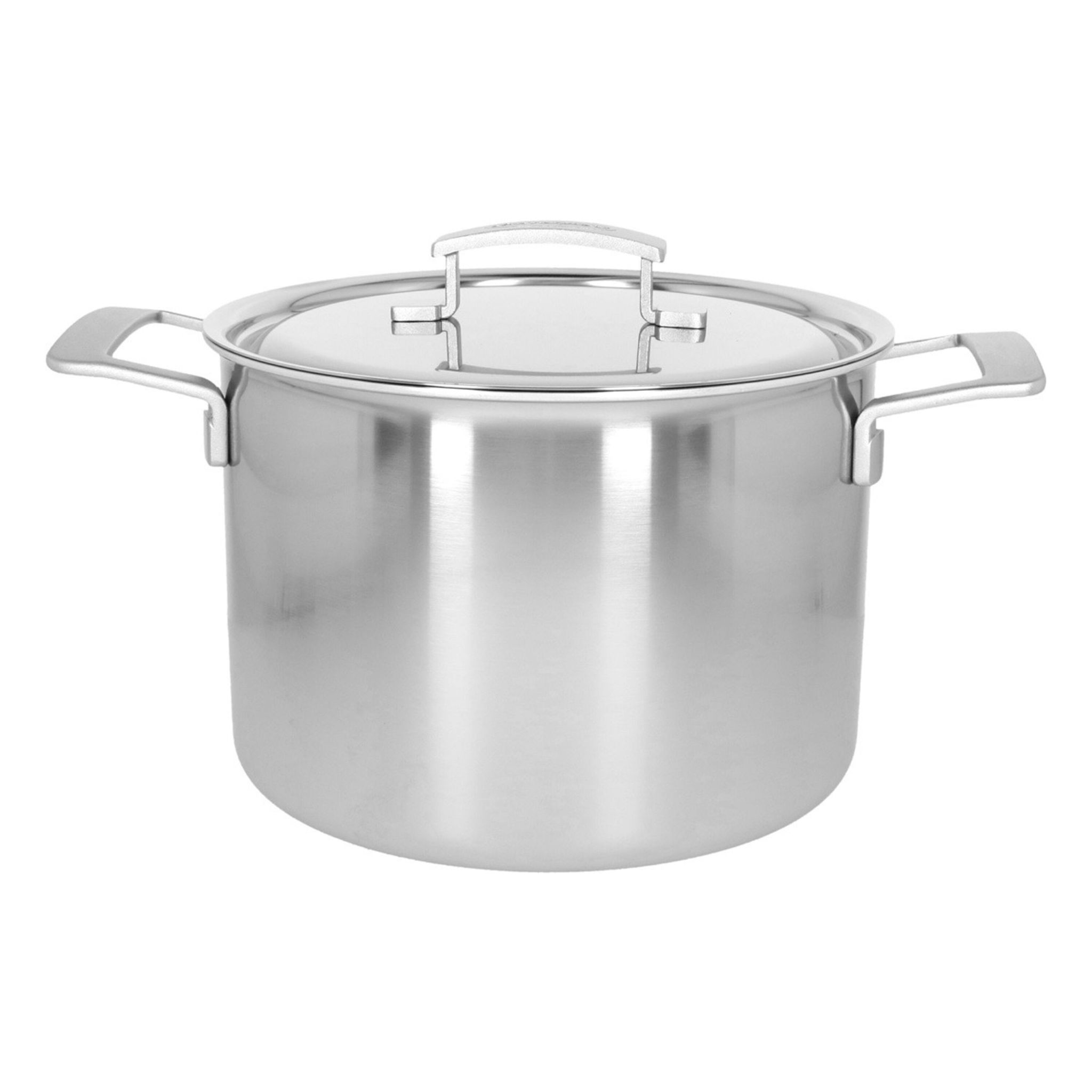
The Demeyere Industry 5 Stock Pot is the same 5-ply, 18/10 stainless, Belgian-made construction as the top-ranked saucepan above, scaled to 8.5 quarts. At 6.69 lbs empty, the pot is heavy for its class: that weight reflects full-height cladding through the body, not just the base. The Silvinox surface treatment is a finishing process that removes free iron from the steel surface and increases corrosion resistance. It is not a coating and does not change the food-contact properties of the steel. This is the right choice if you already own or plan to buy the Demeyere saucepan above. Matched pieces from the same construction line simplify storage and ensure consistent cooking behavior across tasks.
9. Heritage Steel Eater x Heritage Steel 8 Quart Stock Pot with Lid: US-made stock pot

The Heritage Steel Eater x 8 Quart Stock Pot extends the Eater series to stock-pot scale. Same 5-ply, 304 (18/10) stainless, Tennessee-made construction as the saucepan above. At 8 quarts, this pot handles chicken stock, pasta batches, and large soup projects. The wide base improves contact with flat-top stoves. Heritage Steel's disclosure practices are the same at this scale: materials, construction, and manufacturing origin all stated on the product page. If you bought the Eater x Saucepan for US manufacturing reasons, this is the logical stock pot to match it. Available on the Heritage Steel site and on Amazon.
10. Misen 8 QT Stainless Steel Stockpot: Best value stock pot

The Misen 8 QT Stockpot applies the same 5-ply, 3.0mm fully clad construction as the Misen saucier to stock-pot scale. No nonstick coating, no PFAS, no PFOA. Eight quarts handles most home cooking tasks without being unwieldy. At the $$ tier, the Misen stockpot offers 5-ply cladding at a price most competing brands charge for 3-ply. The direct-to-consumer model keeps prices lower than equivalent-spec European cookware. For a home cook who wants matched Misen pieces, buying the saucier and the stockpot together covers most stovetop tasks.
11. Legend Cookware Stainless Steel 5-Ply Stock Pot, 6 Quart: Budget 5-ply stock pot

The Legend Cookware 5-Ply Stock Pot is a 6-quart fully clad pot with 304 stainless interior, 430 stainless exterior, and the same no-PTFE, no-PFAS, no-PFOA disclosure as the Legend saucepan above. The 6-quart size is smaller than most stock pots on this list. That is a reasonable trade at the price if the use case is soups and medium batches rather than large-volume stocks. The 430 stainless exterior is magnetic, so the pot works on induction cooktops. At the $ tier, this is the cheapest 5-ply stock pot on the list. The materials disclosure is specific and matches the saucepan above, making Legend a coherent budget choice if you want matched pieces.
12. Tramontina Signature 8 Quart Tri-Ply Clad Stainless Steel Covered Stock Pot: Value tri-ply stock pot

The Tramontina Signature 8 Quart Stock Pot is a tri-ply, 18/10 stainless steel pot at the $ tier. Same Tramontina disclosure: PFOA and PFAS free, NSF certified, aluminum core bonded between two stainless layers. At 8 quarts, this pot offers the best volume-to-price ratio in the tri-ply segment. It is widely sold at major retailers, which makes finding it easy and warranty service accessible. If you want 8 quarts at the lowest price with fully clad construction and clean materials documentation, this is the right pot. It pairs well with the Triverge saucepan above from the same brand at the same price tier.
13. Viking Culinary Viking Contemporary 3-Ply Stainless Steel 8-Quart Stock Pot: Accessible stock pot

The Viking Contemporary 3-Ply Stock Pot completes the Viking 3-ply set at stock-pot scale. 304 stainless interior, aluminum core sealed inside, magnetic stainless exterior. No nonstick coating. The brand discloses the 3-ply build and the 304 interior grade. Glass lid included. At 8 quarts, the capacity matches the other large stock pots on this list. Viking is widely available at major retailers, so returns and service are straightforward. If you already own a Viking piece, this is the natural match. Otherwise, the Tramontina Signature above is a slightly better price-to-value ratio in tri-ply at the same capacity.
What we passed on
Cuisinart: The brand's mainstream cookware line uses nonstick coatings with no full material disclosure, and the brand fails our precondition on ingredient transparency. The Cuisinart Multiclad Pro is a fully clad stainless line, but we were unable to independently verify the steel grade or ply count from primary brand documentation to our standard. We draft products with a flag when documentation is incomplete rather than publish with unverified claims.
Nonstick cookware broadly: T-fal, Gotham Steel, GreenPan, and similar brands lead with nonstick coatings as their primary cooking surface. PTFE-based coatings belong to the PFAS class (EPA, 2024). Ceramic-style coatings are marketed as PFAS-free but rely on glass-resin hybrid polymers that degrade over time. Neither category passes our material screen.
FAQ
Is stainless steel cookware safe for cooking?
Yes, with the right construction. Fully clad 18/10 stainless steel is a food-safe, non-reactive surface that does not leach harmful chemicals into food under normal cooking conditions. The 10% nickel content can leach at very low levels in prolonged acidic cooking, but the amounts measured in multiple peer-reviewed studies are well below regulatory thresholds. People with confirmed nickel allergies should consult a physician. The risks associated with stainless steel are not in the same category as PTFE coatings or bare aluminum.
What does 18/10 stainless steel mean?
18/10 refers to the chromium and nickel percentages in the alloy: 18% chromium and 10% nickel. Chromium provides corrosion resistance; nickel stabilizes the steel and prevents it from becoming magnetic. This alloy is also called 304 grade and is the standard for quality cookware and food-service equipment. 18/8 (also 304) is functionally identical with slightly less nickel. 18/0 has no nickel and is used in induction-compatible exteriors because it is magnetic.
What is the difference between 3-ply and 5-ply cookware?
Ply count refers to how many bonded metal layers the pan wall has. A 3-ply pan has stainless steel on both sides with one aluminum layer bonded between them. A 5-ply pan adds two more metal layers (alternating aluminum and steel), which improves heat distribution and retention slightly. For most home cooking, the practical difference is small. Five-ply pans are heavier and retain heat better, which can be an advantage for searing and a disadvantage for rapid temperature adjustments.
Can stainless steel pans cause nickel sensitivity?
The nickel in 18/10 stainless steel can leach at trace levels when cooking highly acidic foods for extended periods, such as simmering tomato sauce for several hours. Studies have found that leaching levels are significantly below the tolerable daily intake established by the European Food Safety Authority. For people without a diagnosed nickel allergy, this is not a material concern. For those with confirmed nickel contact dermatitis, 18/0 stainless cookware (nickel-free) is available, though it is not fully corrosion-resistant.
Do these pans need special care?
Stainless steel is more forgiving than nonstick cookware, but a few habits extend its life. Preheating the pan before adding oil prevents sticking. Avoid high heat with an empty pan for extended periods, as this can cause blue or yellow discoloration (heat tint). Bar Keepers Friend powder removes heat tint and stuck food. Avoid steel wool, which scratches the surface. Dishwasher use is generally acceptable for 18/10 stainless, though hand washing preserves the finish. None of these pans require seasoning.
Cover image: Adam Dachis via Unsplash (Unsplash License). Source.


