

Our picks at a glance
| Pick | Best for | Key certifications | Price | Details |
|---|---|---|---|---|
| Truly Free Heavy Duty Degreaser | Heavy stovetop and oven grease | Leaping Bunny | $ | Full review |
| Bon Ami Powder Cleanser, 14 oz | Tough scrubbing on ceramic and enamel | SkinSAFE 100 | $ | Full review |
| Dr. Bronner's Sal Suds, 32 fl oz | Concentrated kitchen and oven degreaser | ECOCERT, Leaping Bunny | $$ | Full review |
| AspenClean Kitchen Cleaner, 22 oz | Everyday kitchen spray | EWG Verified, EcoCert | $ | Full review |
| ATTITUDE Nature+ Citrus Zest, 27 fl oz | Stovetop spray with named fragrance | EWG Verified | $ | Full review |
| Charlie's Soap Kitchen + Bath, 32 fl oz | Minimalist formula at refill pricing | EPA Safer Choice | $ | Full review |
The conventional oven cleaner aisle is built around one chemistry: sodium hydroxide (lye). It dissolves carbonized grease fast, but it also fumes, causes chemical burns on skin contact, and requires ventilation during use. Monoethanolamine (MEA) is the "fume-free" compromise in many products; it is milder than lye but still a respiratory irritant and an occupational sensitizer flagged by the European Chemicals Agency.
None of the six picks on this page use either compound. We also screen against glycol ether solvents (2-butoxyethanol and related), undisclosed synthetic fragrance, and optical brighteners. Every certification claim below links to the issuing authority's registry entry for this product or brand.
What we look for
No caustic alkaline agents. The first check on any oven or stovetop cleaner is whether sodium hydroxide or monoethanolamine appears on the ingredient list. Both cut grease effectively but carry occupational health cautions that make them unsuitable for regular kitchen use without respirators and gloves. The picks on this page replace those chemistry choices with dilute alkaline salts used only as pH adjusters, plant-derived surfactant systems, or mild abrasives.
Surfactant transparency. The word "surfactant" on a label can cover anything from gentle coconut-derived glucosides to ethoxylated surfactants that may carry 1,4-dioxane as a manufacturing byproduct. EPA Safer Choice certification directly addresses this: it screens every ingredient and requires testing for 1,4-dioxane residuals in ethoxylated surfactants. MADE SAFE and EWG Verified require full ingredient disclosure and screen for chemicals of concern across the formulation.
Fragrance disclosure. "Fragrance" and "parfum" as label terms can represent dozens of undisclosed compounds including known sensitizers and phthalate carriers. Every pick on this page either discloses each scent ingredient by name, carries a certification that requires full disclosure, or is fragrance-free entirely.
Certifications weighted most heavily for cleaning products:
- EWG Verified: Full ingredient disclosure required, no chemicals of concern, manufacturing standards reviewed.
- EPA Safer Choice: Designed specifically for cleaning products. Every ingredient passes EPA hazard screening. Screens 1,4-dioxane in ethoxylates.
- ECOCERT: Third-party natural and organic standard covering ingredient origin and biodegradability.
- Leaping Bunny: Cruelty-free supply-chain certification.
The self-clean oven note: If your oven has a self-clean cycle, running it removes baked-on residue without any cleaning product. The cycle heats to around 900 degrees Fahrenheit and oxidizes residue to ash, which wipes out with a damp cloth. The cleaners below are for spot cleaning, cooktops, gas grates, range hoods, and ovens without a self-clean function.
Our picks
1. Truly Free Heavy Duty Degreaser: Best overall
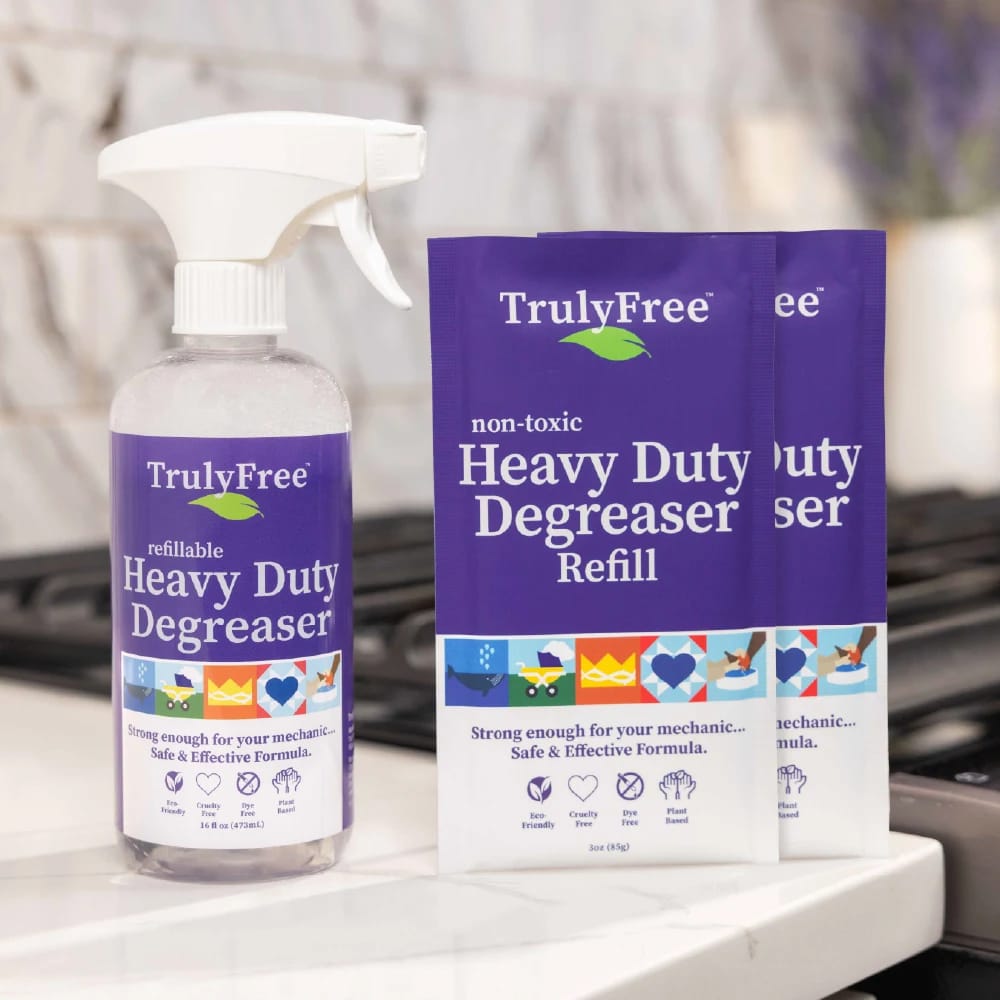
The Truly Free Heavy Duty Degreaser ships ready to use, formulated for stovetop, oven, and kitchen grease specifically. Leaping Bunny certified and manufactured in the USA. The formulation relies on plant-powered surfactants, no glycol ether solvents, no caustic alkalis. The brand discloses ingredients on the product page including the surfactant system.
The 16 oz spray bottle ships with two refill packs, each a 3 oz concentrate that reconstitutes into a full bottle. The refillable model cuts plastic waste and keeps cost per ounce competitive over time. Effective as a spray-and-wipe on stovetop surfaces and as a pre-soak on cast iron or stainless grates before scrubbing.
Best for: Everyday stovetop grease, baked-on splatter, and range grates. Also useful as a pre-treatment for greasy pots before washing.
2. Bon Ami Powder Cleanser, 14 oz: Best for scrubbing
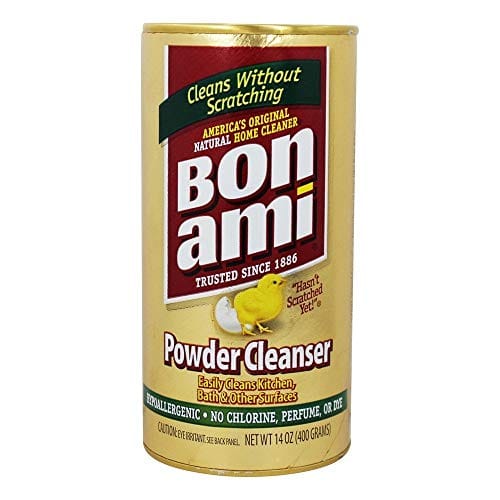
The Bon Ami Powder Cleanser is the only pick here built for scrubbing rather than spraying. Calcium carbonate limestone and feldspar powder provide mild abrasion to lift baked-on residue from ceramic cooktops, cast iron surfaces, and enamel without scratching. Full ingredient list: calcium carbonate, feldspar, sodium bicarbonate, sodium carbonate, C10-C16 alkylbenzene sulfonic acid, alkyl polyglycoside. Fragrance-free, dye-free, and chlorine-free. Made in the USA.
For stuck-on carbonized food on a ceramic cooktop or oven interior walls, a paste of Bon Ami powder and water applied with a damp sponge and left for a few minutes can lift residue that sprays cannot shift. At roughly $4 to $5 for the 14 oz canister, it is also the lowest-cost pick on this page.
Best for: Ceramic cooktop burns, enamel oven interiors, and stainless steel oven grates where physical abrasion is needed alongside chemistry. Not for nonstick surfaces.
3. Dr. Bronner's Sal Suds, 32 fl oz: Best concentrated

Dr. Bronner's Sal Suds Biodegradable Cleaner is built for the heavy work: dilute it for a daily stovetop spray or use it full-strength on baked-on oven grate grease. The ingredient list is water, sodium lauryl sulfate, coco-betaine, Siberian fir needle oil (Abies sibirica), and white spruce oil (Picea glauca). Those are the only scent ingredients, named individually. No fragrance catchall, no MIT/CMIT, no synthetic preservatives.
ECOCERT certified and Leaping Bunny certified. A 32 oz bottle dilutes into roughly 64 quarts of cleaning spray, making it the most economical pick in this guide at well under $0.50 per diluted quart.
Best for: Cost-conscious households and anyone who wants a versatile single cleaner that handles stovetops, oven grates, floors, and dishes from one bottle.
4. AspenClean Kitchen Cleaner, 22 oz: Best everyday spray

The AspenClean Kitchen Cleaner carries EWG Verified and EcoCert certifications on a plant-derived formula built for kitchen surfaces. EcoCert verifies biodegradability and natural ingredient origin, which adds a third-party check on top of EWG's ingredient safety screen. AspenClean discloses every ingredient on the label and on the product detail page, with the EWG database entry confirming the formulation matches.
At $13.99 for 22 oz the price lands comfortably in the mid-range for certified kitchen sprays. No synthetic fragrance, no petroleum solvents. Effective on stovetop surfaces, counters, and appliance exteriors.
Best for: Daily kitchen spray use for households that prioritize both natural-origin certification and full ingredient transparency.
5. ATTITUDE Nature+ Citrus Zest, 27 fl oz: Best stovetop spray
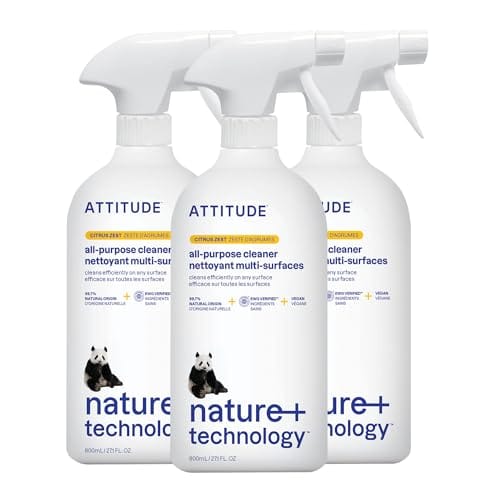
ATTITUDE Nature+ All Purpose Cleaner, Citrus Zest is EWG Verified and specifically positioned for stovetops and cooking surfaces. The surfactant blend is caprylyl glucoside, myristyl glucoside, and lauryl glucoside, all plant-derived. The citrus scent comes from named aroma compounds: terpineol, terpineol acetate, and tetrahydrolinalool. There is no catchall "fragrance" entry. EWG Verified means every ingredient was individually screened against the organization's database.
No SLES, no EDTA, no ammonia, no MIT/CMIT. At 27 fl oz, it is the largest-volume ready-to-use spray in this guide.
Best for: Households that want named fragrance ingredients alongside EWG Verified status for everyday stovetop and kitchen spray use.
6. Charlie's Soap Kitchen + Bath Cleaner, 32 fl oz: Simplest formula
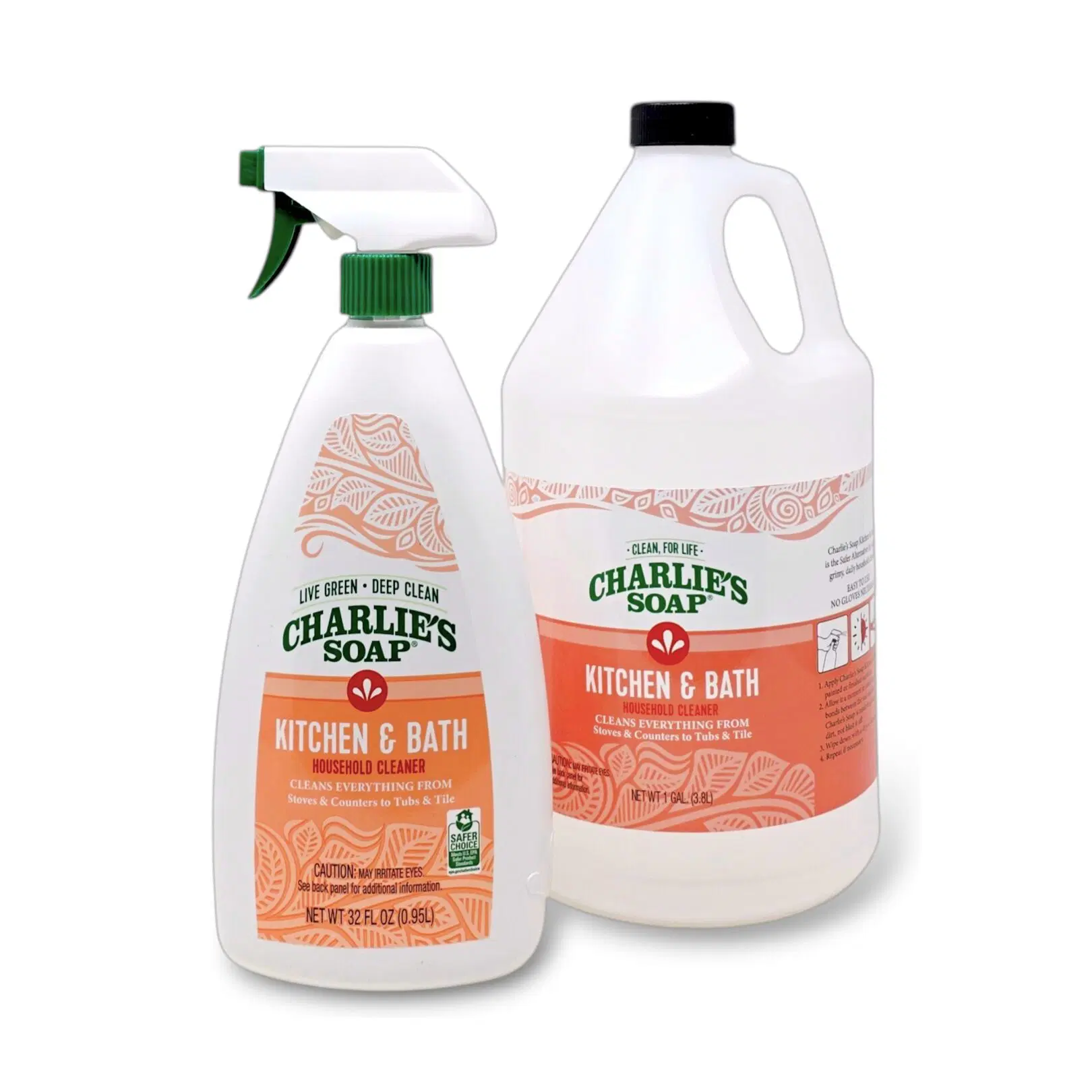
Charlie's Soap Kitchen + Bath Household Cleaner carries EPA Safer Choice certification on a one-surfactant formula: sodium lauryl sulfate, water, and nothing else beyond what Safer Choice requires. This is the shortest ingredient list of any certified cleaner on this page. No added fragrance, no dyes, no preservatives.
At around $17 for 32 oz with a one-gallon refill available, the per-use cost drops below $0.25 at refill pricing. Effective across stovetops, counters, sinks, and tub tile. The gallon refill is particularly cost-effective for high-frequency kitchen cleaning.
What we passed on
Branch Basics Concentrate is MADE SAFE and EWG Verified with a strong heavy-duty dilution, but it is marketed as a general multi-surface concentrate that dilutes across several cleaning jobs. It belongs in a whole-home cleaning guide rather than a guide specific to oven and stovetop surfaces.
Force of Nature Starter Kit produces hypochlorous acid for sanitizing, which is effective against pathogens but not designed as a grease degreaser. It belongs in a kitchen disinfectant guide, not an oven cleaner guide.
Aunt Fannie's APC Spray Fragrance Free is a high-quality cleaner with an EWG A score, but the primary active is dilute acetic acid (vinegar). Vinegar works as a light surface cleaner but is not a degreaser and the product is not positioned for oven or stovetop grease.
ECOS Orange Plus APC is EPA Safer Choice certified and affordable, but marketed as a general all-purpose cleaner with no dedicated oven or stovetop positioning.
ATTITUDE Nature+ APC Unscented was replaced by the Citrus Zest variant from the same ATTITUDE Nature+ line. The Citrus Zest product's features explicitly target stovetops and cooking surfaces; the unscented variant does not make that specific claim.
Several widely marketed "green" kitchen sprays failed the ingredient screen. Method Heavy Duty Degreaser lists "Fragrance (Parfum)" without naming compounds. Grab Green Kitchen Power Degreaser contains methylchloroisothiazolinone (MIT/CMIT), a biocide preservative this site disqualifies in cleaning products. Better Life All Purpose Cleaner contains methylisothiazolinone, same screen failure.
FAQ
Is sodium hydroxide in oven cleaners dangerous?
Sodium hydroxide (lye) is a caustic base that causes chemical burns on contact with skin and eyes and produces fumes that irritate the respiratory tract. Occupational health guidelines require gloves, eye protection, and ventilation when working with it at household-cleaner concentrations. None of the six picks on this page contain sodium hydroxide. For heavy baked-on oven residue, the Truly Free Heavy Duty Degreaser is the strongest non-caustic option here.
Can I use these cleaners in a self-cleaning oven?
Yes, these products are safe on oven interior surfaces. That said, if your oven has a self-clean cycle, running it is the simpler path for baked-on residue: the cycle heats to around 900 degrees Fahrenheit and oxidizes residue to ash, which wipes out with a damp cloth. The products on this page are most useful for spot cleaning between cycles, gas stovetops, range grates, and ovens without a self-clean function.
What does EPA Safer Choice certification cover?
EPA Safer Choice screens every ingredient in a cleaning product against the EPA's Safer Choice Standard, evaluating human health and environmental hazard at each concentration in the formula. It also requires manufacturers to test ethoxylated surfactants for 1,4-dioxane residuals and meet a threshold. One pick on this page carries this certification: Charlie's Soap Kitchen + Bath.
Which picks work on gas burner grates?
Truly Free Heavy Duty Degreaser and Dr. Bronner's Sal Suds at full strength are both effective on cast iron and stainless steel gas grates. Remove the grates, apply generously, let sit for 5 to 10 minutes, then scrub with a stiff brush and rinse. For ceramic cooktop burns, Bon Ami Powder Cleanser is more effective: the mild abrasive lifts baked-on residue that sprays alone cannot shift.
Are these cleaners safe around food-contact surfaces?
All six picks use surfactant systems that rinse clean and are certified by at least one third-party body (EWG Verified, EPA Safer Choice, or ECOCERT). After use on stovetop surfaces or oven interiors, rinse with a damp cloth. Bon Ami Powder Cleanser should be rinsed off fully before cooking on the surface. Dr. Bronner's Sal Suds should be diluted and rinsed from food-contact surfaces after cleaning.
Cover image: Curtis Adams via Pexels (Pexels License). Source.