

| Pick | Best for | Key specs | Certs |
|---|---|---|---|
| TOM Westchester | Best overall | 64"W · 8-way hand-tied springs · LA-made | GOLS · GOTS · FSC |
| Pure Upholstery Chatham 59" | Compact rooms | 59"W · OTCO wool wrap · FSC maple | Greenguard Gold adhesive |
| Medley Dekayess | Design variety | Dunlop latex · GOTS cotton · hardwood frame | Greenguard Gold |
| TOM Alice Sofa 72" | Wide rooms | 72"W · OEKO-TEX linen blend fabric | GOLS · FSC · Greenguard Gold |
| Medley Zavis | Scandinavian profile | 58"W · PureBond plywood · GOLS latex | GOLS · OEKO-TEX |
| BioSofa Elisabetta | Down cushion feel | Goose down layer · velvet jacquard · EU-made | FSC · OEKO-TEX 100 · RDS |
| BioSofa Stellina | Smallest footprint | Most compact · same fill stack as Elisabetta | FSC · OEKO-TEX 100 · RDS |
Most loveseats sold in the US are built on a polyurethane foam core. Polyurethane foam is petroleum-derived, off-gasses VOCs as it ages, and — because it's inherently flammable — requires chemical flame retardants to meet California's TB 117-2013 standard, which has influenced furniture sold nationally even outside California. The retardants used historically include polybrominated diphenyl ethers (PBDEs), organophosphates, and chlorinated compounds, all of which migrate out of foam over time and accumulate in house dust. Infants and toddlers face the highest exposure because they spend more time on or near upholstered surfaces and hand-to-mouth contact is constant.
The alternative is a sofa built on materials that are inherently fire-resistant: natural latex, wool, and goose down all meet the flammability threshold without added chemistry. That's been understood by specialty makers for decades, but those makers were long a niche. The brands on this list now span price points from entry-level to premium and offer genuine aesthetic variety — which means buyers no longer have to choose between clean materials and a couch that looks like it belongs in a hospital waiting room.
Every pick on this list was evaluated against our full disqualifier checklist. No polyurethane foam. No chemical flame retardants. No phthalates, no PFAS fabric treatments, no formaldehyde-based binders or varnishes. Certifications are verified against issuer registries — a cert cited on a brand's website that doesn't appear in the certifying body's registry doesn't count.
What we look for
No polyurethane foam, anywhere. This is the baseline. That includes CertiPUR-US foam: the CertiPUR certification screens for heavy metals and certain VOC thresholds, but the material is still polyurethane — it still requires flame retardants, still off-gasses, and still degrades into microplastic particles. A sofa advertised as "CertiPUR-US certified" with no further qualification is foam-filled. Every pick on this list replaces foam with natural latex, wool batting, or goose down — all of which pass fire standards without chemical intervention.
Natural flame barrier, verified. The most common natural flame barrier in quality upholstered furniture is wool batting wrapped around the cushion core. Wool is inherently self-extinguishing and meets TB 117-2013 without additives when sufficient thickness is present. Natural latex also meets fire standards on its own, and some brands use both in combination. We required that the specific barrier material be named and traceable — not just a claim that no flame retardants were used.
Frame: solid hardwood or documented plywood. Particleboard and MDF use urea-formaldehyde binders that off-gas over years of indoor use. We required solid wood frames (FSC certification preferred) or documented formaldehyde-free plywood (Columbia Forest Products PureBond is the most common verified option). Engineered wood is acceptable only when formaldehyde content is confirmed by testing or third-party certification, not just stated on a product page.
Full material disclosure. Every layer — fill, batting, frame, fabric, adhesive — must be named. "Proprietary blend" or "natural fill" alone is not sufficient; we need the actual material. Brands that disclose by layer (latex cushion + wool batting + hardwood frame + water-based adhesive) tell us far more than brands that lead with a vague certification claim. The sourcing trail for each pick is recorded in that product's attribute set on this site.
Certifications that hold up. GOLS (Global Organic Latex Standard) is the primary certification for organic natural latex; it requires at least 95% certified organic raw material and covers processing. GOTS (Global Organic Textile Standard) covers organic cotton and wool textiles from farm through manufacturing. FSC covers the wood supply chain. RDS (Responsible Down Standard) verifies down fill. OEKO-TEX Standard 100 tests finished textiles for a wide range of harmful substances — it's the most common supporting cert on fabrics and coverings. Where these certs appear, we verify the specific product or manufacturer in the relevant registry.
Our picks
1. The Organic Mattress Westchester Organic Loveseat — Best overall

The Westchester Loveseat is built on eight-way hand-tied springs — an older, more labor-intensive construction than the sinuous springs in most modern sofas, and one that holds its shape longer under regular use. The seat cushions are GOLS certified organic latex; the flame barrier is natural wool batting; the frame is FSC-certified kiln-dried solid maple with corner-blocking. Cover fabrics are available in GOTS certified organic cotton or OEKO-TEX certified options, which means the textile layer meets the same standard as the fill.
Every certification cited is verifiable: GOLS via Ecocert's registry, FSC via the FSC certificate database, GOTS via the GOTS public database. This is a Los Angeles–made piece, which shortens the supply chain and makes production visits feasible for a brand that needs to stand behind its vetting claims. The 64-inch width sits comfortably in the two-seat loveseat range without dominating a smaller room.
2. Pure Upholstery Chatham Organic Loveseat (59") — Best for compact rooms

The Pure Upholstery Chatham at 59 inches is the narrowest piece on this list and the most practical choice for smaller living rooms or apartments where a standard 72–84-inch sofa would be disproportionate. The construction mirrors the standard set by the other top picks: GOLS certified organic latex cushions wrapped in OTCO-certified organic wool, which serves as the fire barrier. The frame is FSC-certified kiln-dried solid maple, and the adhesive used in assembly is Greenguard Gold certified — which means low-VOC emissions are confirmed on the adhesive layer, not just on the fill.
No MDF, no particleboard, no polyurethane foam. The wool wrap is thick enough to meet fire standards without any chemical treatment, which is the key criterion Pure Upholstery addresses directly in its documentation. For a brand that's worked almost exclusively with natural materials from the start, the claim has a longer track record than some newer entrants.
3. Medley Home Dekayess Sofa in Natural Latex — Best for design variety

The Medley Dekayess is notable for what its Greenguard Gold certificate covers: the finished assembled piece, not just individual components. Greenguard Gold tests the full furniture unit for VOC emissions under realistic indoor conditions — it's a more meaningful certification than component-only testing because it accounts for interactions between the frame, fill, adhesive, and fabric together.
The fill is natural Dunlop latex, which meets fire standards without added retardants. The frame is solid North American hardwood (not particleboard or MDF), and the upholstery is GOTS-certified organic cotton with no polyester fill or synthetic finishing treatments. Medley offers a wide range of cover fabrics; buyers should verify that their chosen fabric is GOTS or OEKO-TEX certified — Medley's certifications page lists which options qualify. Medley sources from North American makers and maintains detailed certifications documentation that the brand makes publicly accessible.
4. The Organic Mattress 72" Alice Sofa in Sequoia Ecru — Best for larger rooms

At 72 inches wide with a 35-inch depth and 18-inch seat height, the TOM Alice Sofa is the widest piece on this list and the right call for rooms that need a sofa that reads as a sofa rather than a loveseat. The Sequoia Ecru cover — a Two Sisters Ecotextile blend of 45% viscose, 37% cotton, and 18% linen — is OEKO-TEX Standard 100 certified, which means the finished textile has been tested for harmful substances including formaldehyde, pesticide residues, and heavy metals.
The fill is GOLS certified organic latex cushions wrapped in OTCO certified organic wool; the adhesive is Greenguard Gold certified (water-based Simalfa); the frame is FSC-certified kiln-dried solid poplar. The sinuous spring system uses recycled steel. Made in Waco, Texas. The Alice's certification stack is one of the most complete on this list: GOLS, FSC, Greenguard Gold, and OEKO-TEX all independently verified.
5. Medley Home Zavis Sofa in Natural Latex — Best Scandinavian-profile option
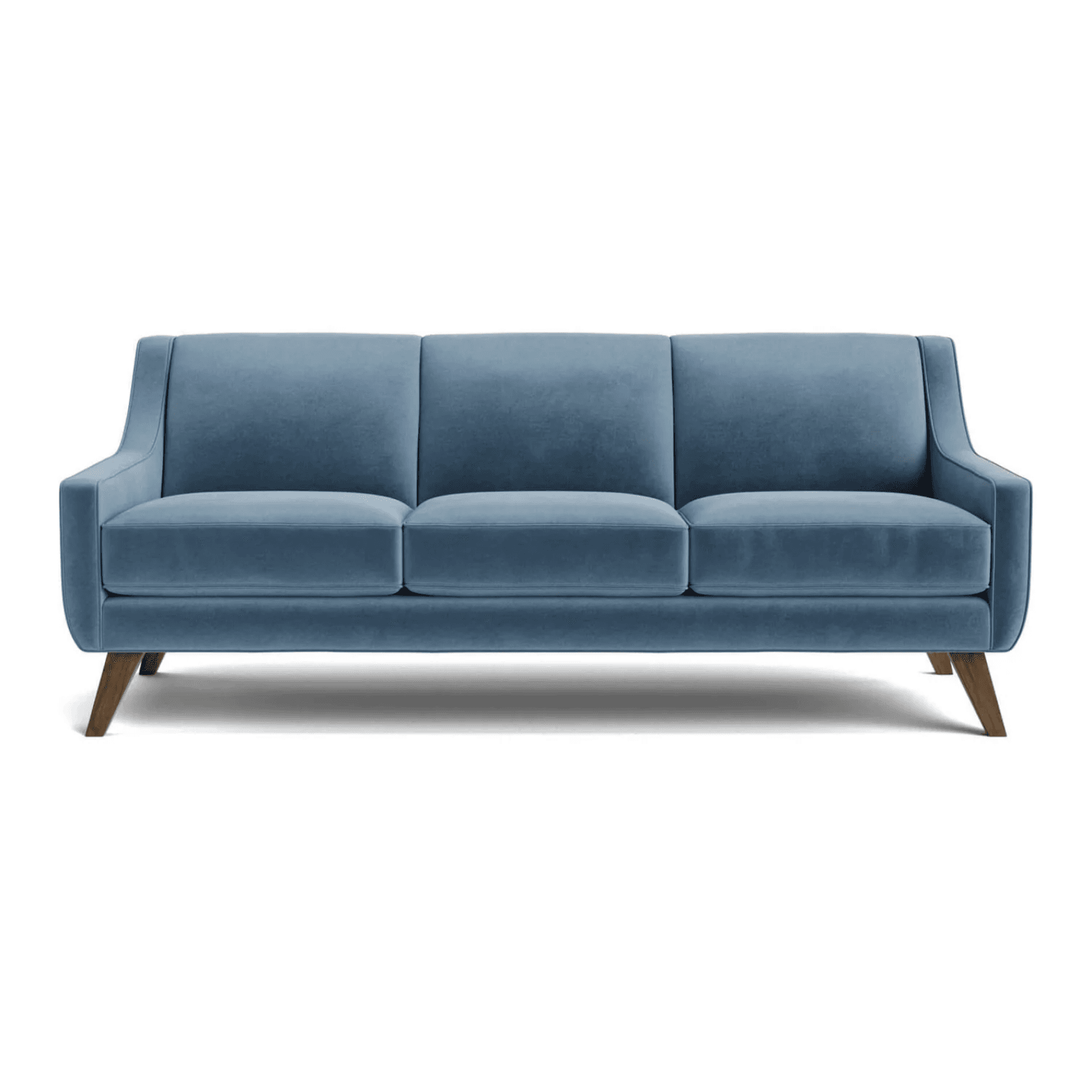
The Medley Zavis has a lower-slung, cleaner profile than the more traditional English-arm pieces at the top of this list — closer to mid-century modern than classic American upholstery. The 58-inch loveseat configuration uses GOLS certified natural latex cushions and OEKO-TEX certified wool wrapping for the fire barrier. The frame is solid wood; the plywood used in the structure is Columbia Forest Products PureBond, which is formaldehyde-free by construction (uses soy-based adhesive rather than urea-formaldehyde binder).
The Zavis is also available in an 82-inch sofa size, built on the same material stack. For buyers who want the clean sight lines of a more modern profile without sacrificing material integrity, the Zavis is the most aesthetically versatile pick on the list. Medley operates showrooms and manufacturing in North Carolina and California.
6. BioSofa Elisabetta Loveseat — Best European-made option

BioSofa is a European maker that has been building natural-fill upholstered furniture before "non-toxic" became a marketing category. The Elisabetta Loveseat uses a layered construction: solid dried beechwood frame, jute webbing and steel springs, 100% natural latex padding, recycled cotton, and a goose down layer on top. That last element — the down — gives the Elisabetta a softer, more pillow-like feel than the all-latex US-made picks. The down is RDS (Responsible Down Standard) certified.
The velvet jacquard upholstery fabric is OEKO-TEX 100 certified; the latex carries Euro Latex certification; the beechwood frame is FSC certified. For buyers who prefer the feel of down-cushion seating over the firmer spring-back of natural latex alone, the Elisabetta is the only piece on this list that includes a down layer with verified chain-of-custody documentation.
7. BioSofa Stellina Loveseat — Best compact option

The BioSofa Stellina shares the Elisabetta's material stack — solid dried beechwood, jute belts, steel springs, natural latex, recycled cotton, and RDS-certified goose down — in a more compact footprint. Where the Elisabetta reads as a formal European piece with its velvet jacquard upholstery, the Stellina's profile is smaller and more neutral. For buyers who want the BioSofa fill stack in the smallest available format, or for secondary seating in a bedroom or office, the Stellina is the practical choice.
The certification stack is identical to the Elisabetta: FSC beechwood, Euro Latex, OEKO-TEX 100, RDS down. No chemical flame retardants, no synthetic foam, no undisclosed materials.
What we passed on
Albany Park makes well-reviewed performance sofas, but their frames use high-resilience polyurethane foam cores. CertiPUR-US certified foam is still polyurethane — the certification addresses specific contaminant thresholds and VOC limits within that foam category, not the material itself. It fails our disqualifier §2 (no plastics or polyester as primary fill in seating). Albany Park does not offer a natural-fill configuration.
Amish Direct Furniture builds solid-wood frames using traditional joinery — the frame construction would otherwise qualify. The disqualifying element is their catalyzed varnish top coats, which use a formaldehyde-based cross-linker. This fails §7 (no formaldehyde or releasers). Until they document a switch to water-based or oil-only finishes, no Amish Direct piece clears our standard.
Also considered but not yet intaken into our catalog: The Futon Shop Custom Organic 2 Arms Loveseat Modular, BioSofa Domino 2 Seater Sofa, BioSofa Rafael 2 Seater Sofa, and the Cisco Home Seda Loveseat – Inside Green configuration. These are not failures — they are queue items for the next intake pass on this category.
FAQ
Why does CertiPUR-US foam fail your standard?
CertiPUR-US certifies polyurethane foam that meets specific limits for heavy metals, VOCs, and certain flame retardants. What it doesn't do is replace the polyurethane itself. Polyurethane is a petroleum-derived plastic; it degrades over time into microplastic particles, off-gasses VOCs as it ages, and is inherently flammable in a way that natural latex and wool are not. The CertiPUR designation is a meaningful improvement within the foam category, but it doesn't make foam equivalent to a natural fill.
How does wool meet fire standards without chemical treatment?
Wool fiber has a high ignition temperature (around 570°C), a low heat of combustion, and a high limiting oxygen index — it doesn't sustain a flame in typical indoor oxygen concentrations. When sufficient thickness of wool batting is wrapped around a cushion core, the composite system can meet California's TB 117-2013 smolder test without any chemical retardant applied to the fabric or fill. Manufacturers who use this approach submit the finished seat assembly for testing; the test report (not just a brand claim) is what verifies it.
Is natural latex safe for people with latex allergies?
Natural latex in upholstered furniture presents a different exposure profile than latex gloves or medical products. Vulcanized latex used in sofa cushions is cured and washed; the residual protein content that triggers most latex allergies is substantially lower than in dipped latex products like gloves. That said, people with documented latex protein hypersensitivity (Type I allergy) should consult their allergist before purchasing any natural latex furniture. This category note is not a clearance — it's context for the reader to make an informed call.
What does GOLS certified mean, and how do I verify it?
GOLS (Global Organic Latex Standard) is administered by Control Union, OneCert, and other accredited certifiers. It requires at least 95% certified organic raw latex content and covers the full processing chain including compounds and vulcanization. To verify: go to the Control Union or OneCert database, search by company name or certificate number. The certificate should name the specific product type (molded latex, Dunlop process, etc.) and the manufacturing location. If the certificate you find in the database is for a different company or facility than the brand indicates, it doesn't count as verification of that product.
Cover: "Sofa And Chair" by Dario Dominico via Wikimedia Commons (CC BY 3.0) — source.


