
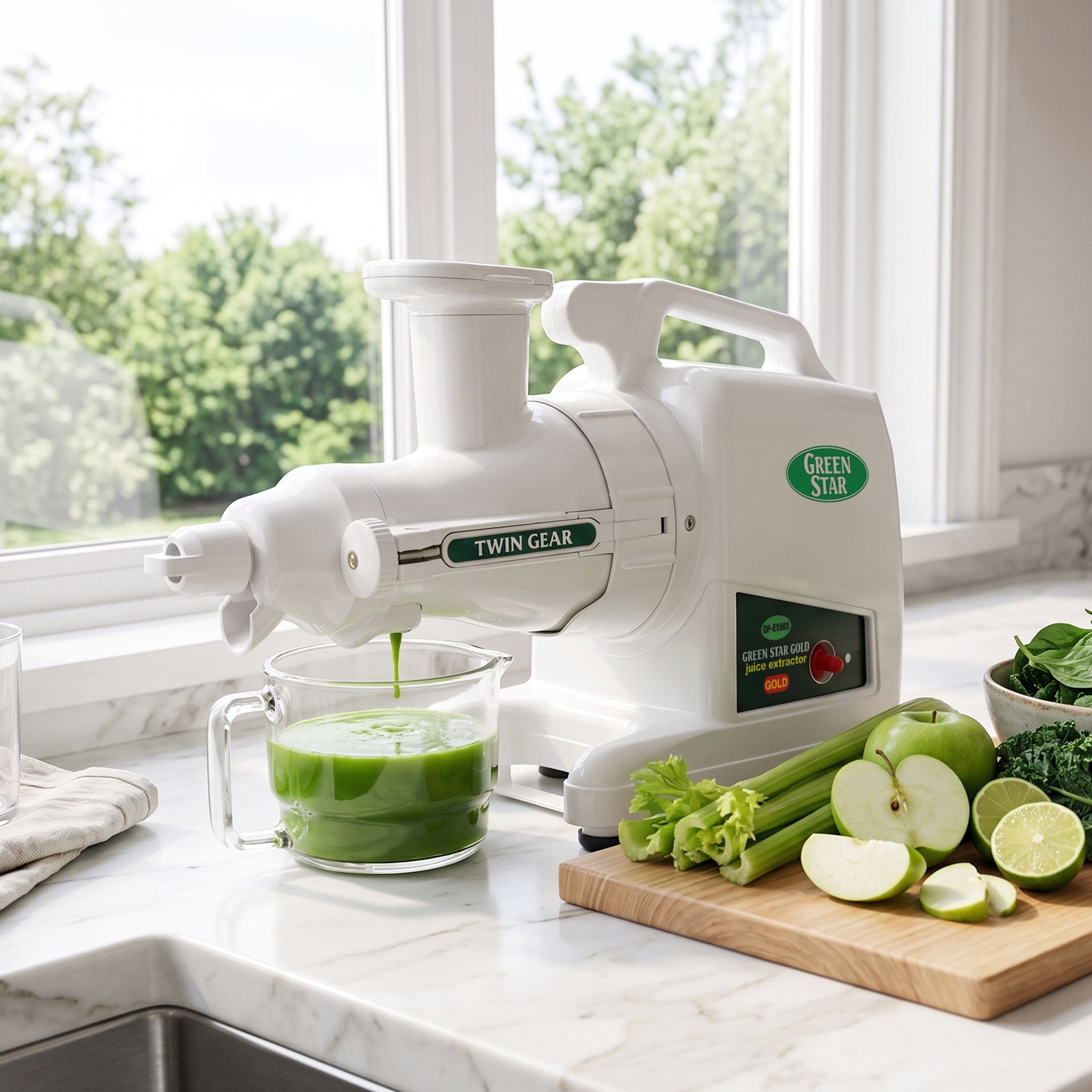
Every juicer sold at consumer price points has a juice path: the surfaces produce contacts from entry to glass. In most machines, significant portions of that path are plastic, typically BPA-free polycarbonate or Ultem. "BPA-free" removes bisphenol A and substitutes bisphenol S, bisphenol F, or other replacement bisphenols that carry similar endocrine-disruption profiles in emerging research. The material that reliably answers the question is stainless steel: food-grade 304 or 316 alloy is non-reactive with acidic fruit juice, does not leach under mechanical stress, and does not absorb residual flavor between uses.
The guides we reviewed before building this list include Wirecutter and Consumer Reports. Neither screens for food-contact material chemistry; both rank on yield, noise, and price. Our criteria are narrower and more specific. Every machine here has a verified all-stainless or all-metal juice path, confirmed from brand specifications or an NSF certification registry entry, not from marketing copy.
What we look for
Stainless steel food-contact path, confirmed from documentation. We require the brand to disclose the specific alloy (304, 316, SUS 304, food-grade SS, medical-grade SS) in product specifications, a tech data sheet, or an NSF certification that covers the juice-contact surfaces. "Stainless steel construction" in marketing text that contradicts the spec sheet is a fail.
No plastic in contact with produce. Augers, screens, gears, cones, strainers, and collection chambers must be metal throughout. Plastic housings that never touch juice (drip trays, external body panels, knobs) do not disqualify a machine. The juice path does.
Independent certification where available. NSF certification of food-contact surfaces is the strongest credential a juicer can carry. UL certification covers electrical safety. We note both where held. No certification is required to make the list, but a certified machine takes priority when two machines are otherwise comparable.
Mechanical yield and practical cleaning. Twin-gear machines extract significantly more juice from leafy greens and fibrous roots than single-auger designs, and far more than centrifugal machines. We note yield advantages where documented. Cleaning time matters too; we describe disassembly across models.
Availability and warranty. Every machine here is currently purchasable from the brand's site or a major retailer. Warranty length reflects the brand's confidence in its own build: Angel's two-year warranty is thin for machines at this price; Tribest's five-to-fifteen-year household warranties are strong.
Our picks
1. Angel Juicer 8500 Premium Cold Press Slow Juicer: Best overall
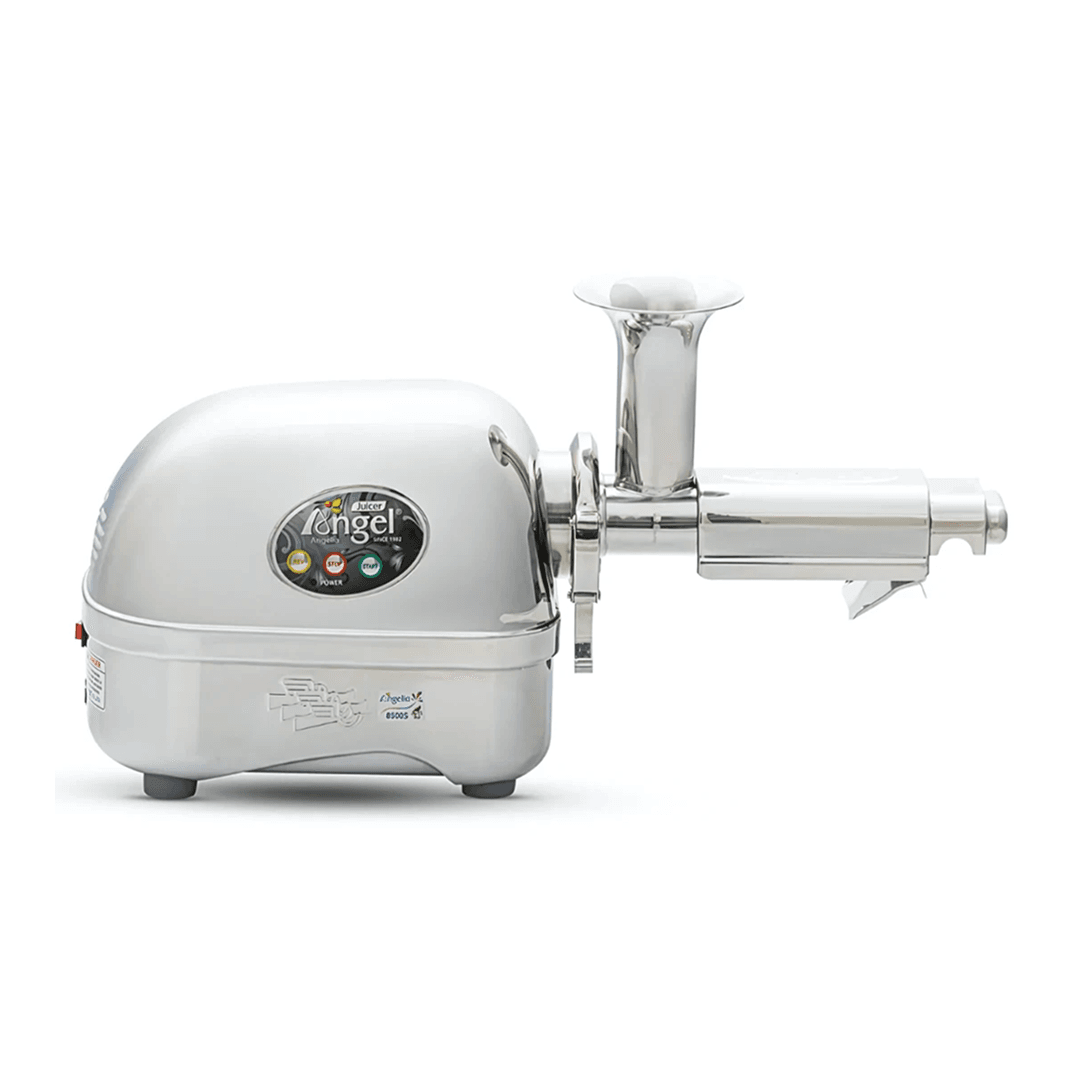
The Angel Juicer 8500 Premium Cold Press is the machine to buy if price is not the primary constraint. The twin gears, screen, and all housing parts that contact produce are SUS 316 stainless steel, NSF certified for food service. SUS 316 adds molybdenum to the 304 base composition, which increases resistance to acidic produce and pitting over time. The 8500 Premium's drive system is stronger than the 7500's, which matters with hard roots: ginger, turmeric, and burdock run through without straining the motor.
Materials documentation is on the brand's product page, with the NSF certification number traceable in the certifier's registry. Twin gears recover roughly 30 percent more juice from wheatgrass than single-auger designs, and about 20 percent more from leafy greens, in published comparative tests. The 82 RPM extraction speed minimizes heat and oxidation, extending juice shelf life. The two-year warranty is the weak point given the price. No competing cold-press juicer at any price matches this material profile.
2. Tribest Greenstar Pro All Stainless Steel Jumbo Twin Gear Commercial Slow Juicer: Best professional

The Tribest Greenstar Pro is Tribest's commercial-grade machine: jumbo medical-grade stainless steel twin gears, NSF certified for food service, rated for continuous commercial operation. The gears are the widest in the Greenstar line, which increases surface contact per revolution and improves yield. The machine runs at 110 RPM, matching the rest of the Greenstar series, and handles leafy greens, wheatgrass, hard roots, fruit, and frozen produce.
The 15-year household warranty reflects Tribest's confidence in the commercial-grade build. Body panels are BPA-free plastic, but juice contacts only the stainless steel gears and screen. Disassembly for cleaning involves four to five parts and takes under two minutes once the motion is memorized. The bioceramic and magnetic extraction system Tribest uses across the Greenstar line is embedded in the gears, not in separate components, so it adds no cleaning complexity.
3. Tribest Greenstar 5 All Stainless Steel Twin Gear Cold Press Masticating Juicer: Best home twin-gear

The Tribest Greenstar 5 is Tribest's current primary all-stainless home twin-gear model. Its jumbo gears are hand-machined from medical-grade stainless steel; the 15-year household warranty matches the Pro. Unlike the older Elite and Gold HD models, the Greenstar 5 ships with jumbo-profile gears as the standard configuration rather than as an upgrade.
Tribest's published research on the bioceramic and magnetic extraction technology suggests better enzyme preservation than flat-gear extraction; whether that translates to a measurable nutritional difference in daily use depends heavily on produce quality and post-extraction storage time. What does translate reliably is yield: the jumbo gears consistently produce drier pulp than entry-level Greenstar models, meaning less produce required per glass. This is the model to choose within the Greenstar family if warranty length and gear quality are the deciding factors and commercial certification is not required.
4. Nutrifaster Opti-Fresh Wheatgrass Juicer #300: Best wheatgrass juicer
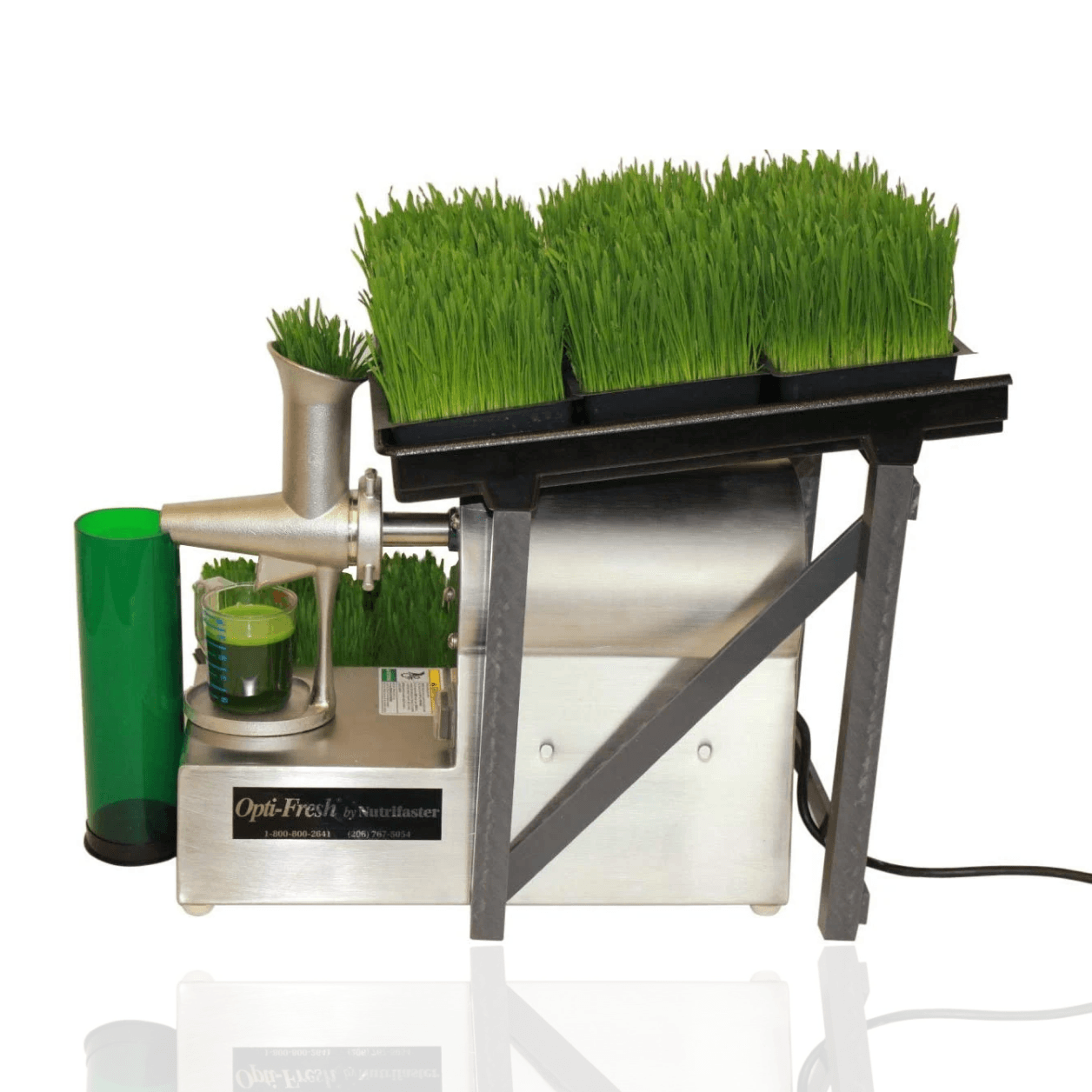
The Nutrifaster Opti-Fresh #300 is a purpose-built wheatgrass juicer and the only wheatgrass-dedicated machine with both UL and NSF certifications. Nutrifaster is a family-owned Seattle manufacturer that has been making commercial juicers since 1994. The machine runs a single stainless steel auger through a stainless screen; the housing and juice collection are all stainless. No plastic contacts the wheatgrass at any point.
NSF certification covers the food-contact path; UL certification covers electrical safety. If wheatgrass is a regular part of your routine and you want a dedicated machine with commercial certifications, this is the only option that clears both hurdles. The machine also handles spinach, kale, and other leafy greens efficiently. For a generalist juicer that also handles wheatgrass, the Angel and Tribest Greenstar options above are more flexible; the Opti-Fresh #300 is the specialist choice.
5. Santos #10 Automatic Citrus Juicer with Lever: Best automatic citrus

The Santos #10 is a restaurant-grade automatic citrus press with stainless steel food-contact parts throughout: the perforated strainer, cone, and collection channel are all stainless. Santos is a French manufacturer; the #10 is a staple of commercial juice bars and hotel breakfasts. The lever mechanism activates the press automatically when you push a half-orange onto the cone. No button required.
For home use, the Santos #10 is over-built in the best sense: it will not wear out under household volume, requires no warm-up, and cleans fast. If you regularly make orange juice for a family or entertain with fresh-squeezed citrus, this machine eliminates the manual-press fatigue with zero plastic in the juice path. It handles citrus only; it is not a general-purpose juicer.
6. Breville Citrus Press Pro 800CPXL: Best home electric citrus

The Breville Citrus Press Pro 800CPXL is a consumer-focused electric citrus juicer with a stainless steel Quadra-Fin cone and stainless steel filter basket. When you press the fruit cone down, the motor activates automatically; juice extracts and drains through the stainless filter into the collection pitcher. Breville's product specification page confirms the cone and filter basket as stainless steel; the external housing and base are die-cast zinc and plastic, neither of which contacts juice.
Compared to the Santos #10, the Breville handles a wider citrus size range from lemon to large grapefruit, and occupies less counter space. It runs at lower volume and lower price. For households that want an electric citrus juicer without the commercial footprint, the 800CPXL is the right choice. The stainless cone and filter are the parts that matter; those are confirmed.
7. Sana Heavy Duty Citrus Press: Best manual lever citrus

The Sana Heavy Duty Citrus Press uses a cast iron body and lever mechanism with stainless steel juicing surfaces: no plastic contacts the juice. The lever arm provides enough mechanical advantage that pressing large oranges or grapefruits requires minimal effort. For households that prefer a manual-operation juicer with no cord and no motor, this is a clean choice.
The cast iron body gives stability; the unit does not need to be bolted down or weighted on a light counter. Cleanup is a rinse of the stainless cone and collection tray. The absence of electronics means no failure modes beyond the lever mechanism itself. This machine handles citrus only; it is not a general-purpose juicer.
What we passed on
Rootborn Rituals Manual Cast Iron Juicer: shares the cast iron plus stainless steel food-contact design with the Tribest Manual Juice Press. The Rootborn machine uses 304 SS food-contact parts and carries no third-party certifications (NSF, FDA, or otherwise). The Tribest manual press carries both NSF and FDA commercial certification and is the stronger sourcing story.
Zefiro Stainless Steel Juicer Wide Mouth: a stainless steel citrus reamer that threads onto a wide-mouth mason jar. All-stainless and no-plastic, but the application is narrower than what a buying guide reader typically seeks. It is a useful bar tool; it is not a standalone juicer in the sense this guide addresses.
Care and cleaning
Twin-gear machines (Angel and Tribest Greenstar models) disassemble into four to six parts and should be rinsed immediately after use. Let the pulp dry and it sets into the mesh screen, making cleaning significantly harder. The screen is the most time-consuming part; a dedicated brush (usually included) handles the mesh in about 90 seconds under running water. None of the machines in this guide have dishwasher-safe juice-path components; the stainless steel tolerates heat but the gaskets and housing components do not.
Citrus presses (Santos, Breville, Sana) are faster: two to three parts, rinse, done in under a minute. The Santos #10's auto-mechanism adds one spring-loaded component; dry it before storage or it can develop surface discoloration at the pivot point.
For all stainless components: dry fully before storage. Stainless steel does not rust under normal conditions but can develop mineral staining from water deposits if left wet, especially in hard-water areas. A weekly wipe with dilute white vinegar keeps the surfaces clean.
FAQ
What is a cold-press juicer?
A cold-press juicer uses a slow-turning auger or twin-gear mechanism to crush and press produce at 50 to 110 RPM, rather than spinning it at thousands of RPM the way a centrifugal juicer does. The slow pressing generates less heat and less oxidation, which extends the juice's storage life and is associated with better enzyme preservation. "Cold press" and "masticating" describe the same extraction method; "slow juicer" is a marketing synonym for both.
Are all stainless steel juicers non-toxic?
Stainless steel food-contact parts address the primary plastic-related concerns: BPA and its bisphenol substitutes, Ultem (PEI), and polycarbonate. Stainless is non-reactive with acidic juice, does not leach compounds under normal use, and does not absorb residual flavor. It does not address concerns unrelated to food-contact materials, such as VOC off-gassing from the motor housing during first use, which is common across most appliances regardless of material. For the juice path specifically, stainless is the verified clean option.
What is the difference between SUS 304 and SUS 316 stainless steel?
Both are food-grade alloys. SUS 316 adds molybdenum to the standard 304 composition, which increases corrosion resistance in acidic environments. Fruit juice is mildly acidic; for most users and most produce, 304 and 316 perform equivalently over time. The difference matters more at commercial use volumes or with very high-acid produce. The Angel 8500 Premium uses SUS 316 stainless steel throughout its food-contact path.
Can I juice wheatgrass in a standard cold-press juicer?
Most twin-gear cold-press machines handle wheatgrass without an attachment: the tight gear mesh processes leafy green fibers efficiently. Single-auger masticating juicers typically require a fine-mesh screen accessory for wheatgrass; check the manufacturer's documentation before assuming compatibility. The Nutrifaster Opti-Fresh #300 is purpose-built for wheatgrass and the most efficient dedicated option. All Tribest Greenstar models and Angel Juicers process wheatgrass in standard configuration.
Why do the Tribest Greenstar models have plastic body panels if this guide is about no-plastic-in-the-juice-path?
The body panels on Tribest Greenstar models are the external housing: the parts you carry the machine by, the hopper you drop produce into, and the collection bowl output chute. These parts are BPA-free plastic. The juice-path components, the parts that actually contact and process produce, are the stainless steel gears and screen. Juice never contacts the plastic panels. Our standard is no plastic in the juice path; that standard is met.
Cover image: Soc Nang Dong via Pexels (Pexels License). Source.


