

Our picks at a glance
| Pick | Best for | Key certifications | Price | Details |
|---|---|---|---|---|
| Cosori Precision Control Stainless Kettle, 1.7L | Multiple beverage types and temperature control | None | $$ | Review |
| Cosori Stainless Steel Kettle SE152, 1.7L | Basic boiling at the lowest cost | None | $ | Review |
| Cuisinart Soho Double-Wall Electric Kettle, 1L | Households needing a cool-to-touch exterior | None | $ | Review |
| ASCOT K1 Retro Stainless Kettle, 1.5L | Countertop aesthetics in an all-stainless look | None | $ | Review |
| Willow and Everett Gooseneck Kettle, 0.8L | Pour-over coffee and precision pouring | None | $ | Review |
| ASCOT K2 Borosilicate Glass Kettle, 1.5L | Visual water-level feedback without a plastic window | None | $ | Review |
| Chantal Mia Stainless Kettle, 32 oz | Single-person households and fast single-cup boiling | None | $$ | Review |
| SAKI Luna Temperature Control Kettle, 1.75L | High-volume use and degree-level precision | None | $$ | Review |
Why your kettle's plastic surfaces matter
Almost every plastic component in a kettle becomes less stable as temperature rises. At 25°C a polypropylene water-level window releases relatively few plastic particles into the water it holds. At 95°C the same window releases far more. A 2025 study published in npj Emerging Contaminants tested plastic kettles under normal-use conditions and found nearly 12 million nanoparticles per milliliter in water from a single first boil. The World Health Organization's 2019 technical review of microplastics in drinking water flagged heated food-contact plastics as a priority exposure pathway requiring further study.
The answer is not to stop boiling water. The answer is to choose a kettle where every surface the water actually touches is either stainless steel or borosilicate glass.
Nearly 12 million nanoparticles per milliliter in water from a first boil in a plastic kettle.
What we look for
Spout interior. Many kettles are marketed as stainless steel but have a polypropylene liner inside the pour spout. We verified the full spout construction for each pick, not just the exterior body.
Lid underside. The lid underside sits directly above boiling water throughout every heating cycle, exposed to steam and condensate on every pour. It is the most common failure point on otherwise stainless-looking kettles. Every pick here has a stainless or borosilicate lid underside.
Water-level indicator. The classic plastic window is a polypropylene strip sitting in permanent contact with the water it measures. The right alternatives are etched MIN/MAX graduations on the stainless body, or a borosilicate glass body where the level is inherently visible.
Filter. The spout basket filter catches limescale before it reaches the cup. Stainless mesh passes. Plastic mesh does not.
Lid seal. A food-grade silicone gasket is acceptable: silicone is thermally stable and chemically inert at boiling temperatures. Undisclosed rubber compounds or hard plastic seals are not.
What does not factor in: plastic handles, plastic bases, exterior lid buttons, and the underside of the base. These parts never contact water.
Our picks
1. Cosori Precision Control Stainless Electric Kettle, 1.7L: Best overall
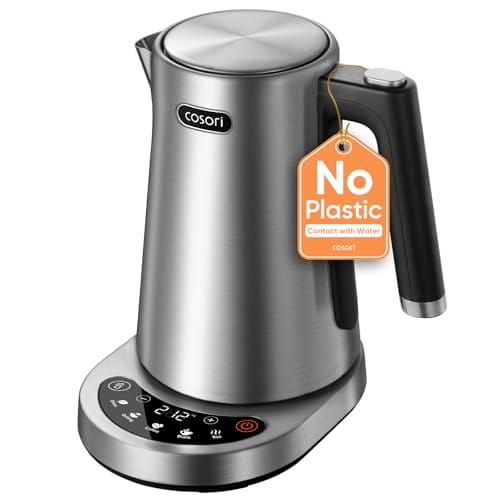
The Cosori Precision Control Stainless Electric Kettle heats to six presets: 104, 140, 167, 176, 185, and 212°F, with a one-hour keep-warm mode. Every water-contact surface is 18/8 stainless steel: the interior body, the full-length spout channel, the lid underside, and the filter basket. Water level is shown by etched MIN and MAX markings on the stainless exterior, so there is no plastic window. The lid seal is food-grade silicone. At $89.98 for 1.7L, it handles four to six cups per fill.
This is the pick for households that heat water for multiple purposes: green tea and white tea call for 167 to 176°F, coffee is best between 195 and 205°F, and most herbal teas want a full boil. The presets eliminate the guess-and-wait approach of boiling to 212°F and then letting the water cool down.
2. Cosori Stainless Steel Electric Kettle SE152, 1.7L: Best value
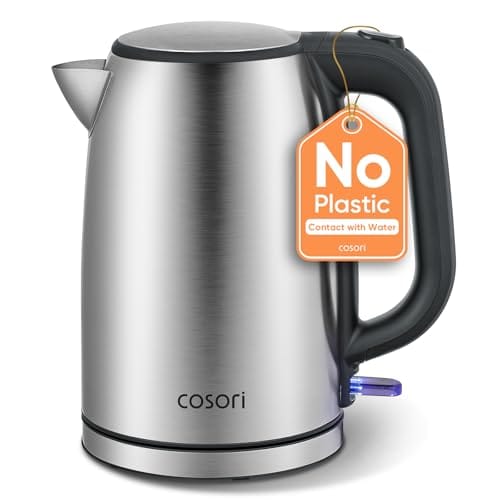
The Cosori Stainless Steel Electric Kettle SE152 uses the same fully stainless water-contact construction as the Precision Control: stainless spout throughout, stainless lid underside, stainless filter, etched water-level markings, food-grade silicone seal. The difference is what it drops: there are no temperature presets, only a single auto-shutoff boil to 212°F. At $29.99 it is the lowest-cost fully stainless kettle that cleared every surface check on this list.
The right choice for households that need a fast, reliable boil for instant coffee, oatmeal, French press, or anything that calls for water at full temperature. No controls to learn: fill, click, pour.
3. Cuisinart Soho 1-Liter Double-Wall Electric Kettle: Best insulated body
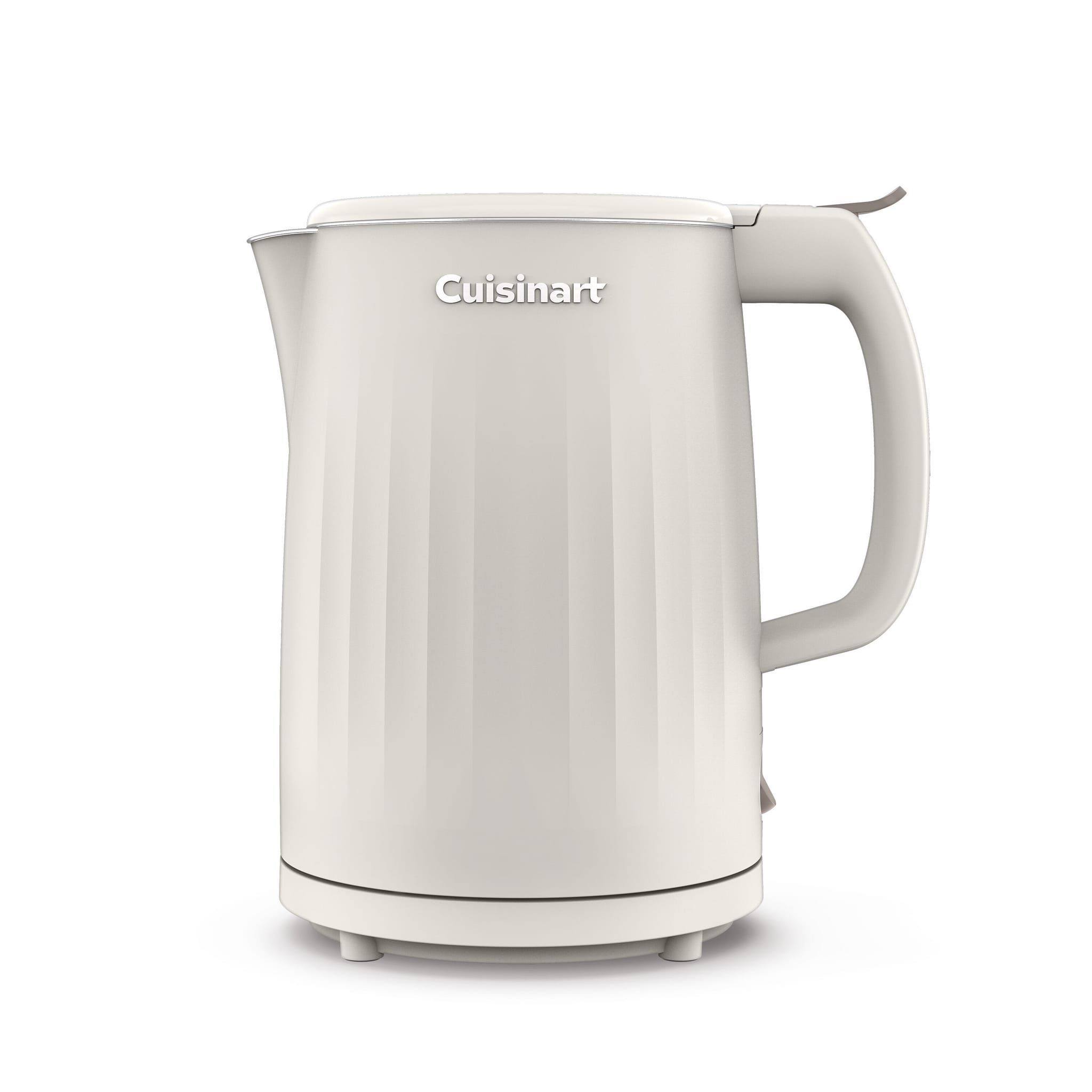
The Cuisinart Soho Double-Wall Electric Kettle places an air gap between its inner and outer stainless walls. The exterior stays near room temperature during and after the boil, which matters in households with children sharing counter space; water also stays hotter longer after auto-shutoff. Cuisinart discloses on the product page that every water-contact surface is stainless steel, with no plastic touching the water at any point. At 1 liter, it suits one to two cups at a time rather than full-kettle batches.
A good pick when surface temperature during a boil is a safety concern, or for shared counters in a household where someone might reach for the kettle before it has fully cooled.
4. ASCOT K1 Retro Stainless Electric Kettle, 1.5L: Best for kitchen aesthetics

The ASCOT K1 Retro Stainless Electric Kettle is the pick for the household that wants a kettle that reads as a considered object on the counter, not a utilitarian appliance. The stainless body has a high-shouldered silhouette with a matte finish. The lid, spout interior, and filter are all stainless. No plastic window. The 1.5L capacity is slightly smaller than the Cosori models, which makes it a better fit for one or two-person households.
Between this and the ASCOT K2 below (Pick 6): the K1 is for those who want an all-stainless look; the K2 is for those who want to see the water level through a glass body.
5. Willow and Everett Gooseneck Stainless Electric Kettle, 0.8L: Best for pour-over coffee
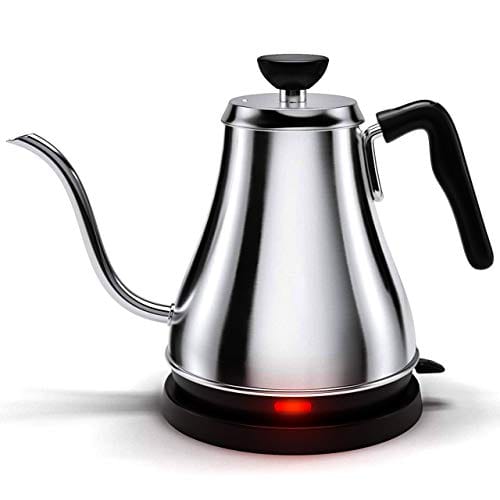
The Willow and Everett Gooseneck Stainless Electric Kettle narrows the pour channel into a gooseneck spout for directional control during pouring. That control is what pour-over coffee, Chemex, and single-origin loose-leaf tea preparation require: you are wetting grounds in a specific pattern at a specific rate, not pouring into a vessel indiscriminately. The full gooseneck spout interior is stainless throughout. On cheaper gooseneck kettles, the long thin spout is often where a polypropylene liner appears. It does not here.
At 0.8L, this is the smallest capacity pick on the list. A gooseneck kettle is a precision tool. For anyone running a drip machine for daily volume and wanting the gooseneck for careful pours, this is the right pairing.
6. ASCOT K2 Borosilicate Glass Electric Kettle, 1.5L: Best glass

The ASCOT K2 Borosilicate Glass Electric Kettle uses a borosilicate glass body, the same material category as laboratory glassware and high-end French press carafes. Borosilicate does not release particles into water at boiling temperatures, and it is thermally shock-resistant relative to standard glass. The lid and base collar are stainless steel. The filter is stainless mesh. Because the body is transparent, there is no water-level window at all: you see the water directly. A blue LED illuminates the interior during heating.
The tradeoff relative to the all-stainless picks: glass requires more careful handling. For users who prefer visual feedback over opacity when filling and pouring, the glass body is a genuine advantage and not a compromise.
7. Chantal Mia Stainless Electric Kettle, 32 oz: Best for single-cup use

The Chantal Mia Stainless Electric Kettle is made by Chantal, a Houston company producing enamel-on-steel cookware since 1971. At 32 oz (946mL), this is the smallest capacity pick here. The interior, spout, lid underside, and filter are all stainless. No plastic window. The enamel exterior is applied over steel and does not contact water.
The smaller chamber reaches a full boil faster than larger kettles on the same wattage, which makes it efficient for one-person households or for someone heating single cups at intervals throughout the day. Chantal's multi-decade record in enamel cookware production is a reasonable signal for material quality.
8. SAKI Luna Stainless Temperature Control Electric Kettle, 1.75L: Best premium

The SAKI Luna Stainless Temperature Control Electric Kettle is the largest capacity and most precise pick here: 1.75L, degree-by-degree temperature control with a digital display, and an extended keep-warm mode. Construction is fully stainless on all water-contact surfaces. At $165.95, it costs roughly twice the Cosori Precision Control.
What the additional cost buys: degree-level precision instead of six presets, a larger capacity, and a display legible from across a counter. The right pick for a high-volume household or for a tea practice specific enough to want precise control beyond fixed presets.
What we passed on
Fellow EKG. The most-cited gooseneck kettle in specialty coffee communities. Most production versions include a small plastic water-level window mounted between the gooseneck and the kettle body, in direct contact with boiling water on every cycle.
OXO Brew Adjustable Temperature. The lid has a plastic ring on its underside that faces the water throughout each boil. OXO's product documentation does not identify the material.
Breville Smart Kettle and Variable Temperature. Breville identifies a section of the interior spout channel as BPA-free polypropylene. BPA-free does not address the underlying microplastic pathway from heated polypropylene surfaces.
Cuisinart CPK-17 and related models. Plastic lid liner and a polypropylene water-level window on the body. The lid liner is the higher-exposure surface because it faces the water directly throughout every cycle.
Hamilton Beach 40880. The spout tip and lid underside include plastic components. The brand's product specifications do not identify the materials.
Comfee. Marketed as stainless steel on the exterior but the brand's published documentation does not specify interior surface materials. Without full material disclosure, the standard is not met.
FAQ
Do plastic handles and bases affect water safety?
No. Plastic handles, plastic bases, exterior lid buttons, and the underside of the base never contact the water. The surface checks in this guide focus only on the five water-contact components: the interior body, the spout interior, the lid underside, the water-level indicator, and the filter basket.
Is BPA-free plastic safe to use in a kettle that heats to boiling?
Not by our standard. BPA-free does not address the underlying microplastic pathway from heated polypropylene surfaces. Research published in npj Emerging Contaminants in 2025 found nearly 12 million nanoparticles per milliliter in water after a first boil in a plastic kettle. The plastic type is the issue, not the BPA content.
Is a glass kettle as safe as a stainless steel kettle?
Yes, if the glass is borosilicate. Borosilicate glass does not release particles into water at boiling temperatures and is thermally shock-resistant. The tradeoff is handling: glass requires more care than stainless steel. The ASCOT K2 on this list uses a borosilicate body with a stainless lid and filter.
What is a gooseneck kettle, and do I need one?
A gooseneck kettle narrows the pour channel into a long curved spout for directional control. That control matters for pour-over coffee, Chemex, and single-origin tea preparation, where you are wetting grounds at a specific rate and pattern. For general boiling, a standard straight-spout kettle is sufficient.
What is a double-wall kettle?
A double-wall kettle places an air gap between an inner and outer stainless wall. The outer surface stays near room temperature during and after the boil, which reduces burn risk if someone grabs the kettle while it is still hot. Water also stays hotter longer after auto-shutoff.
Why do some stainless steel kettles still have plastic inside the spout?
Many kettles are marketed as stainless steel based on the exterior body, while the interior of the pour spout is lined with polypropylene. This is the most common failure mode: the exterior passes a visual check but the spout liner contacts every drop of water on the way to the cup. Full spout construction is verified for each pick on this list.
Cover image: Dương Nhân via Pexels (Pexels License). Source.