Our picks at a glance
| Pick | Best for | Key certifications | Price | Details |
|---|---|---|---|---|
| Chemex Classic Pour-Over 8-Cup | Overall, pour-over | Borosilicate glass + wood collar | $$ | Full review |
| Hario V60 Olive Wood Dripper 02 | Minimalist pour-over | Borosilicate glass + olive wood | $ | Full review |
| Pure Over Signature Brew Kit | Filter-free pour-over | Borosilicate glass throughout | $ | Full review |
| Simply Good Coffee The Brewer | Fully plastic-free auto drip | Stainless + borosilicate glass + silicone seals | $$$ | Full review |
| Caraway 10-Cup Coffee Maker | Plastic-free auto drip, mid-range | AB1200 compliant | $$ | Full review |
| Technivorm Moccamaster KB | Minimized-plastic auto drip | Stainless boiler, borosilicate carafe | $$ | Full review |
| Ratio Eight S2 | Premium auto drip | Borosilicate + stainless + aluminum | $$ | Full review |
| Frieling French Press 36oz | French press | 18/10 stainless throughout | $ | Full review |
| Bialetti Venus Induction 6-Cup | Moka pot, stovetop | 18/10 stainless throughout | $ | Full review |
| Farberware Yosemite Percolator 8-Cup | Percolator | Stainless throughout | $ | Full review |
| Bodum Chambord French Press 51oz | Cold brew, large-batch French press | Borosilicate + stainless | $ | Full review |
Most home coffee makers contain plastic: the water reservoir, the brew basket, the carafe lid, the drip tube, or all four. That plastic sits in continuous contact with water at 195 to 212 degrees Fahrenheit, the range at which chemical migration from polymers accelerates. The industry standard certifications for food contact (FDA compliance, NSF/ANSI 51) set migration limits, not a zero threshold. For a device used every day for decades, "within the limit" means something different than it does for a container used occasionally.
This guide covers six brewing methods and identifies the picks where plastic is either absent from the water path or genuinely minimized. We are explicit about which category is which.
What we look for
The water path, not the whole machine. Plastic in a machine's outer housing or a handle does not concern us. The disqualifying plastic is the kind that sits in the water path: the reservoir, the boiler, the shower head, the brew basket, the carafe, and anything a hot liquid contacts on its way from cold water to your cup. We verified each pick's water-path materials from the brand's own product pages and spec documentation.
No coatings. Non-stick coatings on carafe interiors, plastic-coated heating elements, and "easy-clean" inner surfaces all require the same question the rest of this site asks about cookware: what is the coating, and what happens to it at brewing temperatures? We required brands to name the coating. "Proprietary surface treatment" did not pass.
No BPA and no BPA substitutes. "BPA-free" is not a pass. The replacement bisphenols, including BPS, BPF, and BPAF, have the same receptor-binding profile and appear in the same studies. When a brand claims BPA-free, we asked what the plastic actually is and required a named polymer before evaluating it. Tritan, despite heavy marketing as a safe alternative, is a polyester-based plastic that leaches under heat-stress testing conditions documented in peer-reviewed literature.
Honest method distinctions. Pour-over, French press, moka pot, and percolator can be genuinely plastic-free when built from the right materials. Most auto-drip machines still use some plastic in the water reservoir, brew basket, or spray head. One pick in this guide breaks that pattern: the Simply Good Coffee The Brewer routes water through stainless steel, borosilicate glass, and medical-grade silicone seals only, with no polymer anywhere the water contacts. The remaining two auto-drip picks minimize plastic to the pathway irreducibles. We flag which category each pick falls into so you can make your own call about whether "minimized" meets your threshold.
Espresso machines are excluded. A genuinely plastic-free home espresso machine does not exist. The pressure requirements for espresso (9 bars) and the temperatures involved mean the pump, boiler connections, steam wand, and group head all rely on plastic or rubber components that are difficult to verify and replace. Commercial all-metal espresso equipment exists, but it is not a consumer product. We excluded the category rather than publish a "least-bad" list.
Cold brew and heat exposure. Cold brew involves no heating, which matters for migration risk. At refrigerator temperatures, migration from food-grade silicone gaskets and lids is orders of magnitude lower than at brewing temperatures. The Bodum Chambord French press listed here is an all-stainless and borosilicate vessel used with the cold-steep method: coarse-ground coffee steeped in cold water for 12 to 24 hours in the refrigerator. No heat. No plastic anywhere in the process.
Our picks
1. Chemex Classic Pour-Over 8-Cup: Best overall

The Chemex Classic Pour-Over 8-Cup has not changed since 1941: a single hourglass-shaped piece of laboratory-grade borosilicate glass, a wooden collar secured with a rawhide tie, and proprietary bonded paper filters that are 20 to 30 percent heavier than standard pour-over filters. There is no plastic in the water path. There is no coating. There is no internal mechanism.
Brewing requires hot water between 195 and 205 degrees Fahrenheit, a gooseneck kettle (not included), and about four minutes of hands-on time for a full 40-ounce batch. The grind is coarser than most pour-over methods because of the thick filter. The result is a clean, bright cup with no sediment. The glass body is dishwasher safe, though hand-washing extends its life.
The Chemex does not have a warming function. Coffee cools faster in glass than in a stainless carafe. For a household that brews and drinks immediately, that is not a problem. For one that leaves the pot standing for two hours, it is.
2. Hario V60 Olive Wood Dripper 02: Best minimalist pour-over
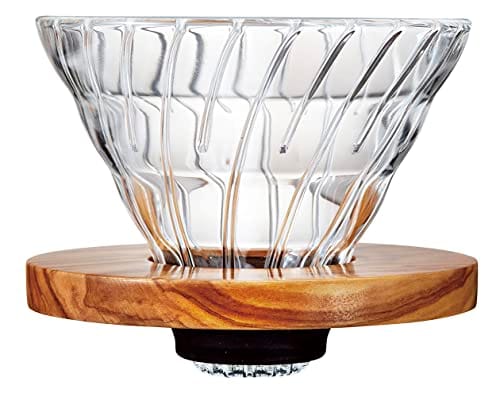
The Hario V60 Olive Wood Dripper 02 is a different proposition than the Chemex: smaller, single-serve to four cups, and built around a borosilicate glass cone with a natural olive wood handle and a stainless steel stand. There is no plastic in the dripper assembly.
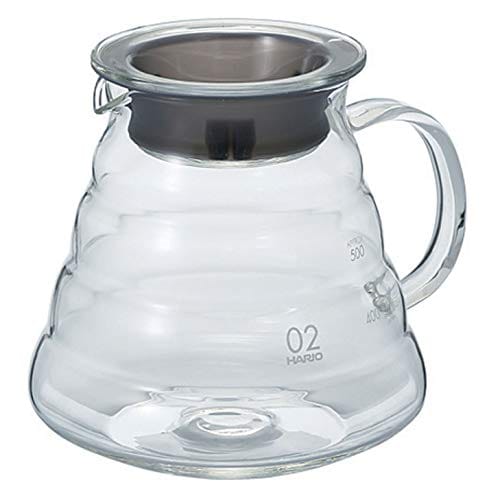
Hario's V60 design uses a cone with spiral ribs that control airflow and give the brewer fine control over extraction speed. The 02 size is designed to sit over any cup or server. A natural companion is the Hario V60 Range Server 600ml, a borosilicate glass carafe with a silicone band grip and no plastic in the brew path, sold separately.
For those who already know pour-over and want material clarity in a smaller footprint than the Chemex, this is the pick.
3. Pure Over Signature Brew Kit: Best filter-free pour-over

The Pure Over Signature Brew Kit uses a different filtration principle than the Chemex or Hario: instead of paper, a porous borosilicate glass disc acts as the filter. Hot water passes through the coffee bed and then through the glass disc, which blocks grounds while letting oils through freely. The result is a fuller-bodied cup than paper-filtered pour-over, closer to French press in character, without the fine sediment a French press lets through.
The brew path is 100% borosilicate glass: the upper brewing chamber, the filter disc, and the lower carafe are all glass. The ceramic base functions as a trivet; it never contacts coffee. There is no plastic in the water path.
Because the glass filter is reusable and permanent, there is no recurring filter cost and no paper waste. The tradeoff is a more deliberate pour technique: the glass disc requires slow water addition to avoid overflow, and contact time is longer than with paper. Brewers who already work with a gooseneck kettle will find the adjustment manageable. For those new to pour-over, the Chemex or Hario V60 with paper filters is more forgiving at the start.
The kit yields approximately 20 ounces per batch and is sold direct from the brand at pureover.com.
4. Simply Good Coffee The Brewer: Best fully plastic-free auto drip

The Simply Good Coffee The Brewer is the only auto-drip machine in this guide where no plastic contacts the water at any stage. The boiler is stainless steel. The shower head is stainless steel. The carafe is borosilicate glass. The seals at every joint are medical-grade silicone. The reservoir, which in the Moccamaster and Ratio Eight is where polypropylene enters the water path, is also stainless steel here.
For households where eliminating all plastic from the brew path is the requirement and pour-over methods do not fit the workflow, this is the answer. It brews 8 cups through the same general process as any auto-drip machine: water heats in the stainless boiler, passes through the stainless shower head over the coffee bed, and drips into the borosilicate glass carafe. The brewing parameters meet the Specialty Coffee Association's Gold Cup Standard. Materials are disclosed on the brand's product page at simplygoodcoffee.com.
At $479.99, it is the highest-priced pick in this guide. The premium is the only verifiably plastic-free auto-drip water path we found.
5. Caraway 10-Cup Coffee Maker: Best everyday plastic-free auto drip

The Caraway 10-Cup Coffee Maker routes hot water through glass and stainless steel at every stage: a glass water reservoir, a stainless water path and shower head, a stainless brew basket with a reusable stainless filter, and a glass carafe. Most auto-drip machines use plastic in the reservoir or the basket, where water sits at or near brewing temperature. The Caraway uses neither. The brew path is plastic-free throughout, and the machine is AB1200 compliant.
At the $$ tier, it is the more accessible of the two fully plastic-free auto-drip options in this guide. The Simply Good Coffee The Brewer is the premium $$$ counterpart: same plastic-free credential, higher price point. For households that want auto-drip convenience with no polymer in the brew path and find the Simply Good Coffee price out of reach, the Caraway is the direct answer.
The 10-cup capacity suits most household workflows. The glass carafe functions as its own serving vessel, and the reusable stainless brew basket eliminates any disposable-filter cost.
6. Technivorm Moccamaster KB: Best minimized-plastic auto drip
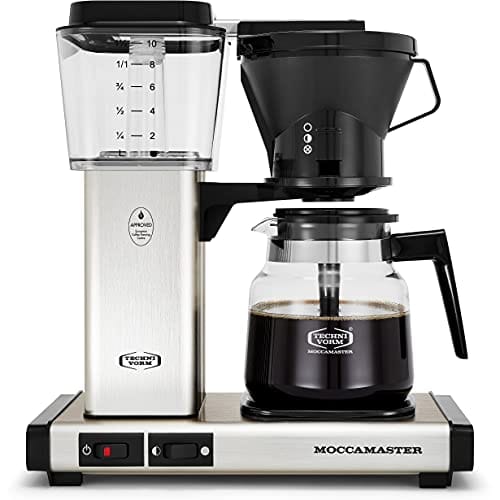
The Moccamaster minimizes plastic to two components: polypropylene in the water reservoir and the brew basket. The boiler is copper-heated stainless steel. The carafe is borosilicate glass. Polypropylene is one of the more inert common food-contact polymers and is standard for medical and food storage applications. It is still plastic.
The Technivorm Moccamaster KB is SCA (Specialty Coffee Association) certified, which means it brews at the correct temperature (196 to 205 degrees Fahrenheit) and delivers the full volume in six minutes or less. It is hand-assembled in Amerongen, the Netherlands, and carries a five-year warranty. The hotplate maintains the carafe at 175 to 185 degrees rather than the 200-plus-degree burn point of cheaper machines.
Technivorm is transparent about materials and responds to direct consumer questions. That transparency is part of what puts this machine on the list alongside the genuinely all-glass and all-steel picks.
Honest flag: if eliminating all plastic from the brew path is the requirement, this does not qualify; the Simply Good Coffee The Brewer does. If reducing plastic to the minimum possible in a proven, warrantied machine is the goal, this is the answer.
7. Ratio Eight S2: Best premium auto drip

The Ratio Eight S2 is built around a glass and stainless water path. The boiler is stainless steel. The carafe is hand-blown borosilicate glass with a wood handle. The machine body is die-cast aluminum. Like the Moccamaster, it uses plastic in the water reservoir and some internal valve components; unlike the Moccamaster, it adds a pre-infusion bloom cycle (30 seconds of water to wet the grounds before the full brew starts).
The bloom makes a meaningful difference for specialty coffee: it degasses CO2 from fresh-roasted beans before extraction, which produces a more even and complex cup. At this price point, the machine earns its place by doing two things well. It brews at the correct temperature with the correct timing, and every surface the coffee itself touches is glass or stainless. The plastic is upstream of the brew.
Ratio is a Portland, Oregon company that publishes full materials documentation and warranties the machine for three years. The primary buy link is through their own site.
8. Frieling French Press 36oz: Best French press
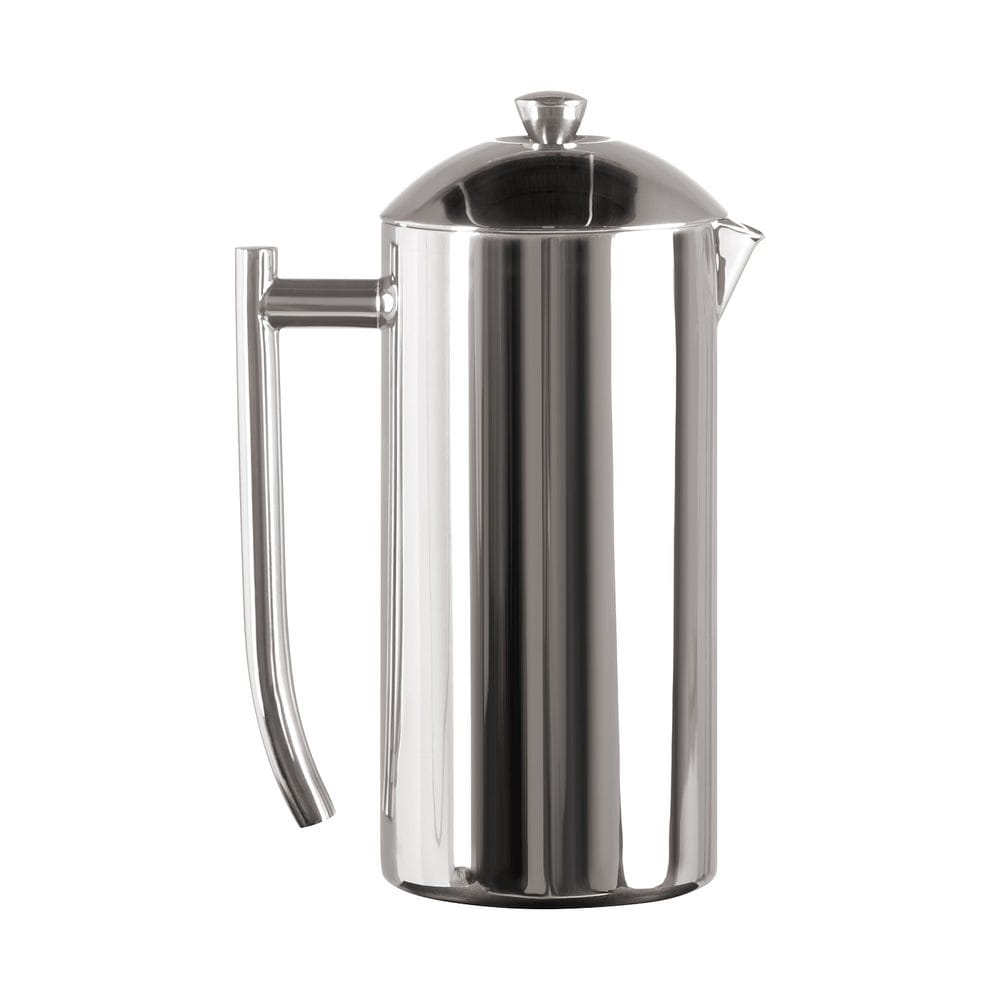
French press is the simplest zero-plastic-in-the-brew-path method: coarsely ground coffee, hot water, four minutes, press. The variable is the vessel material. Most French presses use borosilicate glass, which is inert but fragile. The Frieling solves the fragility problem with a double-wall 18/10 stainless steel body that keeps coffee hot for significantly longer than glass and does not shatter if dropped.
The Frieling French Press 36oz uses stainless steel throughout: body, plunger, filter screen, and frame. There is no plastic in the water path. The double-wall construction means the exterior does not get too hot to hold and coffee stays at drinking temperature for an hour or more.
The filter is a fine-mesh stainless screen with a spring-tension base that presses cleanly to the bottom. Some sediment passes through, as with any French press; this is not a flaw, it is the method. If sediment-free coffee is important, pour-over is the correct category.
Frieling is a Minnesota-based company that has sold this press in the same configuration for over 20 years. The warranty is limited lifetime.
9. Bialetti Venus Induction 6-Cup: Best moka pot
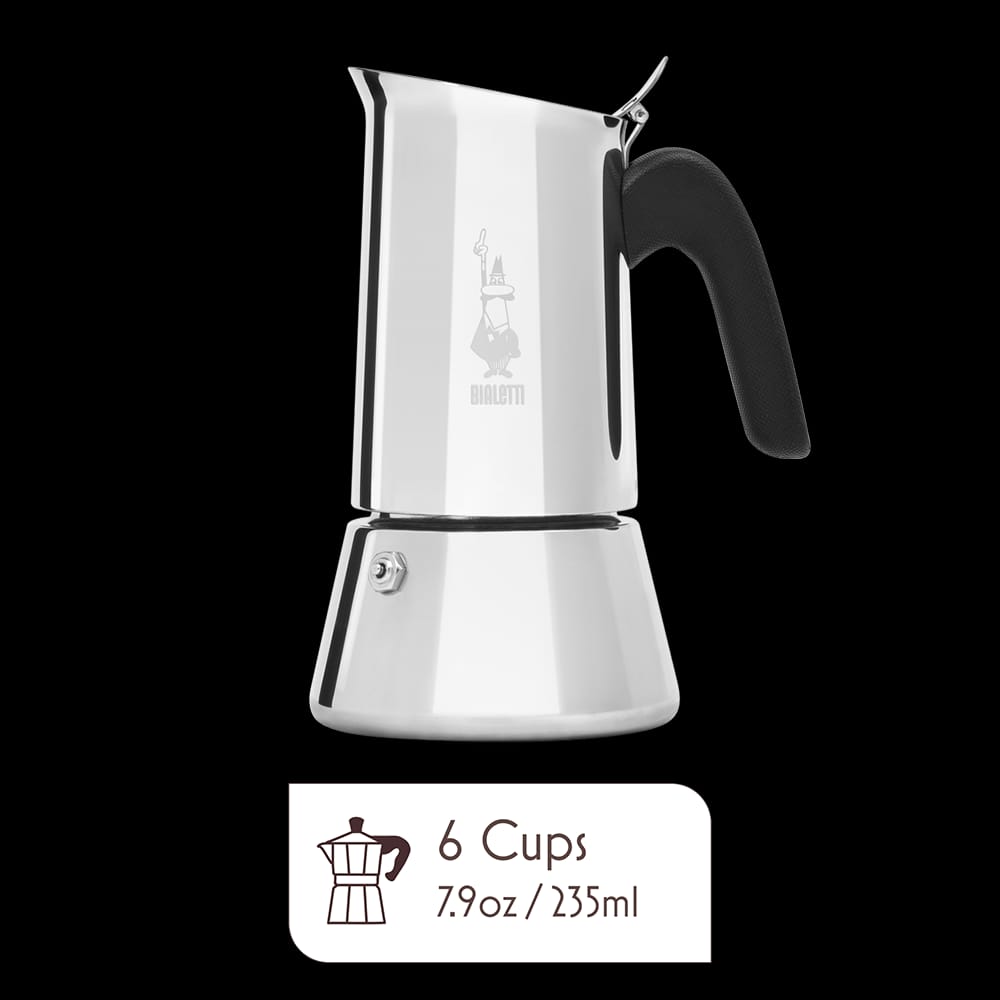
A moka pot is stovetop-extracted coffee: ground coffee sits in a pressurized basket, steam pressure pushes water up through the grounds and into an upper chamber, and the result is a concentrated espresso-adjacent coffee that requires no pump, no electricity, and no plastic in the brew path. The process takes about five minutes.
The Bialetti Venus Induction 6-Cup is made from 18/10 stainless steel throughout: lower chamber, filter basket, upper chamber. The handle is Bakelite (a phenolic resin that predates modern thermoplastics), which does not contact water or coffee at any stage. The seal gasket is food-grade silicone.
Bakelite is a phenolic resin, not a modern engineered thermoplastic. The handle never touches water. We accepted this as outside the water-path disqualifier.
The Venus is induction-compatible, which the classic Bialetti Moka Express in aluminum is not. If you have an induction cooktop, this is the moka pot pick. For gas or electric coils, either works; the aluminum Moka Express is a less expensive alternative for those who accept aluminum as the water-contact material.
10. Farberware Yosemite Percolator 8-Cup: Best percolator
A percolator cycles hot water through coffee grounds repeatedly: water heats at the bottom of the pot, rises through a central tube, showers over the grounds, drips back through the basket, and cycles again until the pot reaches full brewing temperature. The result is a strong, full-bodied cup. The material story is simple: stainless steel throughout.
The Farberware Yosemite Percolator 8-Cup uses a stainless steel body, stainless perk tube, stainless filter basket, and a glass-knob lid so you can watch the percolation. There is no plastic in the water path. The exterior handle is phenolic resin, the same material category as the Bialetti Venus handle, and it does not contact water at any point.
This is the most affordable pick in the guide. It brews eight cups, has no moving parts beyond the removable basket, and works on all stovetop types including induction. The percolation method produces more bitterness than pour-over or drip because water passes through the grounds multiple times; this is a feature for those who prefer a strong cup, and a reason to look at pour-over or French press for a cleaner extraction.
11. Bodum Chambord French Press 51oz: Best for cold brew
Cold brew is coffee steeped in cold or room-temperature water for 12 to 24 hours, then filtered. Because no heat is involved, chemical migration from any material in the vessel is dramatically lower than in hot-brew methods. The question remains which materials contact the coffee, and the answer for this method is borosilicate glass and stainless steel.
The Bodum Chambord French Press 51oz uses a borosilicate glass carafe and a stainless steel frame, plunger, and filter. The food-grade rubber gasket and band are the only non-glass, non-stainless components, and neither one contacts the liquid in a meaningful way during the steeping process. There is no plastic in the brew path.
To use it for cold brew: add coarse-ground coffee at roughly a 1:8 ratio by weight (about one cup of coffee to four cups of water), fill with cold water, stir, refrigerate, and press after 12 to 24 hours. The concentrate can be diluted with water or milk, or served straight over ice. This is the simplest, lowest-cost, and most material-honest cold brew method available.
At 51 ounces, approximately six cups, the Chambord is large enough to make a batch that lasts two days refrigerated.
What we passed on
Espresso machines. No consumer espresso machine has a fully plastic-free water path. The pressure requirements at 9 bars and the temperatures involved mean the pump, boiler connections, steam wand, and group head all rely on plastic or rubber components that are difficult to verify and replace. We excluded the category rather than publish a best-of-a-bad-situation list. If you want espresso at home and accept some plastic in the internal components, prioritize machines with a stainless steel boiler and avoid machines with plastic portafilters.
AeroPress. The AeroPress chamber and plunger are copolyester plastic. The company has tested the materials at brewing temperatures and published results showing no detected BPA, but the base polymer is a polycarbonate-adjacent plastic that researchers have flagged in other contexts at high-temperature use. The AeroPress Go and AeroPress Clear variants use Tritan, which is a different plastic with similar concerns. We did not pass it for this guide.
Pod and capsule machines. The plastic exposure from K-Cup and Nespresso machines comes not just from the machine itself but from the capsule: a plastic pod that boiling water passes through under pressure. We excluded this category. If you own one and want to reduce plastic exposure, open-format stainless reusable capsules exist for most platforms and are worth considering.
Bodum Bean cold brew carafe. The Bodum Bean uses a plastic outer carafe with a glass insert. The plastic is on the exterior, but the construction is complex enough that material-contact claims are difficult to verify independently. We chose the all-glass, all-stainless Chambord instead.
FAQ
Is pour-over coffee genuinely plastic-free?
With the right equipment, yes. The Chemex and the Hario V60 Olive Wood Dripper use borosilicate glass and wood with no plastic in the dripper assembly. Paper filters touch only glass. The Pure Over Signature Brew Kit takes this further, using a built-in porous glass filter instead of paper so the brew path is glass throughout with no recurring filter cost. Water contacts no polymer at any stage in any of these three setups. Pour-over is the one common brewing method where this is straightforwardly achievable.
Are paper coffee filters safe?
Chemex-brand bonded filters are made from oxygen-bleached paper. Oxygen bleaching avoids the chlorine-based process that can leave trace dioxin residues in the paper. Unbleached (natural brown) filters are available from Chemex and most third-party suppliers and are an acceptable alternative. Metal filters in fine-mesh stainless are available for the Hario V60 and avoid the paper question entirely; they allow more oils and micro-fines through, which changes the cup character toward French press territory.
Does the Moccamaster really reduce plastic exposure versus a standard drip machine?
Compared to a standard drip machine where plastic is the carafe, the basket, the lid, the boiler housing, and the water-path tubing: yes, meaningfully. The Moccamaster limits plastic to polypropylene in the reservoir and basket only, and it brews at the correct temperature rather than the overheated water that accelerates leaching in cheaper machines. It is not zero plastic, and we want to be direct about that. If zero plastic in the brew path is the goal, the Simply Good Coffee The Brewer is the auto-drip pick for you.
Is a glass French press safe?
Glass itself is inert at any temperature coffee is brewed at. The concern with glass French presses is the gasket material on the plunger, which varies by manufacturer. Bodum uses rubber (food-grade, but a polymer); Frieling uses no gasket (the stainless mesh fits by spring tension). Both are acceptable; the Frieling is the strictly cleaner choice. Stainless steel frames and plungers present no migration risk.
Can I use a French press for cold brew?
Yes, and the Bodum Chambord listed here is sized for it. Use coarse-ground coffee, fill with cold water at approximately 1 cup coffee to 4 cups water by volume, refrigerate for 12 to 24 hours, and press. Cold water does not extract the bitter acids that hot water does, producing a smoother and less acidic cup. The Chambord's 51-ounce capacity makes a batch that lasts two days refrigerated.
Why are espresso machines excluded?
A genuinely plastic-free home espresso machine does not exist at consumer price points. Espresso requires 9 bars of pressure and temperatures above 200 degrees Fahrenheit through pump seals, boiler connections, the group head, and the steam wand. All of those components rely on rubber or plastic parts to handle the pressure and thermal cycling. The engineering that makes espresso possible at home is inseparable from the polymer components.
Cover image: Anna Tukhfatullina Food Photographer/Stylist via Pexels (Pexels License). Source.