
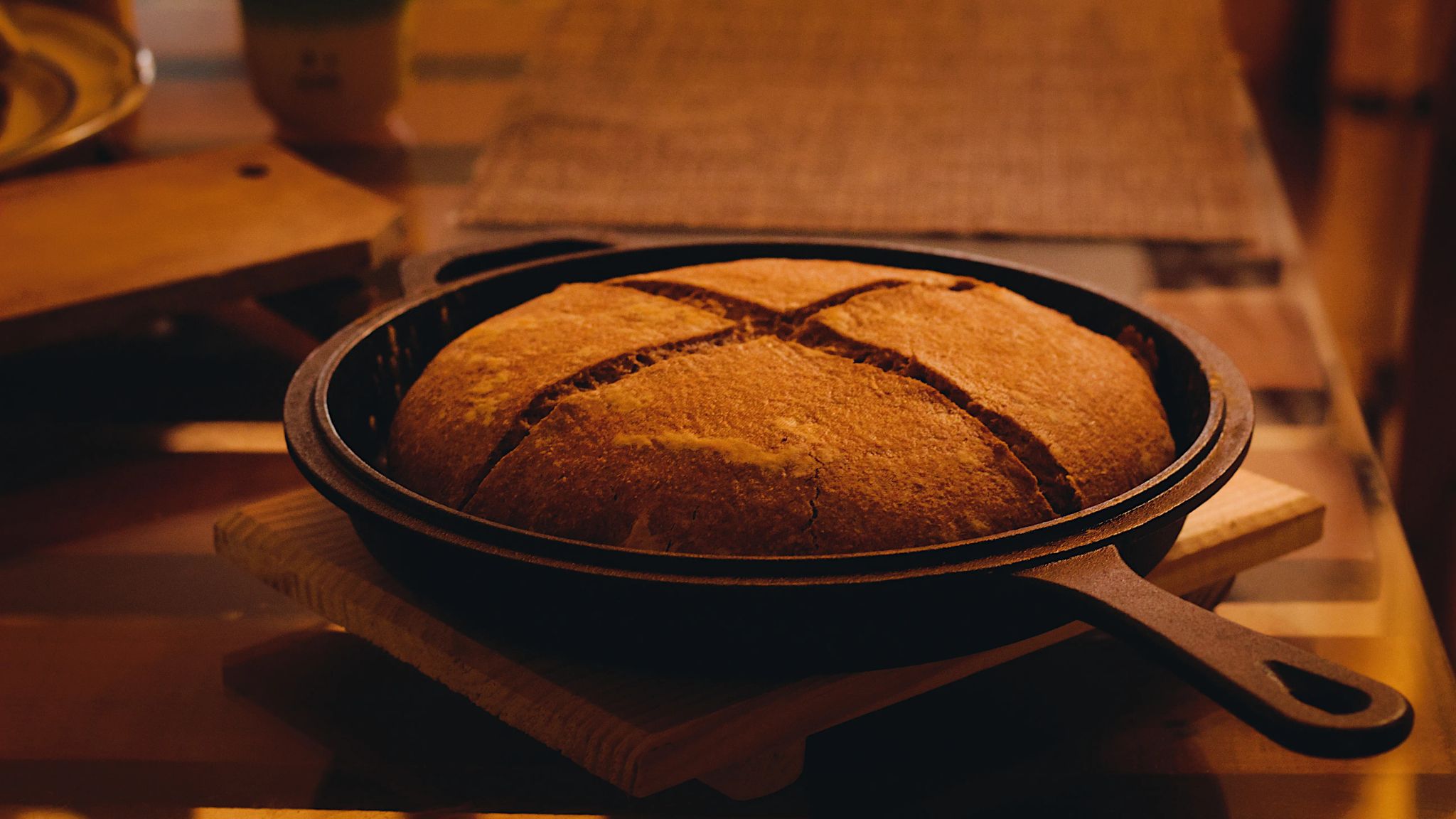
Cast iron pans are among the most chemically inert cooking surfaces available. The cooking surface is iron and polymerized oil, nothing else. That story breaks down when brands use synthetic pre-seasoning compounds without disclosing them. Every skillet on this list names its factory seasoning, so you know exactly what was on the cooking surface when the pan left the foundry.
What we look for
The pass criteria for a cast iron skillet are narrow. The pan must be bare cast iron or pre-seasoned with a named plant oil or beeswax. That means no PTFE, no enamel, no ceramic coating with an undisclosed binder, and no "nonstick" finish of any kind.
Seasoning oil disclosure. This is the differentiating factor among cast iron brands. A pan seasoned in a factory before shipping carries residue from that oil on its cooking surface. If the brand lists "vegetable oil" without further specification, that is not adequate disclosure. Field Company says certified organic grapeseed oil. Stargazer names a non-GMO blend of canola, grapeseed, and sunflower. Lancaster says grapeseed, two coats. Fredericksburg says avocado oil. Those are the standard we require.
No synthetic coatings. PTFE (polytetrafluoroethylene, sold under brand names including Teflon) is a fully fluorinated polymer in the PFAS family. It is stable at normal cooking temperatures but begins to off-gas above 500 degrees Fahrenheit and degrades with scratching. Any "nonstick" cast iron or "ceramic-coated" cast iron is out of scope for this guide.
No enamel. Enameled cast iron is a valid choice for many purposes, but it introduces different disclosure questions: colorants and binder chemistry in the glass frit. Le Creuset, Staub, and Lodge's enamel line belong in their own guide. This guide covers bare metal only.
Made-in and foundry transparency. All 8 pans on this list are made in the United States by named foundries that disclose their location.
Weight and machining. Traditional cast iron is poured into sand molds and left rough. Modern premium brands machine their cooking surfaces after casting, producing a smoother surface that seasons faster. Field Company and Stargazer machine their interiors; Lancaster and Fredericksburg cast to a smooth pour finish. The machined surface builds usable, non-stick seasoning in 3 to 5 cooks rather than 10 to 15.
1. Field Company No. 8 Cast Iron Skillet - Best overall

The Field Company No. 8 Cast Iron Skillet is the skillet we would reach for first. Field Company machines their pans to thinner, more uniform walls than sand-mold pours achieve, bringing the No. 8 to around 4 pounds versus the 5.4 pounds of a comparable Lodge equivalent. That difference matters on the stove, in the oven, and when carrying a full pan to the table.
The brand's pre-seasoning is certified organic grapeseed oil, confirmed on their care FAQ page. That is the full disclosure we require: a named oil with a verifiable source. The polished interior builds seasoning faster than a rough-cast surface; after a few cooks it takes on the dark patina that is itself a polymerized oil finish.
Field Company sells direct-to-consumer only. Their lifetime guarantee covers manufacturing defects. The No. 8 at 10.25 inches handles two to three eggs, a chicken breast, or a small steak without crowding.
2. Stargazer 10.5-Inch Cast Iron Skillet - Best for one or two servings

The Stargazer 10.5-Inch Cast Iron Skillet is made in Allentown, Pennsylvania by a small-batch foundry that CNC-machines their cooking surface after casting. The result is a smooth interior that behaves more like a well-seasoned pan from the first use than rough-cast alternatives.
Stargazer discloses their factory seasoning as a certified non-GMO blend of canola, grapeseed, and sunflower oil, confirmed on their how-it's-made page. This is a multi-oil blend chosen for its polymerization characteristics at foundry temperatures, not a proprietary coating.
At 10.5 inches (similar in cooking area to a vintage size 8), this pan handles two eggs, a large chicken thigh, or a small sear. The helper handle on the rear of the pan makes oven-to-table transfers safer under load. At $155, it is the most affordable pick in the guide.
3. Lancaster No. 8 Cast Iron Skillet - Best Pennsylvania-made

The Lancaster No. 8 Cast Iron Skillet comes from a Lancaster, Pennsylvania foundry that casts and seasons locally. It is bare cast iron with a smooth-pour interior, pre-seasoned with two coats of grapeseed oil before shipping.
The grapeseed oil disclosure appears on Lancaster's seasoning and cleaning page, confirmed with a source URL. Two factory coats give the pan a head start over unseasoned bare iron, and grapeseed oil polymerizes at moderate heat to a stable, non-tacky film.
The No. 8 at 10.5 inches is their most popular size, priced at $175. Lancaster casts flared pour spouts into both sides of the rim. The long handle keeps knuckles clear of a hot oven rack. At just over 5 pounds it is in the traditional weight range for sand-mold cast iron, but the smooth pour surface means faster seasoning buildup than a rough-pour alternative.
4. Fredericksburg No. 10 Cast Iron Skillet - Best avocado-oil finish

The Fredericksburg No. 10 Cast Iron Skillet is made by a family-owned artisan foundry in Fredericksburg, Texas, pre-seasoned with avocado oil as confirmed on their FAQ page.
Avocado oil has one of the highest smoke points of any plant-based cooking oil (around 520 degrees Fahrenheit), which makes it a stable seasoning choice for a pan that will routinely see high heat. The brand's FAQ lists avocado oil explicitly with no "proprietary blend" qualification. That directness distinguishes this pan from conditionals in our research.
The No. 10 is an 11.75-inch pan that handles family-sized portions of eggs, two to three chicken thighs, or a pound of ground beef without crowding. At $185, it is priced competitively with the Lancaster and Stargazer pans of similar size.
5. Stargazer 12-Inch Cast Iron Skillet - Best large-batch pan

The Stargazer 12-Inch Cast Iron Skillet applies the same machined-interior, non-GMO oil-blend construction as the 10.5-inch, scaled to a 12-inch cooking diameter. It handles a 12-ounce ribeye with room for butter basting, a full pound of ground meat, or four chicken thighs at once.
The CNC-machined interior means less break-in time than a rough-pour large pan, which matters more at this size. A rough large pan requires more seasoning cycles to become non-stick across its full surface. Stargazer discloses the same non-GMO canola-grapeseed-sunflower blend as the smaller pan.
At $175, the 12-inch is only $20 more than the 10.5-inch. If you cook for one or two most nights, the 10.5-inch is the better fit; if you cook for three or more, start here.
6. Lancaster No. 10 Cast Iron Skillet - Best large Pennsylvania-made

The Lancaster No. 10 Cast Iron Skillet is the larger sibling of the No. 8, cast in the same Lancaster, Pennsylvania foundry and seasoned with two coats of grapeseed oil. At 11.625 inches it is wide enough for a whole spatchcocked chicken or four servings of hash browns.
The No. 10 weighs just over 6 pounds, which is heavier than the machined pans but manageable. The long handle and rear helper handle follow the same design as the No. 8, with flared pour spouts on both sides. If you already own a Lancaster No. 8 and want a larger complement, this is the natural step up at $225.
7. Fredericksburg No. 12 Cast Iron Skillet - Best Texas artisan large

The Fredericksburg No. 12 Cast Iron Skillet is Fredericksburg Cast Iron Co.'s large-format offering: a 13.75-inch pan pre-seasoned with the same avocado oil as the No. 10, made in the same Texas foundry.
At this size the pan handles a full spatchcocked chicken, four large steaks, or a family-sized batch of cornbread in one pass. The No. 12 weighs more than the smaller pans, so this is a pan for the oven and for transferring with two hands. At $230, it is the most expensive pick in the guide.
8. Field Company No. 10 Cast Iron Skillet - Best lightweight large

The Field Company No. 10 Cast Iron Skillet applies Field Company's machined-wall, polished-surface approach to an 11.625-inch pan. The seasoning is the same certified organic grapeseed oil as the smaller models.
What sets the Field Company large apart from the Lancaster and Fredericksburg large pans is weight. The machined walls bring the No. 10 to around 4.5 pounds versus the 6-plus pounds of the Lancaster No. 10. For daily stovetop use that matters; for oven roasting it matters less. The polished interior also builds usable non-stick seasoning faster than rough-cast alternatives at this size.
At $215, it costs $10 less than the Lancaster No. 10. If the machined-surface advantage matters to you, it is the better large-pan choice; if the Lancaster pour tradition is what you want, the Lancaster No. 10 is the right pick.
What we passed on
Smithey Ironware: Smithey is a Charleston, South Carolina brand with a hand-finished interior that earns consistent praise. It is not in this guide because Smithey does not disclose their factory pre-seasoning oil anywhere on the brand site. The product page, the seasoning FAQ, and the brand story page all recommend oils for reseasoning (grapeseed, flaxseed, tallow) but do not name the factory-applied oil. That is the single criterion we could not confirm.
Camp Chef Cast Iron: Camp Chef describes their pre-seasoning as a "True Seasoned Finish" and a "chemical-free seasoned finish," which is marketing language rather than a material disclosure. The specific oil is not named anywhere on their site. Same conditional as Smithey: we cannot list a pan whose factory seasoning is unnamed.
Enameled cast iron (Le Creuset, Staub, Lodge Color): These are a different product category. The enamel glass layer is durable and does not require seasoning, but it introduces cadmium and lead colorant questions this guide does not address. See our enameled cast iron guide for that category.
Nonstick cast iron: Any pan marketed as "pre-seasoned nonstick" via a coating rather than via seasoning is out of scope. PFAS-free ceramic coatings still have undisclosed binder questions; we do not include them.
Cast iron care
Cast iron care is simpler than its reputation suggests. Heat the pan before adding fat. Wash with hot water while still warm (a stiff brush handles residue without soap in most cases). Dry immediately on the stove over low heat for one minute. Apply a thin layer of oil before storage.
Soap is not catastrophic on a well-seasoned pan, but it is unnecessary. The bigger risk is moisture: cast iron rusts quickly if left wet or stored in a damp environment. For stubborn residue, boil water in the pan for one minute, then scrub. For rust, scrub with a chain-mail scrubber or coarse salt and oil, rinse, dry immediately, and re-season in a 400 to 450 degree oven with a thin layer of oil for one hour.
FAQ
Is bare cast iron safe to cook in?
Bare cast iron with a named plant-oil seasoning is among the simplest cooking surfaces available. There is no synthetic polymer coating to degrade. At normal cooking temperatures the pan is chemically inert. The question of iron leaching into food is real but typically trivial for healthy adults. People with hemochromatosis should consult their doctor.
Why does the seasoning oil matter if I will re-season it myself?
The factory pre-seasoning oil is on the cooking surface when the pan arrives. If the oil is unnamed, you cannot evaluate it. Some synthetic finishes have been marketed as natural seasoning. The brands on this list each name a specific plant oil so the disclosure chain is unbroken from factory to your kitchen.
Does bare cast iron contain PFAS?
No. Bare cast iron pans do not contain PFAS. PFAS appears on cast iron only when a brand applies a "nonstick" or "easy-release" coating on top of the iron. If a cast iron pan claims nonstick performance from a coating rather than from seasoning, check whether that coating is named. Any PTFE or fluoropolymer coating belongs to the PFAS family.
Can I use cast iron on an induction cooktop?
Yes. All cast iron pans are magnetic and work on induction cooktops without any special treatment.
Is cast iron better than stainless steel?
They serve different purposes. Stainless steel is non-reactive and lighter. Cast iron retains heat longer, tolerates higher oven temperatures without lid or handle concerns, and can serve as a baking vessel. A well-seasoned cast iron skillet develops low-stick properties comparable to a moderate nonstick, without any coating.
Cover image: Silva Montanis via Pexels (Pexels License). Source.


