

Our picks at a glance
| Pick | Best for | Key certifications | Price | Details |
|---|---|---|---|---|
| Woolino 4 Season Ultimate Baby Sleep Bag | Temperature adaptability | Woolmark, RWS | $$$ | Full review |
| Woolino Ecolino Organic Cotton Baby Sleeping Sack | Budget GOTS cotton | GOTS | $$ | Full review |
| Disana Long Sleeve Merino Wool Sleep Sack | Certified wool with long sleeves | GOTS, IVN BEST | $$ | Full review |
| Parade Organics Sleep Sac | GOTS cotton with bottom-entry zipper | GOTS, OEKO-TEX | $$ | Full review |
| aden + anais Organic Cotton Light Sleep Sack | Certified muslin | GOTS | $$ | Full review |
| Burt's Bees Baby Beekeeper Wearable Blanket | Lowest price with GOTS | GOTS | $ | Full review |
| HALO SleepSack Wearable Blanket, 100% Cotton | Mainstream retail availability | FR-free confirmed | $$ | Full review |
| Love to Dream Swaddle UP Organic Cotton TOG 1.0 | Swaddle transition | Organic cotton (brand-stated) | $$ | Full review |
Most sleep sack guides recommend bamboo viscose without disclosing that the fabric is viscose rayon made with carbon disulfide — a neurotoxic solvent classified as a hazardous air pollutant by the EPA. Others recommend "organic cotton" sleep sacks with zero third-party certification. We set out to make the most verification-rigorous guide on the market.
Every pick below passed our three site disqualifiers: no chemical flame retardants, no polyester or synthetic fill, no bamboo viscose without at least OEKO-TEX Standard 100. Every certification claim links to a source URL. If it couldn't be verified, it's not here.
Safe sleep first
8
infant deaths
linked to weighted sleep products, CPSC 2018–2022
0
chemical FR
on every pick in this guide
8
picks
each with documented FR-free or snug-fit exemption
The American Academy of Pediatrics' 2022 safe sleep guidelines explicitly prohibit weighted sleep sacks and weighted swaddles following 8 infant deaths. Any sleep sack marketed as "weighted" or "calming" is a disqualifier, regardless of materials.
Sleep sacks also sit at the intersection of a federal sleepwear safety rule (16 CFR 1615, CPSC). Garments size 0–6X must either be chemically flame-resistant OR fit snugly to the body. Organic cotton sleep sacks that qualify for the snug-fit exemption must carry the label "FITS SNUGLY — NOT FLAME RESISTANT." That label is not a warning; it is a compliance statement. It means the product meets the standard without chemical treatment. It is one of the clearest signals that a brand understands the rule.
Two recent recalls illustrate how this goes wrong. The CPSC recalled WeeSprout sleep sacks in 2023 for zipper-pull choking hazards. Zigjoy sleep sacks were recalled in 2026 for burn hazard — the product failed to meet either the snug-fit or the chemical FR path of 16 CFR 1615. Neither brand appears in this guide.
TOG: matching warmth to room temperature
TOG (Thermal Overall Grade) measures how much heat a sleep sack retains. Use room temperature, not outdoor weather, as your guide:
| TOG | Room Temperature | When to use |
|---|---|---|
| 0.5 | 74–77°F / 23–25°C | Summer, warm climates |
| 1.0 | 68–72°F / 20–22°C | Year-round in most US homes |
| 2.5 | 61–68°F / 16–20°C | Cool rooms, winter |
| 3.5 | Below 61°F / 16°C | Cold rooms — wool recommended |
Source: Lullaby Trust safer sleep guidance.
The Woolino 4 Season design spans 68°F to 97°F using a removable merino layer — the only temperature-adaptive pick in this guide.
What we look for
Certifications that mean something
GOTS (Global Organic Textile Standard) is the strictest: it requires organic fiber and prohibits toxic dyes, finishes, and processing chemicals through the full supply chain. OEKO-TEX Standard 100 tests the finished fabric for harmful substances but does not regulate farming or processing methods. A GOTS certification is the most reliable signal that a sleep sack is what it claims.
RWS (Responsible Wool Standard) traces wool from farm to finished product and requires higher animal welfare and land-management standards. Woolmark is the quality certification of the International Wool Textile Organisation. Both are relevant to wool picks.
The bamboo viscose problem
Bamboo viscose — also sold as "bamboo rayon" or "bamboo fabric" — is not a natural fiber. It is reconstituted cellulose made by dissolving bamboo pulp in carbon disulfide. The FTC has penalized multiple brands for marketing bamboo viscose as natural or eco-friendly without disclosure. An OEKO-TEX certification on bamboo viscose confirms the finished fabric tests below residue limits; it does not mean the processing was clean.
Bamboo viscose with OEKO-TEX is on the conditional list (see Kyte Baby in "What we passed on"). Bamboo viscose without OEKO-TEX is a disqualifier.
Flame retardants and the snug-fit rule
Every pick qualifies for the 16 CFR 1615 snug-fit exemption or has documented FR-free confirmation from the brand. Both paths are acceptable; neither involves chemical treatment. If a brand cannot tell you which path their product takes, the product was not considered.
Automatic disqualifiers
Polyester fill or fleece variants; bamboo viscose without OEKO-TEX or GOTS; "organic cotton" with zero third-party certification; chemical flame retardants in any form; weighted or "calming" designs.
How this was vettedVerified June 2026
Each pick was verified against the brand's materials page, certification-body registries (GOTS public database, Woolmark), and CPSC recall records. FR status was confirmed via brand documentation or snug-fit label evidence. Reddit sentiment drawn from r/beyondthebump, r/sleeptrain, and r/BabyBumps, past 12 months, minimum 3 thread mentions with >0.85 upvote ratio.
Read the full criteria →Our picks
1. Woolino 4 Season Ultimate Baby Sleep Bag — Best overall

The Woolino 4 Season Ultimate Baby Sleep Bag is the only temperature-adaptive pick in this guide. The outer is 100% fine merino wool — Woolmark and RWS certified, no synthetic fill, no chemical FR — with a removable layer that adjusts the TOG rating across a 68°F to 97°F range. That single purchase replaces the typical three-sack seasonal rotation.
Merino wool regulates temperature passively: the fiber absorbs moisture vapor when the infant runs warm and releases heat, reducing the overheating risk that comes from a sleeping baby who can't kick off a blanket. The RWS certification tracks the wool from the farm through finished product — supply-chain transparency that organic cotton picks rarely match.
At $109, it carries the highest price in this guide. Most parents report buying one instead of three seasonal cotton sacks.
2. Woolino Ecolino Organic Cotton Baby Sleeping Sack — Best budget GOTS cotton

The Woolino Ecolino is 100% GOTS-certified organic cotton at $25.99, among the lower-priced GOTS-certified picks. It is Woolino's cotton line, manufactured in a GOTS-certified facility. Where the Woolino Ultimate is the all-season wool design, the Ecolino is the straightforward cotton lightweight option for warm climates or those who want GOTS at the lowest available entry price.
3. Disana Long Sleeve Merino Wool Sleep Sack — Best certified wool with long sleeves
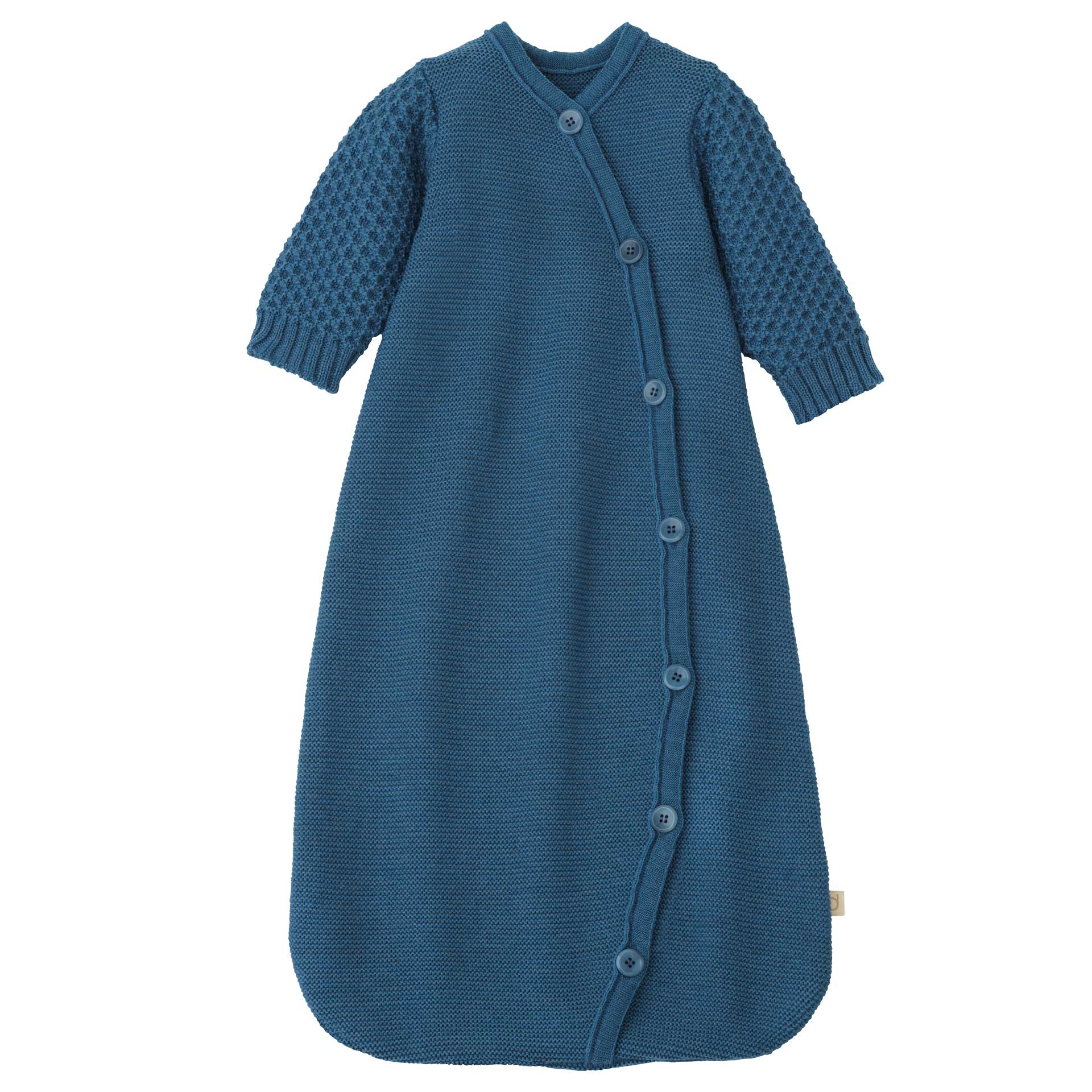
The Disana Long Sleeve Merino Wool Sleep Sack carries both GOTS and IVN BEST certification — the strictest natural textile standard available. Disana is a founding member of the International Association of Natural Textiles Industry in Germany, where the bag is made from 100% organic merino wool.
The long-sleeve construction means no bare arms during sleep, and the honeycomb-knit weave breathes at TOG 1.7. Available in sizes 0–6m and 6–18m. At $84–$92, it is the most affordable GOTS-certified wool pick in this guide.
4. Parade Organics Sleep Sac — Best GOTS cotton with bottom zipper

Parade Organics' sleep sac is 100% GOTS-certified organic cotton with a two-way zipper that opens from the bottom, one of the few certified options that allows nighttime diaper changes without fully unzipping from the top. Canadian-designed; also carries OEKO-TEX Standard 100. At $34 it sits in the mid-range among certified picks.
5. aden + anais Organic Cotton Light Sleep Sack — Best certified muslin

The aden + anais Organic Cotton Light Sleep Sack is GOTS-certified organic cotton muslin, TOG 1.0. The certifying body is listed on the product page — a specific distinction from HALO's own-brand "organic" sleep sack sold on the same website, which carries no third-party verification. Now sold via halosleep.com following HALO's acquisition of aden + anais.
The TOG 1.0 rating covers the 68–75°F range that applies to most US nurseries year-round.
6. Burt's Bees Baby Beekeeper Wearable Blanket — Best entry price with GOTS

Burt's Bees Baby's Beekeeper wearable blanket is 100% GOTS-certified organic cotton at $12–$22.46 depending on size, the widest price range and lowest floor of any GOTS pick here. The brand confirmed no chemical FR is applied. Available in TOG 0.5 (lightweight) and TOG 1.5.
One hard note: do not purchase the PolarBee Fleece variant. It is 100% polyester and is excluded from this guide. The GOTS-certified cotton Beekeeper is the pick.
7. HALO SleepSack Wearable Blanket, 100% Cotton — Best mainstream availability

The HALO SleepSack Wearable Blanket, 100% Cotton is the most widely stocked pick in this guide — available at Target, BuyBuy Baby, Amazon, and most baby-gear retailers. As a single-layer 100% cotton garment meeting the CPSC snug-fit sizing requirement, no chemical FR treatment is required or applied (16 CFR 1615).
This pick is here because HALO simultaneously sells a Micro-Fleece variant (100% polyester, excluded), an "organic" own-brand cotton line with no third-party certification (excluded), and this conventional 100% cotton version with FR-free status by material composition. The cotton version passes; the others do not. If certification is the threshold, choose one of the GOTS picks above.
8. Love to Dream Swaddle UP Organic Cotton TOG 1.0 — Best for swaddle transition

Love to Dream's Swaddle UP Organic Cotton is the only arms-up swaddle-to-sleep-sack transition design in this guide. The 95% organic cotton, 5% elastane (DreamStretch) construction holds the arms-up position that some infants prefer when transitioning off a traditional wrap swaddle. TOG 1.0.
One required disclosure: Love to Dream's OEKO-TEX certification applies only to their bamboo line. There is no GOTS or OEKO-TEX on the organic cotton Swaddle UP. The organic cotton claim is brand-stated only. If third-party certification is your threshold, this pick does not meet it. It is included because the arms-up transition design has no equivalent in the certified pool.
What we passed on
Kyte Baby bamboo sleep bag — Bamboo OEKO-TEX Standard 100 certified, which is above uncertified bamboo viscose. But the material is viscose rayon processed with carbon disulfide. The OEKO-TEX certification limits residue in the finished fabric; it does not mean the manufacturing process was clean. Included conditionally: if you choose Kyte Baby, this disclosure is required reading.
HALO Organics own-brand sleep sack — HALO's own-label "organic" sleep sack carries no GOTS, OEKO-TEX, or any third-party certification. The organic cotton claim is brand-stated only. The aden + anais GOTS muslin sold on the same site makes the gap explicit.
Finn + Emma Organic Cotton Sleep Bag — Dropped during verification. Product-specific URLs 404'd on finnandemma.com. The sleep bag listed on their site under that category was a Mushie-branded product via Shopify Collective, not a Finn + Emma product. We cannot verify the material claims for the product described in the research brief.
Weighted sleep sacks (any brand) — AAP 2022 explicitly prohibits weighted infant sleep products following 8 reported deaths. This disqualifies the category regardless of materials.
FAQ
What is TOG and which rating do I need?
TOG (Thermal Overall Grade) measures how well a sleep sack retains heat. Match the rating to room temperature: 0.5 for 74°F to 77°F, 1.0 for 68°F to 72°F, 2.5 for 61°F to 68°F, and 3.5 for rooms below 61°F. The Woolino 4 Season covers 68°F to 97°F via a removable merino layer, so one purchase covers most nursery conditions.
Is bamboo viscose safe for sleep sacks?
Bamboo viscose is reconstituted cellulose processed with carbon disulfide, a neurotoxic solvent and EPA-classified hazardous air pollutant. The FTC has penalized multiple brands for marketing it as a natural or eco-friendly fabric without disclosure. An OEKO-TEX certification on bamboo viscose confirms the finished fabric tests below residue thresholds; it does not mean the manufacturing process was clean. This guide treats bamboo viscose with OEKO-TEX as a conditional pick and excludes bamboo viscose without OEKO-TEX entirely.
What does the "FITS SNUGLY: NOT FLAME RESISTANT" compliance label mean?
That label is a compliance statement, not a warning. Federal sleepwear regulations (16 CFR 1615, CPSC) require garments sized 0 to 6X to either use chemical flame retardants or fit snugly enough that they do not catch fire easily. The snug-fit path requires no chemical treatment. Every organic cotton pick in this guide that carries a snug-fit compliance label meets federal standards through fit, not through flame-retardant chemistry.
Are weighted sleep sacks safe?
No. The American Academy of Pediatrics' 2022 safe sleep guidelines explicitly prohibit weighted infant sleep products following 8 infant deaths linked to weighted sleep products reported to the CPSC between 2018 and 2022. Any sleep sack marketed as weighted or calming is a disqualifier in this guide regardless of materials.
What is the difference between GOTS and OEKO-TEX for sleep sacks?
GOTS (Global Organic Textile Standard) certifies the entire supply chain: the fiber must be organically grown, and processing must meet strict standards for dyes, finishes, and chemistry throughout. OEKO-TEX Standard 100 tests the finished fabric for harmful substances but does not regulate farming or processing inputs. A GOTS certification is the more reliable indicator that a sleep sack is what it claims across its full production chain.
Cover image: Mesut çiçen via Unsplash (Unsplash License) — source.