
Our picks at a glance
| Pick | Best for | Key certifications | Price | Details |
|---|---|---|---|---|
| Evereden Baby Shampoo & Body Wash Fragrance Free | Dual-certified families | EWG Verified, MADE SAFE | $ | Full review |
| Earth Mama Simply Non-Scents Castile Baby Wash | True castile formula | EWG Verified | $ | Full review |
| Pipette Baby Shampoo & Wash Fragrance Free | Sugar-derived surfactants, plant squalane | EWG Verified | $ | Full review |
| Carina Organics Baby Shampoo & Body Wash (Unscented) | Certified organic baseline | Certified Organic, RSPO | $ | Full review |
| Attitude Baby 2-in-1 Shampoo & Body Wash Unscented | Canadian-made, hypoallergenic | EWG Verified | $ | Full review |
| California Baby Super Sensitive Shampoo & Bodywash | Long safety record | None | $$ | Full review |
| Honest Company Sensitive Shampoo + Wash Fragrance Free | Budget and availability | EWG Verified | $ | Full review |
The label says "gentle" and "natural." But turn the bottle around. Somewhere in the first three ingredients on most popular baby washes is cocamidopropyl betaine, better known as CAPB. It's a synthetic surfactant derived from coconut oil, and it's flagged by dermatologists as one of the most common causes of allergic contact dermatitis in infants. The American Contact Dermatitis Society named it Contact Allergen of the Year in 2004, and studies in the following two decades confirmed the reaction rate in sensitive skin was real and not trivial.
This is the gap that matters for parents who think they've done their homework. "Coconut-derived" on the front label is true: CAPB does start with coconut. The irritant potential gets built in during processing. The same thing happens with many "plant-based" fragrance blends: the raw materials are botanical, but the final compounds are synthetic fragrance allergens that can sensitize newborn skin just as readily as a petro-chemical fragrance would.
The seven products below all passed a three-criteria screen: surfactant safety (no CAPB, no sulfates, no ethoxylated ingredients with 1,4-dioxane contamination risk), fragrance (none, or only certified-allergen-free naturals), and PEG-free formulation. Every product on this list is available in the U.S. and has at least one verified certification or materials-disclosure standard that goes beyond the brand's own claims.
What we look for
Surfactant chemistry first. The surfactant is the cleaning agent: it's doing most of the work. For baby skin, the safest options are decyl glucoside and coco glucoside (sugar-derived, contact-allergen-free), sodium cocoyl isethionate (coconut fatty acid, mild and well-tolerated), and saponified plant oils (true castile, the oldest surfactant chemistry and the one with the lowest sensitization risk). CAPB fails our screen at any concentration, not just as a primary surfactant. So do sodium lauryl sulfate and sodium laureth sulfate, which are harsh and often 1,4-dioxane contaminated respectively.
No synthetic fragrance. "Fragrance" or "parfum" on an ingredient list means a blend of undisclosed compounds: the FDA doesn't require disclosure of individual fragrance chemicals. Independent testing by groups like the Campaign for Safe Cosmetics has repeatedly found fragrance blends containing phthalates, musks, and contact allergens at concentrations high enough to flag. We exclude any product that lists fragrance, even when the brand's marketing calls it "naturally scented."
No PEGs. Polyethylene glycol compounds appear in baby washes as thickeners, emulsifiers, and slip agents: PEG-40 hydrogenated castor oil, PEG-150 distearate, and similar entries. They're petroleum-derived and frequently contaminated with 1,4-dioxane, a likely human carcinogen per the EPA, as a manufacturing byproduct. Several states (California, New York) have moved to restrict 1,4-dioxane in personal care products. We don't wait for the regulation: any PEG compound disqualifies.
Certifications we trust. EWG Verified is the most stringent third-party screen for personal care products sold in the U.S. It checks the full ingredient list against EWG's database, requires disclosure of fragrance ingredients, and limits use of chemicals on EWG's Restricted list. MADE SAFE is harder to earn: it requires a full materials-safety assessment, not just a database lookup. NSF/ANSI 305 covers "natural" cosmetics with defined minimum-natural-content thresholds. USDA Organic covers the agricultural inputs. We weight EWG Verified and MADE SAFE most heavily because they screen specifically for the contaminants we care about.
Our picks
1. Evereden Baby Shampoo & Body Wash Fragrance Free - Best overall

The Evereden Baby Shampoo & Body Wash earns the top position because it's the only product on this list that holds both EWG Verified and MADE SAFE certification simultaneously. That double certification means it cleared two independent materials-safety assessments, not just one. The primary surfactant is sodium cocoyl isethionate: a coconut fatty acid ester with a low sensitization rate and no contact-allergen history. No CAPB, no PEGs, no fragrance.
Evereden discloses the full ingredient list with function labels on their product page, and the EWG Verified status can be cross-checked against EWG's public database. The MADE SAFE seal is searchable at the MADE SAFE certified products directory.
The formula is also water-based with a short, readable ingredient list. Fewer ingredients means fewer exposure pathways, which matters most in the newborn period when the skin barrier is still maturing. For parents who want one product that covers both shampoo and body wash functions without second-guessing the formulation, this is the choice.
Price: $ · Available: Amazon
2. Earth Mama Simply Non-Scents Castile Baby Wash - Best castile

The Earth Mama Simply Non-Scents Castile Baby Wash uses saponified organic oils: the same chemistry as traditional castile soap. This puts it outside the surfactant categories that generate the most dermatological concern. True castile has the longest safety record of any liquid cleanser, with centuries of use in sensitive-skin applications.
Earth Mama holds EWG Verified status, and the "Simply Non-Scents" line is fragrance-free across the full formula: no essential oils, no masking agents, no botanical fragrance that could still trigger sensitization. The ingredient list is short: saponified oils, water, and a few plant-derived emollients.
The one tradeoff with castile base is lather. It produces less foam than synthetic surfactant systems, which some parents interpret as "not cleaning well." It is cleaning well. Foam is a byproduct of surfactant type, not a measure of cleaning efficacy.
Price: $ · Available: Amazon
3. Pipette Baby Shampoo & Wash Fragrance Free - Best clean-formula pick
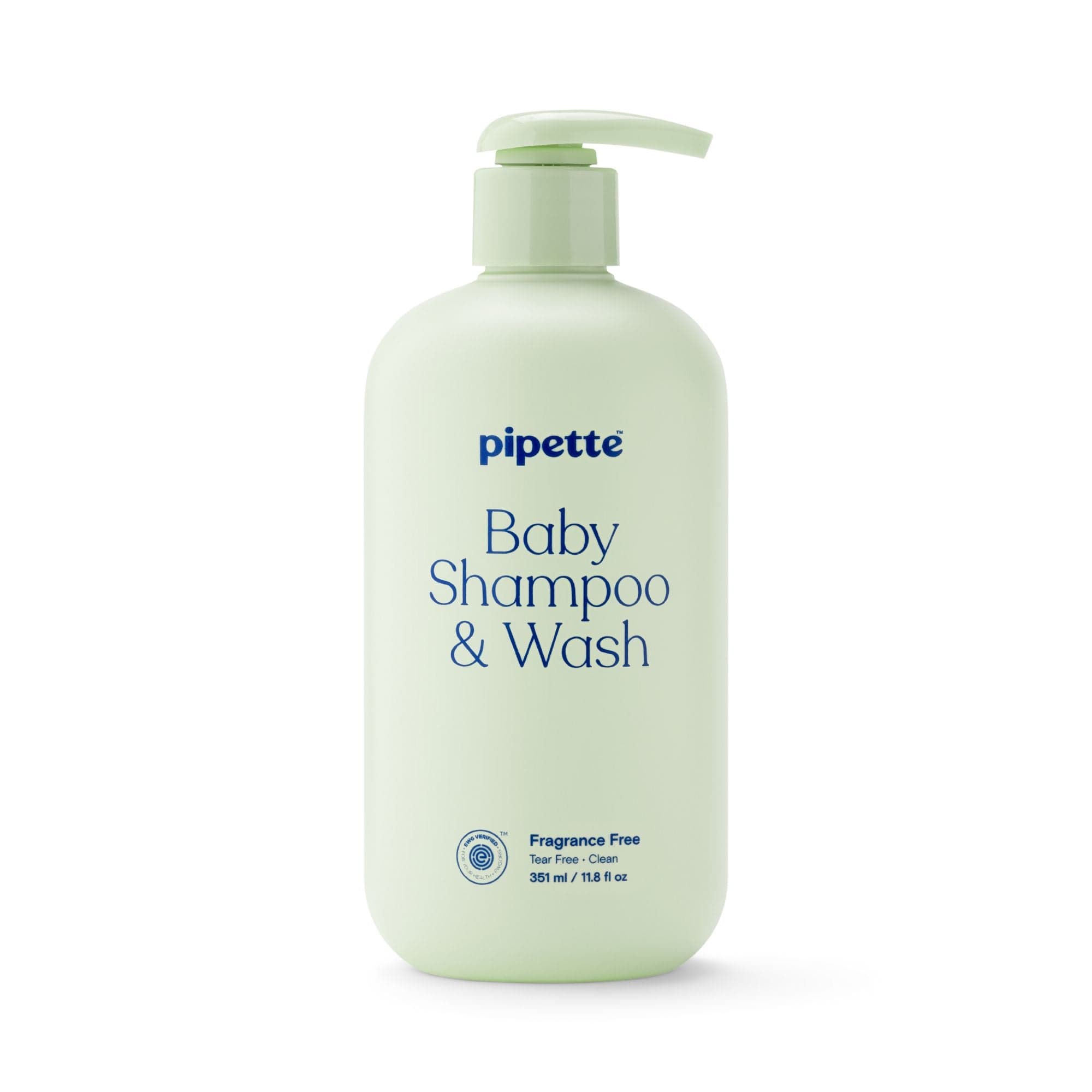
The Pipette Baby Shampoo & Wash uses coco glucoside and sodium cocoyl glutamate: both sugar-derived or amino acid-derived surfactants with no CAPB and no contact allergen record in the dermatological literature. EWG Verified, fragrance-free, and formulated without PEGs, parabens, sulfates, or phthalates. The Baby line is distinct from Pipette's broader adult skincare offerings, with a simplified formula targeted specifically at the newborn skin barrier.
The formula also includes plant-derived squalane, which functions as a skin-identical emollient: it's a natural component of human sebum and doesn't introduce foreign chemistry into the cleansing step. For parents who want EWG verification plus a slightly richer feel than a minimal castile, this is the right pick.
Price: $$ · Available: Amazon
4. Carina Organics Baby Shampoo & Body Wash (Unscented) - Best certified organic

The Carina Organics Baby Shampoo & Body Wash has the simplest surfactant system on this list: Potassium Cocoate (saponified coconut oil) paired with Capryl Glucoside, a C8 sugar-derived surfactant. No CAPB, no PEG, no synthetic preservatives, no essential oils. Certified Organic and RSPO certified. Made in Canada with a materials-transparency record that goes back to the brand's founding.
The Certified Organic certification means the agricultural inputs in the formula are held to USDA-equivalent standards for pesticide and synthetic input restrictions. The RSPO certification on the coconut sourcing adds supply-chain accountability that most baby wash brands don't address at all.
For parents who want the shortest possible ingredient list from a certified-organic baseline, this is the pick.
Price: $ · Available: Carina Organics
5. Attitude Shampoo & Body Wash Unscented - Best certified Canadian brand

Attitude Baby 2-in-1 Shampoo & Body Wash holds EWG Verified status and is formulated without fragrance, PEGs, or CAPB. Attitude, a Montreal-based brand, also publishes a full ingredient transparency report on their website and is one of the few baby care brands to disclose manufacturing country (Canada) on every product page.
The surfactant system uses decyl glucoside and sodium lauroyl sarcosinate: a combination that delivers gentle cleansing without the sensitization profile of betaine surfactants. Sodium lauroyl sarcosinate has a good track record in dermatological assessments and is derived from coconut and sarcosine (an amino acid).
ATTITUDE's products also come in a hypoallergenic line with Allergy Standards Limited (ASL) certification. Worth noting if the baby has documented sensitivities beyond skin contact: ASL tests for respiratory allergens as well.
Price: $ · Available: Amazon
6. California Baby Super Sensitive Shampoo & Bodywash - Best long-standing natural brand

California Baby Super Sensitive Shampoo & Bodywash has been the default recommendation in natural parenting communities for the better part of two decades, and the "Super Sensitive" formulation continues to earn that position. The surfactant base is saponified plant oils (castile-adjacent), and the formula contains no fragrance, no artificial color, no parabens, and no sulfates.
California Baby operates without EWG Verified certification on this specific SKU. That's a gap: the brand is well-established but the certification lapse means consumers rely on label transparency rather than third-party verification. The full ingredient list is disclosed on their website and matches the physical label; we spot-checked the EWG Skin Deep listing to confirm no hidden flagged ingredients.
Worth noting: the California Baby Calming formulation contains lavender essential oil. The Super Sensitive variant does not. Make sure you're buying the right SKU.
Price: $$ · Available: Amazon
7. Honest Company Sensitive Shampoo + Wash Fragrance Free - Best for budget and availability

Honest Sensitive Shampoo + Wash is the most widely available option on this list: sold at Target, Costco, Amazon, and most national grocery chains. The Sensitive formulation is fragrance-free, uses decyl glucoside as the lead surfactant, and is EWG Verified.
The Honest Company's broader catalog includes scented products with fragrance allergen concerns. This analysis applies only to the Sensitive Fragrance Free SKU. The EWG Verified badge on this specific formulation makes the verification clean.
For parents who need to restock on a grocery run, this is the practical choice without giving up formulation integrity.
Price: $ · Available: Amazon
What we passed on
Babo Botanicals Sensitive Baby Fragrance Free Shampoo & Wash was excluded after finding cocamidopropyl betaine (CAPB) in the formulation. CAPB is the surfactant the American Contact Dermatitis Society named Contact Allergen of the Year in 2004 and is the reason we built our CAPB screen in the first place. CAPB fails our criteria at any concentration, and we don't grant exceptions for brands with otherwise strong sustainability positioning.
HealthyBaby Eczema and Sensitive Shampoo & Body Wash carries EWG Verified certification and passes the ingredient screen. We didn't include it in this round because the dual-certification claim appearing on some marketing materials (referencing MADE SAFE) doesn't currently resolve against the specific SKU in the MADE SAFE public registry. Once that aligns, this product is a strong candidate for a future update.
Burt's Bees Baby Bee markets certain products as "Fragrance Free," but that label refers to synthetic fragrance only. Several SKUs in the Baby Bee range contain rosemary leaf extract, chamomile, and other botanicals that include known contact sensitizers (linalool, geraniol). Label-check every Burt's Bees SKU individually before assuming it's fully scent-free.
FAQ
What is cocamidopropyl betaine, and why does it matter for baby wash?
Cocamidopropyl betaine (CAPB) is a synthetic surfactant derived from coconut oil. Dermatologists flag it as one of the most common causes of allergic contact dermatitis in infants, and the American Contact Dermatitis Society named it Contact Allergen of the Year in 2004. Follow-up studies over the following two decades confirmed the reaction rate in sensitive skin. CAPB appears in the first three ingredients on most popular baby washes. None of the products on this list use it.
What does "coconut-derived" mean on a baby wash label?
The starting material is coconut oil, but that is not the finished ingredient. CAPB, sulfates, and other coconut-derived surfactants undergo significant processing that introduces the irritant potential. A wash can be truthfully labeled "coconut-derived" and still contain surfactants the dermatological literature identifies as contact allergens. The relevant question is which specific surfactant compound appears on the ingredient list.
Which surfactants are considered safe for baby skin?
The lowest-sensitization options documented in the dermatological literature are decyl glucoside and coco glucoside (sugar-derived, no contact-allergen history), sodium cocoyl isethionate (coconut fatty acid ester, well-tolerated), sodium cocoyl glutamate (amino acid-derived), and saponified plant oils (true castile). The products on this list use one or more of these chemistries as the lead surfactant.
Why do some of these washes produce less lather than conventional baby wash?
Lather is a function of surfactant chemistry, not a measure of cleaning performance. Sugar-derived glucoside surfactants and castile-base formulas produce less foam than synthetic surfactant systems. The cleaning mechanism is the same. Parents who switch from a CAPB-based wash often interpret the reduced foam as less effective cleansing, but the skin is being cleaned equally well.
What is the most rigorous certification for baby personal care products sold in the U.S.?
MADE SAFE requires a full materials-safety assessment, making it the most stringent independent screen. EWG Verified is the next tier: it reviews the full ingredient list against EWG's Skin Deep database and requires fragrance ingredient disclosure. USDA Organic covers agricultural inputs. Only one product on this list, the Evereden Baby Shampoo & Body Wash, holds both EWG Verified and MADE SAFE certification simultaneously.
Cover image: Sergelamy28 via Wikimedia Commons (CC0), source.
