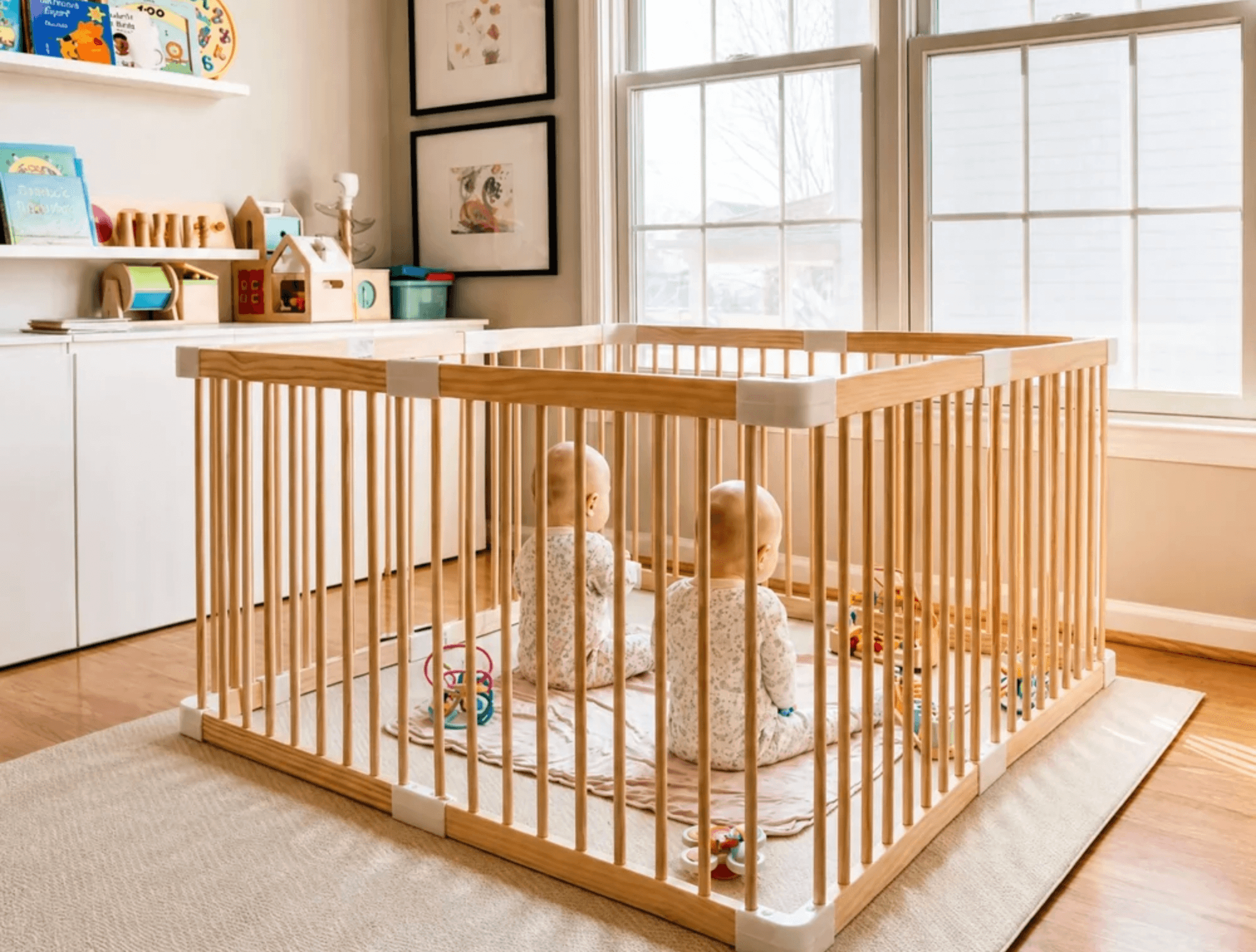

Most baby cribs combine solid wood rails with composite panels: MDF, particleboard, or plywood bound with urea-formaldehyde adhesive. GREENGUARD Gold certification measures whether those panels off-gas below a VOC threshold, not whether they are present at all. For parents who want to push past the threshold, the options narrow -- but they exist at several price points.
When the first thing your newborn breathes is the air in their crib, the chemistry of the wood panels 8 inches below their face is not an abstraction. This guide applies the full site disqualifier list to every pick: no PFAS treatments, no undisclosed composite binders, no chemical flame retardants, no undisclosed finishes.
What we look for
Solid wood versus composite. A solid wood crib uses milled lumber throughout: every slat, every rail, every panel, and crucially the mattress support board underneath the mattress. Most cribs, including many GREENGUARD Gold-certified ones, use solid wood for the visible outer rails and MDF or particleboard for the less visible interior panels and the mattress support board. That board sits directly below where a baby sleeps for 12 to 16 hours a day.
The formaldehyde problem with composite. MDF and particleboard use urea-formaldehyde (UF) resin as the binding agent. UF resin off-gasses formaldehyde continuously, at a rate that decreases over years but never reaches zero. CARB2 Phase 2, California's strictest composite standard, sets a formaldehyde emission cap of 0.05 ppm for MDF and 0.09 ppm for particleboard. "No-added-formaldehyde" (NAF) panels use non-UF binders and emit near-zero formaldehyde. Solid wood emits trace amounts of naturally occurring aldehydes that are orders of magnitude lower than composite.
GREENGUARD Gold as a floor, not a ceiling. GREENGUARD Gold tests the assembled product in a chamber and measures overall VOC off-gassing. It is a meaningful certification: cribs that fail it are out. But it measures emissions below a threshold, not the absence of composite wood. A GREENGUARD Gold crib can still be made from substantial MDF. We use it as the minimum requirement, then look at what is actually in the build.
FSC certification tells you about the forest, not the chemistry. Forest Stewardship Council certification confirms responsible forestry practices. It does not address finishes, adhesives, or composite content. It is a useful signal on supply-chain accountability but does not substitute for material disclosure.
Finishes and hardware. Water-based topcoats are the standard non-toxic finish for baby furniture. Solvent-based lacquers, which off-gas VOCs long after application, are the failure mode. We also look for crib feet made from natural rubber or solid wood, not polyurethane pads.
Conversion longevity. A crib that converts to a toddler bed, daybed, and headboard extends the useful life of the purchase to 10-plus years. We prefer designs where the conversion uses the same solid-wood or CARB2 components as the original build, not a separate particleboard panel kit shipped years later.
Our picks
1. Romina New York Crib - Best solid wood

The Romina New York Crib is the most material-rigorous crib we could find: every structural component, including the mattress support board that most competitors make from MDF, is solid European beech. No composite panels, no particleboard, no veneer, and no formaldehyde-based adhesive anywhere in the build.
The New York is part of Romina's flagship collection, made in their own factory in Romania. The finish is a water-based lacquer, applied at the factory and documented in Romina's product specification. GREENGUARD Gold covers the full assembled crib. The conversion path goes to a toddler bed and full-size headboard using Romina's solid-wood conversion kits; the material profile does not change through conversion.
The price is high. What you are paying for: no compromise on materials, European production under close quality control, and a build designed to outlast the nursery years by a wide margin. Romina cribs appear regularly in second-hand markets 10 to 15 years after purchase, still structurally sound.
Who this is for: Parents who want the most complete solid-wood build available and are willing to pay for it.
2. Babyletto Hudson 3-in-1 Convertible Crib - Best value

The Babyletto Hudson 3-in-1 Convertible Crib is the most recommended non-toxic crib at the $$ price tier, and it earns that status: GREENGUARD Gold and FSC certification together, solid New Zealand pine for the main structural elements, and CARB2-compliant engineered panels on lower-contact interior surfaces.
Babyletto (a Million Dollar Baby Co. brand) is the most transparent mid-market crib producer on material disclosure. Their documentation names every material down to the specific composite standard. The Hudson's solid pine frame covers the primary sleep contact surfaces; the CARB2 panels are in lower-visibility, lower-contact areas.
It converts to a toddler bed with the included rail. Water-based paint finish. The crib is available in a range of solid and two-tone colors. For families who want GREENGUARD Gold plus explicit material transparency at a price that fits a normal nursery budget, this is the default recommendation.
Who this is for: Families who want solid certifications and visible material transparency without paying Romina prices.
3. Babyletto Lolly 3-in-1 Convertible Crib - Best open-slat design

The Babyletto Lolly 3-in-1 Convertible Crib is the open-spindle variant in Babyletto's core line. Solid New Zealand pine throughout the visible structure, GREENGUARD Gold certified, with a pared-back design that reduces the total area of composite paneling compared to the Hudson.
The Lolly's open base makes the mattress support system visible from underneath, which is a useful design transparency: you can see what is holding the mattress. Like the Hudson, it converts to a toddler bed with the included rail. The finish options include natural, which is the lowest-intervention surface option in this price tier.
The main reason to pick the Lolly over the Hudson is the design aesthetic. The material story is the same, and the pricing is similar.
Who this is for: Families who prefer the open-spindle look and want the Babyletto material profile.
4. DaVinci Kalani 4-in-1 Convertible Crib - Best budget 4-in-1

The DaVinci Kalani 4-in-1 Convertible Crib is the most conversion-capable crib at the $ price tier: GREENGUARD Gold, FSC-certified solid beech end panels plus sustainable New Zealand pine, with a four-stage path to toddler bed, daybed, and full-size headboard.
DaVinci is another Million Dollar Baby brand, and the Kalani has been their flagship 4-in-1 for over a decade. At this price, you get honest certification, named FSC sourcing, and a long-standing product with a deep supply chain for conversion kits. The composite content is higher than the Romina options but meets CARB2, with publicly available material documentation.
The GREENGUARD Gold certification covers the full assembled product. Conversion hardware is sold separately. This is the best sub-$300 crib we could find that clears all site disqualifiers.
Who this is for: Families who want 4-in-1 longevity on a tight budget, with dual certification from a legacy brand.
5. Namesake Nantucket 3-in-1 Convertible Crib - Best mid-range design

The Namesake Nantucket 3-in-1 Convertible Crib is Namesake's flagship product, distinguished by its coastal arch panel headboard. Solid pine rails, GREENGUARD Gold certified, with CARB2-compliant engineered wood on the panel sections. The toddler rail is included in the box.
Namesake launched in 2020 as a design-led alternative to the established mid-market cribs. The Nantucket's arch headboard profile is visibly different from Babyletto's geometric designs, making it the right pick for nurseries styled around a softer coastal or coastal-rustic aesthetic.
Tradeoff: more composite panel content than the Romina picks, priced below them, and a more distinctive design than the standard Babyletto palette.
Who this is for: Families who want a crib with a distinct character in the $$ tier, and are comfortable with GREENGUARD Gold plus CARB2 as the material floor.
6. Babyletto Scoot 3-in-1 Convertible Crib - Best entry-level solid frame

The Babyletto Scoot 3-in-1 Convertible Crib is the lowest-price option in Babyletto's certified lineup. Solid pine for the main frame, CARB2-compliant engineered panels, GREENGUARD Gold certified, with a toddler conversion rail included.
The Scoot's main design distinction is its lower, more open footboard profile compared to the Lolly. For material purposes they are equivalent. If the Lolly is out of stock or priced higher at the time of purchase, the Scoot is a direct substitute.
Who this is for: Families who want the Babyletto certification story at the lowest available price.
7. DaVinci Charlie 4-in-1 Convertible Crib - Budget 4-in-1 alternative
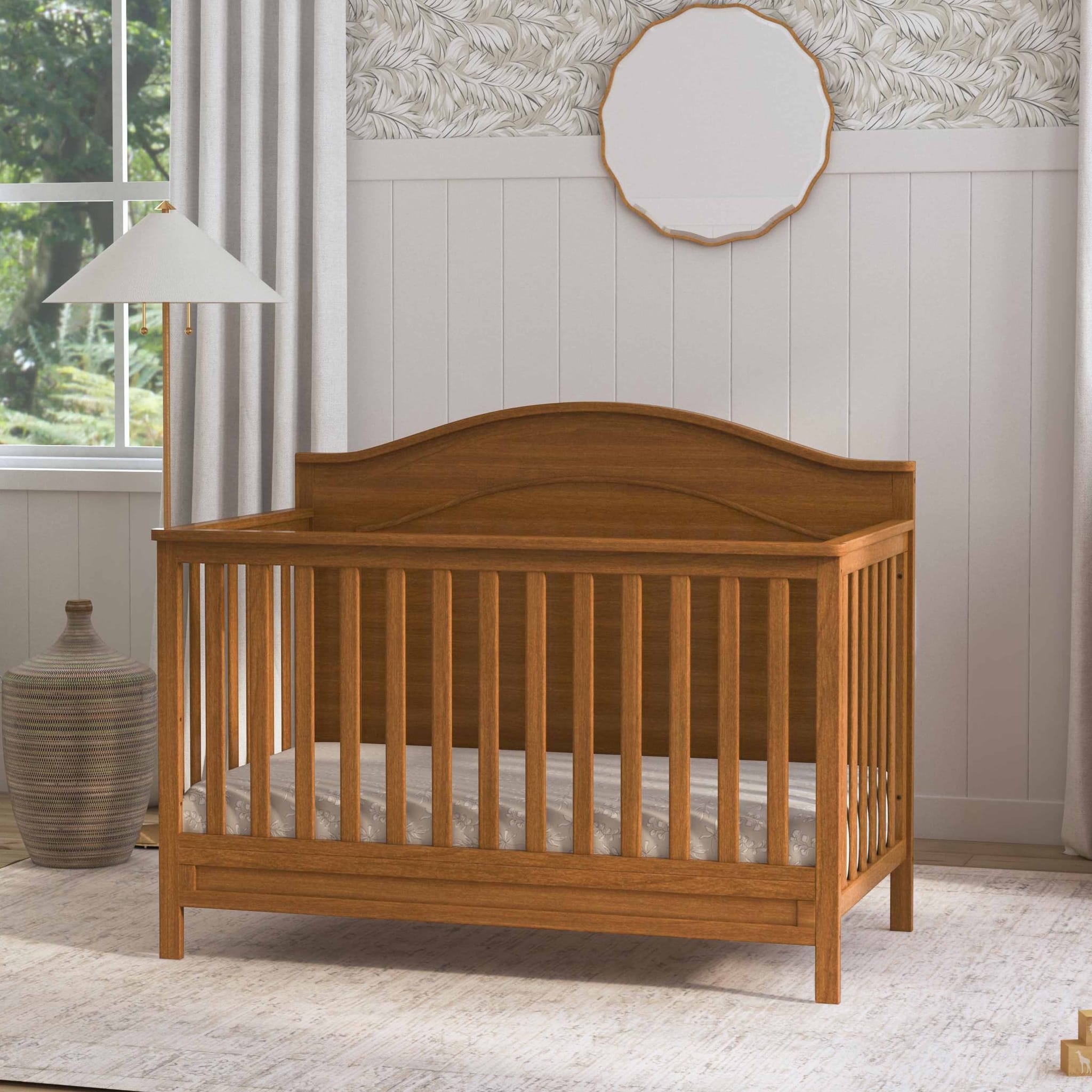
The DaVinci Charlie 4-in-1 Convertible Crib is DaVinci's newer 4-in-1 model. Solid pine frame, CARB2-compliant composite panels, GREENGUARD Gold certified. The design features a cleaner tapered leg profile compared to the Kalani's thicker posts.
The Charlie and the Kalani are functionally equivalent at this price: same material floor, same certification, same four-stage conversion path. The Charlie is the newer design, and it suits nurseries where a slimmer silhouette fits better. If one is out of stock, the other is a direct substitute.
Who this is for: Families looking for a 4-in-1 at $ pricing with the same material floor as the Kalani.
8. Romina Dakota Convertible Crib - Solid wood, streamlined design

The Romina Dakota Convertible Crib is the entry point for Romina's solid-wood construction. The Dakota uses solid European beech and poplar throughout: no composite panels, no MDF, no veneer. GREENGUARD Gold certified, made in Romania.
The Dakota differs from the New York line primarily in design: straight rails and a simpler headboard profile, compared to the New York's more traditional sculpted panel. The underlying material commitment is identical. If you want the Romina material story in a cleaner, more modern silhouette, the Dakota is the right pick.
Like all Romina cribs, it converts to a toddler bed using the brand's conversion kit. Finish is a water-based stain or paint depending on color choice.
Who this is for: Parents who want the Romina solid-wood build in a streamlined, contemporary silhouette.
9. Stokke Sleepi Bed V3 - Best for small-space nurseries
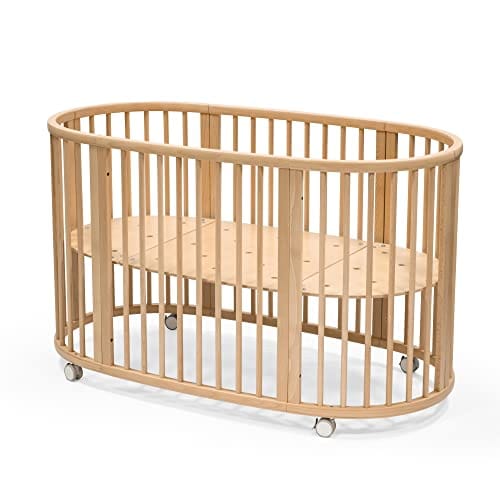
The Stokke Sleepi Bed V3 is the only round crib in this guide. Solid beech wood throughout, GREENGUARD Gold certified, made in Norway. The oval form factor is designed for small nurseries where a standard rectangular footprint does not fit cleanly, and it can be positioned in corners in ways a rectangular crib cannot.
The Sleepi grows with the child through dedicated extension kits: the Sleepi Mini (newborn insert), the standard crib size, and the Junior bed configuration. Each stage uses a Stokke-specific kit and mattress. The price for the V3 is high, and the required accessories add significantly to the total cost of ownership.
The material profile is equivalent to the Romina picks: solid beech only, no composite, no MDF. We include it as a specialist pick for parents who have a genuine space constraint and want the same solid-wood standard.
Who this is for: Parents in tight spaces who want solid-wood construction and are comfortable building within the Stokke ecosystem.
What we passed on
OEUF Sparrow. OEUF uses NAF (no-added-formaldehyde) plywood and solid birch, a strong material story. The Sparrow Crib is in our catalog. We did not include it in this guide's main slate because the conversion path to a toddler bed requires an additional separate kit that significantly increases the total cost. If the NAF standard is the deciding factor, the Sparrow is worth looking at directly.
Nestig Cloud Crib. Pending confirmation of the adhesive chemistry used in the base panel. We will add it to this guide when the brand's disclosure is complete.
Pottery Barn Kids cribs. Polyurethane foam in the mattress support system on most models. Excluded on that basis.
FAQ
Does GREENGUARD Gold mean no formaldehyde in a crib?
No. GREENGUARD Gold certifies that a crib's total VOC off-gassing, including formaldehyde, tests below UL's thresholds in a chamber test. A GREENGUARD Gold crib can still contain MDF and particleboard panels with urea-formaldehyde adhesive. The certification means the emissions are below a threshold, not that composite wood is absent.
What is CARB2 and why does it matter?
CARB2 Phase 2 is California's composite wood products standard, the most stringent in the US. It limits formaldehyde emissions from MDF, particleboard, and hardwood plywood. CARB2-compliant panels emit significantly less formaldehyde than non-compliant composite, but they are not zero-formaldehyde. The next step up is NAF (no-added-formaldehyde) panels, which use non-formaldehyde binders.
Should I get a 3-in-1 or a 4-in-1 crib?
A 4-in-1 crib adds a daybed configuration and typically converts to a full-size bed headboard. A 3-in-1 usually goes to toddler bed only. Both types require a conversion kit sold separately. If you want to use the crib in your child's room through elementary school, a 4-in-1 is worth the slight price premium. If you plan to buy a separate toddler bed or full bed later, a 3-in-1 is sufficient.
Are round cribs safe?
Yes, provided the crib meets current ASTM F1169 safety standards, which have applied to all new cribs sold in the US since June 2011. The Stokke Sleepi V3 meets those standards. The main practical consideration is the mattress: the Sleepi requires a Stokke-specific oval mattress, not a standard rectangular one.
Can I buy a used crib?
Cribs manufactured before June 2011 may not meet current ASTM safety standards, which banned drop-side rail designs and introduced new slat-spacing requirements after several recall events. Do not use a pre-2011 crib regardless of condition. For post-2011 cribs, check the CPSC recall database for the specific model before purchasing.
Cover image: Polina Tankilevitch via Pexels (Pexels License). Source.