

Our picks at a glance
| Pick | Best for | Key certifications | Price | Details |
|---|---|---|---|---|
| Stokke Flexi Bath with Newborn Support | Best baby tub | Polypropylene, no PVC | $$ | Review |
| Burt's Bees Baby Organic Cotton Washcloths, 3-Pack | Best washcloths | GOTS | $ | Review |
| Natemia Organic Baby Washcloths, 5-Pack | Best value washcloths | GOTS | $ | Review |
| Burt's Bees Baby GOTS Organic Hooded Towels, 2-Pack | Best hooded towel | GOTS | $$ | Review |
| Natemia Organic Hooded Baby Bath Towel | Best value hooded towel | GOTS | $$ | Review |
| Safety 1st Rapid Read 3-in-1 Thermometer | Best for clinical accuracy | None | $ | Review |
| FridaBaby 3-in-1 True Temp Thermometer | Best all-around thermometer | None | $ | Review |
| Munchkin Mini Infrared Forehead Thermometer | Best non-contact thermometer | None | $$ | Review |
Why bath time materials matter for babies
Newborn skin functions differently than adult skin: the barrier layer is thinner and more permeable, which means materials from bath products, towels, and tub components have a shorter path to the bloodstream. The research on synthetic textiles is fairly settled. A 2019 study in Environmental Science and Technology documented that synthetic fabrics shed microplastic particles during washing, and those particles are detectable throughout laundry wastewater. The bath environment makes the exposure more direct: a wet baby pressed against a polyester-blend towel is a different exposure scenario than an adult wearing synthetic athletic wear.
The products in this guide clear four material categories where the concern is real: tub plastics (BPA, phthalates, PVC), washcloth and towel textiles (polyester blends, optical brighteners, antimicrobial biocide finishes), foam components in tubs (potential flame retardant treatments), and general material disclosure. Thermometers are simpler. They contact skin briefly and carry no coatings, treated textiles, or foam.
What we look for
Tub materials: polypropylene, not PVC. The standard baby tub material is polypropylene (PP), which is inert, BPA-free, and phthalate-free by formulation. The version to avoid is PVC: softer, often used in rubberized grip zones or inflatable tubs, and associated with phthalate plasticizers that have been found in bath water at measurable concentrations. Several popular tubs also use foam padding inserts, which are usually polyurethane foam. Foam in baby products is subject to California TB117 flammability requirements, and many foam-padded tubs have been found to contain chemical flame retardants including TDCPP (chlorinated tris), listed as a carcinogen under California's Prop 65. We required disclosed polypropylene construction with no foam inserts.
Textile certification: GOTS, not a self-declared organic claim. The GOTS standard (Global Organic Textile Standard) traces cotton from field to finished product, setting limits on pesticide residues, dyes, heavy metals, and chemical auxiliaries including optical brighteners and antimicrobial biocide finishes. A brand's self-described "organic cotton" with no third-party certification is a marketing claim, not a verified standard. Every textile in this guide carries the GOTS mark, verifiable in the GOTS certified suppliers database at global-standards.org.
No polyester or synthetic blends. Polyester is a petroleum-derived plastic fiber. Blended into washcloths and towels, it sheds microplastics during washing and reduces absorbency. "Bamboo" or "bamboo rayon" textiles are almost always viscose, a chemically processed fiber requiring sodium hydroxide and carbon disulfide in production. Many are blended with polyester to improve durability. We required 100% natural fiber, unblended.
No optical brighteners. Many commercial towels and washcloths are treated with fluorescent whitening agents (FWAs) to make white textiles appear brighter under UV light. FWAs are skin sensitizers and persist in laundry wastewater. GOTS certification prohibits them at the manufacturing stage.
No antimicrobial biocide finishes. A growing number of baby bath products are marketed with antimicrobial or odor-control claims, usually nanosilver or silver-ion coatings. The EPA classifies nanosilver antimicrobials as pesticides. We excluded any product with antimicrobial marketing that could not confirm an untreated underlying textile.
Synthetic fibers and fluorescent whitening agents are excluded from certified products at all stages of processing.
The tub
1. Stokke Flexi Bath with Newborn Support: Best baby tub

The Stokke Flexi Bath with Newborn Support passes the tub screen on every point: the shell is polypropylene (BPA-free, phthalate-free, no PVC anywhere in the construction), there is no foam insert, and Stokke publishes the material specification rather than a vague "BPA-free" claim. The collapsible design folds from full depth to roughly two inches flat and stores in a cabinet or suitcase, which is a genuine functional advantage for small bathrooms.
The newborn support sling included in this bundle is polypropylene mesh, not foam, which means no flame retardant exposure in the support component. The sling positions a newborn at a slight recline so the head stays clear of the water without requiring a parent to hold it continuously. The drain plug sits at the bottom of the tub rather than the side, which makes draining cleaner. Price is around $89 for the bundle. The tub alone is available separately for roughly $20 less, but the bundle is the clear buy for anyone starting from the newborn stage.
Price tier: $$. Available at Stokke ($89) and Amazon ($29).
Washcloths
2. Burt's Bees Baby Organic Cotton Washcloths, 3-Pack: Best washcloths

The Burt's Bees Baby Organic Cotton Washcloths are 100% GOTS-certified organic cotton in a terry loop construction, verifiable in the GOTS public certification database. Terry loop provides enough texture to clean without friction against newborn skin, and the single-fiber construction means no polyester backing or fill. No antimicrobial treatment, no optical brighteners.
At $9.95 for three, this is the lowest-cost entry point for GOTS-verified washcloths in this guide. The 3-pack is smaller than competing 5-packs, but the terry loop density is higher than muslin alternatives, which makes these more effective for actual cleaning. The trade-off: terry loops take longer to dry than muslin weaves, so you need at least two sets in rotation for daily bath use.
Price tier: $. Available at Burt's Bees Baby ($7.96) and Amazon ($7.96).
3. Natemia Organic Baby Washcloths, 5-Pack: Best value washcloths
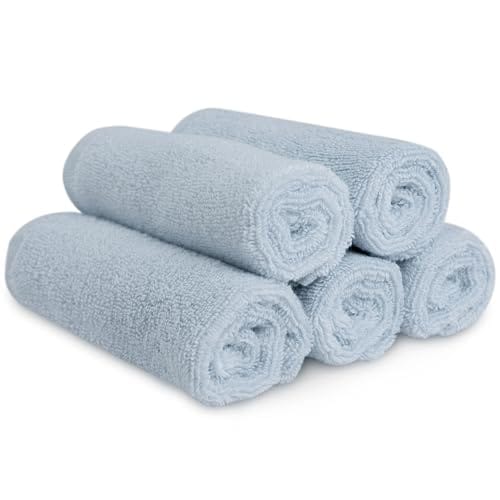
The Natemia Organic Baby Washcloths are 100% GOTS-certified organic cotton in a muslin weave, sold in a 5-pack. Muslin is lighter and faster to dry than terry, which matters if you are doing twice-daily face wipes or sponge baths between full immersion baths. The muslin weave softens further with each wash cycle rather than stiffening, making it well-suited for newborns with reactive skin.
At $24 for five, the per-cloth cost is $4.80, higher than the Burt's Bees option on a unit basis, but the larger pack and faster dry time offset that for many families. Both carry the same GOTS certification. Natemia has a smaller retail footprint, so Amazon is the primary buy path.
Price tier: $. Available on Amazon ($24).
Hooded towels
4. Burt's Bees Baby GOTS Organic Hooded Towels, 2-Pack: Best hooded towel

The Burt's Bees Baby GOTS Organic Hooded Towels are 100% GOTS-certified organic cotton terry in a full-coverage hooded design. The 2-pack gives you a rotation, which matters since towels need to dry fully between uses to prevent mildew without the antimicrobial treatments that most "stays fresh" towels rely on. The hood is a seamed pointed panel rather than a flat gathered loop, which fits newborn and infant heads better and stays in place during the carry from tub to changing table.
No fragrance, no optical brighteners, no antimicrobial biocide finish. Burt's Bees Baby carries a live affiliate program, so the brand-site price ($29.95 for two) is the primary buy link.
Price tier: $$. Available at Burt's Bees Baby ($29.95) and Amazon ($29.95).
5. Natemia Organic Hooded Baby Bath Towel: Best value hooded towel
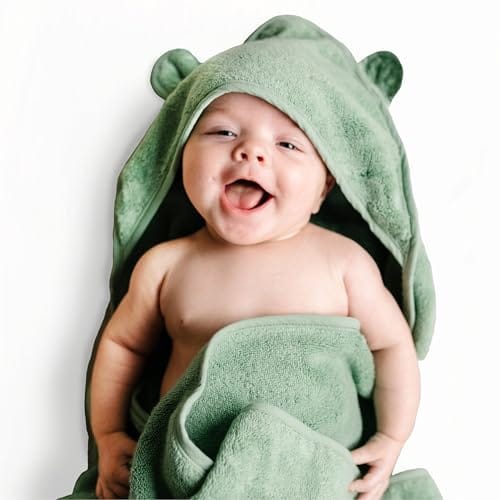
The Natemia Organic Hooded Baby Bath Towel is a single GOTS-certified organic cotton towel at $37.99, which is higher per unit than the Burt's Bees 2-pack. The trade-off is a heavier weight terry construction: the Natemia towel runs noticeably thicker and wraps a baby more completely, which some parents prefer for the towel-to-onesie transition in cooler rooms. If you are buying one premium towel rather than a rotation set, this is the pick.
Both the Natemia and Burt's Bees options carry GOTS certification verifiable via the public database. No antimicrobial treatment, no optical brighteners.
Price tier: $$. Available on Amazon ($37.99).
Thermometers
Thermometers contact skin briefly, carry no coatings or treated textiles, and present no meaningful chemical exposure concern. The screen here is practical: clinical accuracy, ease of use for sleep-deprived parents, and honest performance expectations. We excluded non-contact forehead models that are not recommended for infants under three months, where rectal measurement is the clinically accurate standard.
6. Safety 1st Rapid Read 3-in-1 Thermometer: Best for clinical accuracy

The Safety 1st Rapid Read 3-in-1 Thermometer reads in roughly 10 seconds in rectal mode, which is the clinically recommended method for children under three. At $9.99, it is the most affordable option in this guide and the right buy if the primary use case is rectal measurement for newborns and infants. Probe cover replacements are standard and available at most pharmacies. The probe tip is stainless steel; the casing is standard ABS plastic, not a skin contact surface during use.
Price tier: $. Available on Amazon ($13.99).
7. FridaBaby 3-in-1 True Temp Thermometer: Best all-around

The FridaBaby 3-in-1 True Temp Thermometer reads in rectal, oral, and underarm modes and comes with color-coded probe covers that distinguish between modes, reducing sanitation confusion. The thermometer vibrates and beeps when a reading is complete, useful for rectal measurements where you cannot watch the display. At $19.99, it costs $6 more than the Safety 1st option and offers multi-mode functionality if you expect to transition from rectal to oral measurement as the child grows.
Probe tip is stainless steel, probe body is BPA-free plastic. No unusual coatings or treatments.
Price tier: $. Available at Frida ($19.99).
8. Munchkin Mini Infrared Forehead Thermometer: Best non-contact

The Munchkin Mini Infrared Forehead Thermometer is the non-contact option at $23.49. Non-contact infrared thermometers are not recommended for children under three months (the American Academy of Pediatrics recommends rectal at that age), but are appropriate from three months onward. The advantage is clear: no probe insertion, no waking a sleeping baby. The Munchkin Mini is compact enough for a bedside table and includes a silent mode for nighttime checks.
The infrared sensor does not contact skin. Casing is ABS plastic. No toxic coatings. The main caveat: infrared forehead readings run 0.5 to 1 degree Celsius below rectal in clinical comparisons, so use this as a fast screening tool and reach for the rectal thermometer when accuracy matters.
Price tier: $$. Available on Amazon ($23.49).
What we passed on
Foam-padded bath seats and tub inserts. Several popular tub insert options use polyurethane foam padding. Foam in baby bath products is subject to California TB117 flammability requirements, and testing by consumer safety groups has documented chemical flame retardants including TDCPP (chlorinated tris, a Prop 65-listed carcinogen) in foam-padded infant bath products. Foam in a wet environment is a particular concern because the retardant can leach into bath water.
Bamboo-rayon towels marketed as organic. "Bamboo" textiles are almost always viscose, a chemically processed fiber produced using sodium hydroxide and carbon disulfide. Many are blended with polyester to improve durability. Neither the raw material nor the processing chemistry meets our material criteria, and GOTS does not certify bamboo-rayon products.
Antimicrobial-treated washcloths. Several brands in the specialty baby space sell washcloths with silver-ion finishes or "naturally antimicrobial bamboo" claims. The EPA classifies nanosilver antimicrobials as pesticides, and the "naturally antimicrobial" claim for processed bamboo fiber is not supported by primary evidence. We excluded both categories.
FAQ
What makes a baby bath tub non-toxic?
The two main material concerns in a baby tub are PVC (which may contain phthalate plasticizers that can leach into bath water) and foam padding (often treated with chemical flame retardants, including TDCPP, a Prop 65-listed carcinogen). A tub made from disclosed polypropylene with no foam insert and no PVC components clears both concerns.
Why does GOTS certification matter for baby washcloths and towels?
GOTS (Global Organic Textile Standard) traces cotton from field to finished product, setting limits on pesticide residues, dyes, heavy metals, optical brighteners, and antimicrobial biocide finishes. A brand's "organic cotton" label without third-party certification is a marketing claim. GOTS certification is verifiable in the public certified-suppliers database at global-standards.org.
What is the most accurate thermometer method for newborns?
The American Academy of Pediatrics recommends rectal measurement for infants under three months, as it provides the most clinically accurate core temperature. Non-contact infrared forehead thermometers are not recommended for this age group. From three months onward, forehead infrared thermometers are appropriate for screening but typically read 0.5 to 1 degree Celsius below rectal in clinical comparisons.
Are bamboo-rayon baby towels safe?
"Bamboo" textiles sold for babies are almost always viscose, a chemically processed fiber produced using sodium hydroxide and carbon disulfide. The processing does not meet GOTS criteria, and many bamboo-rayon products are blended with polyester. Neither the fiber nor the processing aligns with the material standards used in this guide.
What are optical brighteners and why are they excluded from this guide?
Optical brighteners (fluorescent whitening agents) are chemicals applied to white fabrics to make them appear brighter under UV light. They are skin sensitizers and persist in laundry wastewater. GOTS certification prohibits them at the manufacturing stage, which is why every textile pick in this guide carries the GOTS mark.
Cover image: Vie Studio via Pexels (Pexels License). Source.